

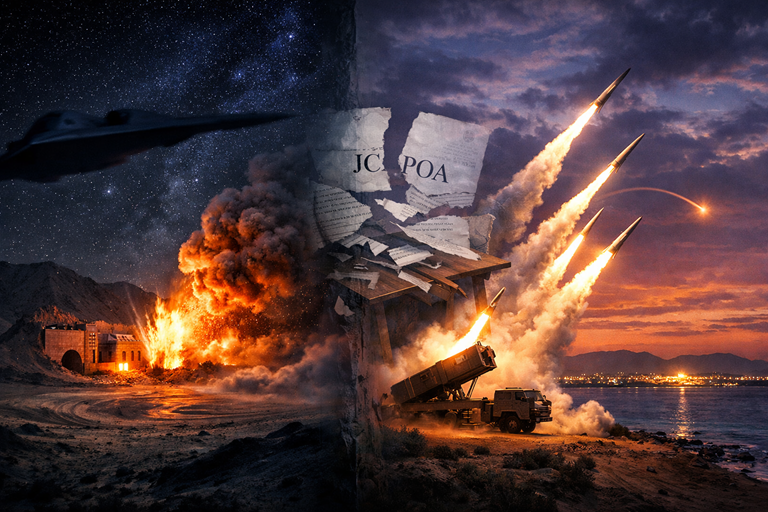
The recent 12-Day War on Iran did not erupt in a vacuum. did not erupt in a vacuum. It was the culmination of years of shadow war, nuclear brinkmanship, and shifting regional alliances.
The surprise attack on June 13 was launched as a “pre-emptive strike,” according to Israeli Defence Minister Israel Katz, who justified the operation on the grounds that Iran was on the verge of a nuclear and military breakthrough. It is a justification that Prime Minister Benjamin Netanyahu has offered regularly for over two decades—a sustained campaign to persuade Washington to strike Iran or grant Israel the latitude to do so itself. This time, Netanyahu found a willing partner in Donald Trump, who proved amenable to the long-standing but still-unverified assertion.
The 12-day campaign saw the U.S. join Israeli forces in an unprecedented, direct assault on Iranian soil. According to American leadership, Tehran’s nuclear capabilities were “completely and fully obliterated” by U.S. strikes on key nuclear enrichment sites. The scale of the attack was immense. Israel was able to significantly degrade Iran’s aging air defences, with an Israeli military spokesman declaring that Israel had “achieved full air control over Tehran” and destroyed “a third of the Iranian regime’s surface-to-surface missile launchers.” From Iran’s perspective, this “war of aggression” was both punitive and treacherous—designed not merely to cripple its sovereign programs but to destabilize its leadership.
The Diplomatic Foundation and the Shadow War
For decades, Israel has portrayed Iran’s nuclear program as an existential threat, while Iran has consistently framed its nuclear activities as a legitimate civil and scientific enterprise conducted within its rights as a signatory to the IAEA’s Nuclear Non-Proliferation Treaty. Tehran further demonstrated its willingness to cooperate by submitting its program to stringent supervision under the Joint Comprehensive Plan of Action (JCPOA), signed with the Obama administration in 2015—a deal that current American president Donald Trump unilaterally discarded in 2018 during his first term, following aggressive Israeli lobbying.
Yet alongside this diplomatic track ran a parallel and destructive shadow war. A key component of the broader conflict was a series of long-standing, clandestine Israeli operations targeting Iranian nuclear scientists and officials, conducted with covert assistance from Western powers, mainly the United States. These operations escalated dramatically over the years, bringing the region repeatedly to the brink of open warfare.
The targeting came into stark relief on January 3, 2020, when a U.S. drone strike ordered by President Trump killed Major General Qasem Soleimani, commander of Iran’s Quds Force, at Baghdad International Airport while he was engaged in official business. From Tehran’s perspective, the assassination was not merely an act of war but a fundamental violation of international law—Soleimani was, as Iran’s Ministry of Foreign Affairs stated, “on a diplomatic mission by invitation of the Iraqi government and an official guest of the state.”
Then, amid its ongoing genocide in Gaza, Israel struck Iran’s embassy compound in Damascus on April 1, 2024, killing seven Iranian military advisors, including senior commanders of the Quds Force. The strike flattened the consulate building and was widely condemned as a violation of the Vienna Conventions, which protect diplomatic facilities. By targeting an embassy—sovereign Iranian territory under international law—Israel signalled that no space would be off limits.
Israel doubled down on its provocations in an apparent effort to draw Iran into a full-scale war on July 31, 2024, when Hamas political chief Ismail Haniyeh was assassinated in Tehran. Haniyeh was in the Iranian capital as an official guest, attending the inauguration ceremony of newly elected Iranian President Masoud Pezeshkian.
Iran’s Retaliation: The Calculus of Asymmetric Power
Facing a technologically superior coalition and with its air force effectively grounded, Iran’s response during the 12-day war was not one of conventional warfare but of strategic deterrence through missile and drone power. Even before the war began, Iranian officials had warned that a barrage of hundreds of ballistic missiles would be launched at Israel without hesitation if the country was struck.
During the conflict, Iran fired hundreds of missiles and deployed more than 1,000 attack drones. While the strikes reportedly killed nearly three dozen Israeli civilians and wounded thousands, their strategic value extended far beyond the casualty count. The most significant retaliatory act was Tehran’s launch of missiles at the Al Udeid Air Base in Qatar—the largest U.S. military installation in the Middle East—in direct response to American stealth bombers striking Iran’s fortified nuclear enrichment facilities at Israel’s behest. This was an unambiguous message to Washington: your network of bases encircling Iran are not sanctuaries and lie within our direct reach.
By warning the U.S. of the strike in advance, Iran ensured there were no American casualties, thereby managing escalation and avoiding an uncontrollable confrontation. This move demonstrated a sophisticated understanding of escalation control, showcasing Iran’s ability to project power across the Gulf while deliberately calibrating its response to signal capability without inviting annihilation. Even after the devastating blows of June 2025, assessments indicated that while Iran’s medium- and long-range missile capabilities had been degraded, its arsenal of short-range ballistic missiles—capable of striking nearby U.S. bases with precision—remained a credible and ever-present threat.
Beyond missile strikes, Iran demonstrated its capacity to penetrate Israel’s most sensitive sites. On June 15, 2025, Iran targeted the Weizmann Institute in Israel. According to the Tehran Times, the attack damaged 65 of its buildings, one of which was completely destroyed. Iran justified the strike by asserting that the institute functions as a hub for Israel’s military technology, conducting research in artificial intelligence, drone technologies, and autonomous systems in close collaboration with Israeli defence contractors.
The Diplomatic Ruse: Talks as a Smokescreen for War?
Perhaps the most damning accusation levelled against the U.S. and Israel is that they used nuclear negotiations as a ruse to facilitate a military attack. The June 2025 war began just days before Iran and the U.S. were due to meet for another round of talks.
The diplomatic manoeuvring was complex. According to The Washington Post’s investigation, the U.S. was well informed of Israel’s plans to strike Iran. On June 12—the deadline Trump had given for Iran to agree to a deal—despite U.S. knowledge that Israel had decided to strike, the American leader continued to publicly state that he was unsure such a strike might happen and that he preferred a diplomatic solution.
Even after the operation began, the Trump administration offered what Iran did not know was their final opportunity to agree to a deal before U.S. firepower joined the campaign. The Washington Post reported that this deal included Iran discontinuing support for Hezbollah and Hamas and replacing all fuel enrichment plants with alternative facilities. A senior diplomat was cited as saying that Iran rejected the proposal shortly after it was offered through Qatari diplomats, and that Trump subsequently authorized the U.S. strikes.
This timeline led many to conclude that the talks were a strategic deception. For Iran, the message was clear: engaging with the Trump administration on its nuclear program offered no sanctuary from military force.
The Question of Victory: A Hollow Prize?
At the end of the 12-day war, when the U.S. president imposed a ceasefire between Israel and Iran, both countries claimed victory. Determining a true “winner” in this protracted confrontation, however, defies easy categorization.
On a purely tactical and military level, Israel and the U.S. achieved significant victories. They penetrated Iran’s defences, destroyed nuclear infrastructure, assassinated key top military figures and over a hundred nuclear scientists, and Trump insisted that Tehran’s nuclear capabilities were “completely and fully obliterated.” The doctrine of pre-emption appeared, in the short term, to have paid off.
Yet measured against broader strategic goals, the concept of victory becomes murky. While Israel claimed to have set back Iran’s nuclear program by years, the program was not destroyed—and more importantly, the attack did not lead to Iranian capitulation. Iran stood its ground without relying on the “Axis of Resistance,” a network of non-state allies already on their back foot, and forcefully fought back despite the initial setback. The Iranian people rallying behind their leadership also fell short of Western expectations to stir mass unrest inside the country. Perhaps this is why Iran’s Supreme Leader Ayatollah Ali Khamenei could credibly claim victory: the regime survived, the nation rallied, and the adversary failed to achieve its ultimate goal of regime destabilization.
Instead of breaking Iran, the war hardened Tehran’s position. In June 2025, Iran accused IAEA Director General Rafael Grossi of bias and collusion with Israel, alleging that his office leaked confidential documents that directly facilitated the assassination of Iranian nuclear scientists and guided strikes on facilities like Fordow. Following this profound breach of trust, Tehran signalled it would only engage in future negotiations through new, trusted intermediaries, insisting it was no longer enriching uranium at declared sites. Yet Israeli officials remained concerned about Iran rebuilding its supply of long-range missiles, prompting Trump to threaten to attack Iran again—a cycle of violence with no end in sight.
Conclusion: The Legacy of Distrust
In a nutshell, the true “winner” in this so-called 12-Day War may be impossible to name, but the “losers” are clear: diplomacy, regional stability, and the cause of peaceful coexistence. The attack during active negotiations poisoned the well for future dialogue. If the Iranian leadership believes its survival is at stake in a future conflict, its restraint in retaliation would vanish, potentially leading to an all-out regional war.
The events of June 2025 shattered the illusion that Iran can be bombed into compliance or that its nuclear ambitions can be paused indefinitely from the air. The use of diplomacy as a smokescreen for war left a legacy of deep mistrust. As the world watched the Middle East in the aftermath of the 12-day war, the question was no longer just who won the last battle, but whether any party has the will to build a peace that makes the next war unthinkable.
