
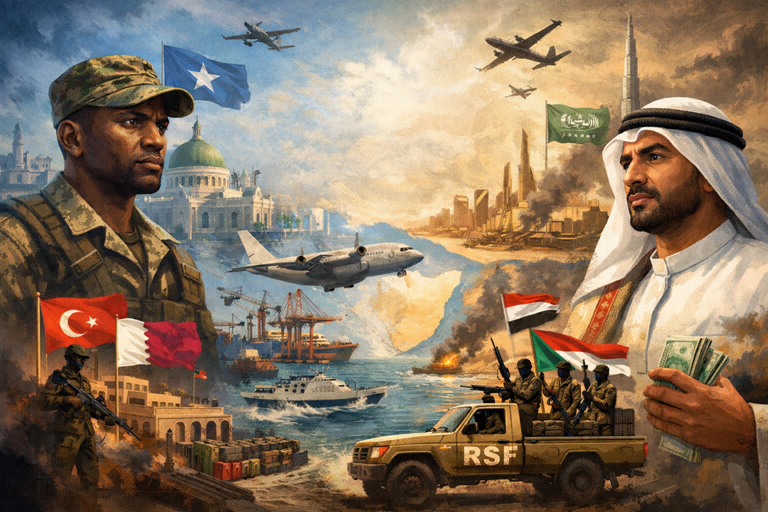
On January 12, Somalia’s Federal Government declared it was annulling all agreements with the United Arab Emirates—security cooperation, defence pacts, port concessions in Berbera, Bosaso, and Kismayo. The language from Mogadishu was unmistakable: sovereignty had been violated, national unity undermined, and foreign actors had crossed a red line.
Among the incidents cited by Somali officials was the alleged transport of Aidarous al-Zubaidi—the Emirati-backed leader of Yemen’s separatist Southern Transitional Council—through Berbera and Mogadishu airports without clearance, a violation Mogadishu characterized as evidence of Emirati disregard for Somali jurisdiction.
For a government already struggling to assert control over federal states that conduct their own foreign engagements, the issue cut to the heart of what sovereignty means in a fractured polity: if the centre cannot regulate who enters its airspace or signs deals in its ports, does it truly govern at all?
But behind the formal communiqués lies a far more complex realignment—one shaped by Gulf rivalries, Red Sea militarization, the war in Sudan, Somaliland’s diplomatic advances, and Somalia’s own fragile federal bargain. This is not merely a diplomatic dispute. It is a recalibration of power across the Horn of Africa.
The Official Case: Sovereignty and Airspace
Somalia’s government framed its decision as a matter of national dignity and constitutional authority. Officials accused the UAE of violating Somali sovereignty, particularly through its engagement with federal member states and through alleged unauthorized use of Somali airspace and infrastructure.
The immediate friction involved Emirati-linked flights and activities that bypassed federal approval. The al-Zubaidi incident was presented by Mogadishu as conclusive proof of Abu Dhabi’s willingness to operate as though Somalia’s central government did not exist.
For a government already struggling to assert control over its federal regions—where regional presidents sign their own port deals and host foreign officials without notifying Mogadishu—the issue cut both ways. Challenging the UAE became, in part, a challenge to the regions themselves: a assertion that foreign policy authority rests with the centre, and that external actors cannot exploit internal fragmentation as license to bypass federal oversight.
Yet the rupture cannot be understood without looking beyond the official explanation.
The Somaliland Factor
For years, the UAE has cultivated deep ties with Somaliland, the self-declared republic in northern Somalia. Through DP World, Abu Dhabi invested heavily in Berbera Port, transforming it into a strategic commercial and logistics hub along the Red Sea corridor. What Mogadishu has long suspected, and what regional analysts now confirm, is that Berbera’s function is not purely commercial: satellite imagery confirms naval and airstrip facilities beyond commercial requirements, enabling Emirati power projection into the Red Sea basin and Yemen.
Tensions escalated dramatically after reports that Israel moved toward recognizing Somaliland—a development widely believed in Mogadishu to have been facilitated or encouraged by Emirati diplomacy. For Somalia’s federal government, this crossed a strategic threshold.
Recognition of Somaliland would not simply be symbolic; it would reshape regional alignments, insert Israel formally into Red Sea geopolitics via a non-recognized entity, weaken Somalia’s territorial claim at a moment of internal fragmentation, and reward a decades-long secessionist project that Mogadishu has spent three decades trying to reverse.
Sudan, the RSF, and the Air Corridor Question
Another layer of tension involves the war in Sudan. United Nations experts and investigative reports have documented allegations that the UAE provided weapons and logistical support to Sudan’s Rapid Support Forces (RSF)—claims Abu Dhabi has consistently rejected. The UAE maintains its engagements in Sudan are humanitarian and diplomatic.
Within Somalia, however, concerns intensified over reports that Somali airspace and facilities—particularly in semi-autonomous regions like Puntland—may have been used as transit points for logistics linked to the Sudan conflict. Investigative reporting has traced Emirati military supply networks that utilize East African air corridors, though no Somali official has confirmed federal knowledge or approval of such arrangements.
Whether or not Mogadishu publicly detailed these concerns, the perception that Somalia risked becoming an unintended corridor for another nation’s war added fuel to the sovereignty argument—and deepened distrust of Emirati intentions.
Gulf Rivalries Spill into the Horn
The rupture also reflects shifting dynamics between Saudi Arabia and the UAE. Once closely aligned, the two Gulf powers increasingly compete for influence across the Red Sea basin. Riyadh has deepened its engagement with Horn of Africa states, while the UAE has expanded its network of ports and security partnerships stretching from Yemen to Eritrea, Somaliland, and Puntland.
Saudi Arabia’s recent diplomatic and economic overtures to Mogadishu have provided the federal government with an alternative Gulf partner—one wary of Emirati expansionism and eager to reassert its own influence in a region it has historically considered part of its strategic backyard.
Somalia’s move can be read as part of this broader recalibration. Aligning more closely with Riyadh—while maintaining strong ties with Turkey and Qatar—provides Mogadishu with counterweights to Emirati leverage.
Turkey, in particular, has become Somalia’s most visible security partner. Ankara operates Somalia’s largest overseas military facility near Mogadishu, trains the country’s elite Gorgor special forces, and manages key infrastructure in the capital, including the airport and seaport. Qatar has also maintained political ties with Somalia’s current leadership, offering financial support and diplomatic cover.
In this context, distancing from Abu Dhabi may be less about isolation and more about repositioning within a multipolar Gulf order.
The Shadow of 2018
This is not the first rupture between Mogadishu and Abu Dhabi.
In April 2018, under President Mohamed Abdullahi “Farmajo,” Somali authorities seized $9.6 million in undeclared currency from a UAE aircraft at Mogadishu international airport, triggering a diplomatic crisis. The UAE maintained the funds were destined for salary payments to Somali troops as part of a bilateral security arrangement; the Somali government, suspicious of the transfer’s opacity and legality, refused to release the cash.
The incident precipitated a sharp deterioration in relations. The UAE suspended its military training programmes in Somalia, and bilateral engagement effectively froze for years.
When President Hassan Sheikh Mohamud returned to office in 2022—following a contentious electoral process that involved substantial external mediation—ties were cautiously restored. The seized funds were returned to Abu Dhabi in a conspicuous diplomatic gesture, and engagement resumed. His election, viewed by some domestic critics as benefiting from Gulf backing, initially signaled renewed cooperation.
The current break therefore represents not a sudden shift, but the latest swing in a volatile relationship marked by recurrent distrust and competing expectations.
Domestic Politics: Reasserting the Centre
Somalia’s internal dynamics are critical to understanding the decision’s timing and framing.
Federal member states such as Puntland and Jubaland maintain their own relationships with the UAE, particularly in security cooperation and port development. Puntland’s Bosaso port has been a focal point of Emirati interest; Jubaland’s leadership has hosted UAE officials without coordinating with Mogadishu. By cancelling federal agreements, Mogadishu is also sending a message to regional leaders: foreign policy authority rests with the centre, not with semi-autonomous administrations pursuing independent engagement with Gulf powers.
In a country where federal cohesion remains fragile, sovereignty is not just external—it is internal.
The move allows President Hassan Sheikh to reclaim nationalist ground amid domestic criticism and to demonstrate that Somalia, despite its weaknesses, is not beholden to any single external patron. It also preempts further entrenchment of Emirati influence in regions that might otherwise drift further from federal control.
The Economic Gamble
The costs, however, are real and immediate.
The UAE has been one of the most active investors in Somali infrastructure, particularly in the port sector. DP World’s involvement in Berbera, while politically contentious, has generated revenue and employment in Somaliland. The cancellation of agreements risks deterring foreign direct investment more broadly, as potential investors observe that long-term contracts can be unilaterally annulled when political winds shift.
For a country rebuilding after decades of conflict, with limited domestic revenue and heavy reliance on external support, walking away from Gulf capital is not a trivial decision. Trade flows through Emirati-linked ports may face disruption; security cooperation that, however fraught, provided training and equipment to Somali forces will need replacement.
Yet the calculation appears strategic: sovereignty and political cohesion may, in the government’s view, outweigh immediate economic gains. Mogadishu appears to be betting that alternative partners—Saudi Arabia, Turkey, Qatar—can fill some of the gap, and that the long-term benefits of asserting federal authority will justify short-term economic pain.
A Signal Beyond Contracts
Ultimately, Somalia’s decision is less about terminating agreements and more about redefining boundaries.
It signals that the country’s current fragility will not be treated as a geopolitical opening for others to maneuver unchecked. Mogadishu is asserting that vulnerability does not equal permission — and that competition among Gulf powers, regional rivals, and global actors must unfold on terms set in the Somali capital, not negotiated around it.
Whether this posture can be sustained amid economic pressures, regional rivalries, and the undeniable reality that federal member states continue to pursue their own foreign engagements remains to be seen. The UAE has shown no inclination to withdraw from Somaliland or Puntland, and the regions hosting Emirati projects have publicly rejected Mogadishu’s annulment.
But the message is unmistakable: Somalia intends to play a more assertive role in shaping how external power struggles unfold on its own soil.
n the Horn of Africa’s new era of strategic competition—where Gulf states project power through ports and bases, where Red Sea chokepoints acquire new geopolitical weight, and where recognition of breakaway territories becomes a diplomatic weapon—Somalia is no longer content to be an arena. It wants to be an actor.
Whether it can sustain that role, against the weight of its own fragmentation and the interests of far more powerful external players, is the question that will define not only Somalia’s future, but the shape of competition across one of the world’s most strategically contested regions.
This analysis draws on official statements from Somalia’s Ministry of Foreign Affairs, UN Monitoring Group reports on Sudan (2024–2025), open-source investigative reporting on Gulf military logistics networks and regional diplomatic briefings.