


Somalia is grappling with one of the most complex drought emergencies in its modern history. What began as a series of failed rainy seasons has evolved into a nationwide catastrophe, driven by persistent rainfall deficits, intensifying heat, and the cumulative weight of years of climate shocks. Declared a national disaster in late 2025, the crisis now touches nearly every region, pushing communities to the brink and straining both government capacity and the international humanitarian system.
Nearly 6.5 million people—roughly one-third of the population—have been impacted. More than two million face acute hunger, while an estimated 1.8 million children under five are at risk of severe malnutrition. The Shabelle and Juba rivers have receded dramatically; boreholes and shallow wells have run dry or turned salty. Across the countryside, livestock are dying in devastating numbers, stripping families of both income and sustenance.
A Crisis Measured Against History
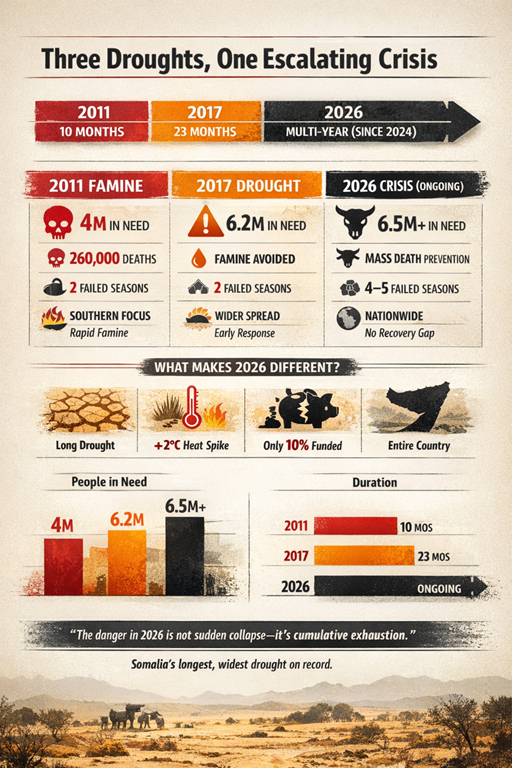
Aid workers increasingly compare the current emergency to the devastating famines of 2011 and 2017—crises that claimed hundreds of thousands of lives and reshaped global understanding of hunger in the region. Yet the 2026 drought stands apart. Unlike the rapid-onset 2011 crisis or the prolonged 2016–2017 drought, this is the result of a multi-year pattern of climatic failure. Since around 2020, Somalia has endured repeated below-average rains, culminating in four to five consecutive poor or failed seasons.
This “long drought” effect has eroded nearly all coping mechanisms. Herders have lost their animals, farmers have exhausted seed reserves, and families have depleted their savings. What makes 2026 especially dangerous is not only the scale of need—greater than in previous crises—but the absence of any remaining buffer.
A Perfect Storm: Five Crises in One
This drought is distinguished by its complexity. Somalia is not facing a single dry spell but a convergence of collapsing systems. Rainfall failure has triggered a water shortage, which then crippled agriculture. Rivers and groundwater depletion reflect a deepening water crisis, while soaring food and water prices signal a breakdown of everyday life. Meanwhile, degraded grazing lands and dying livestock point to broader environmental collapse. Compounding these factors are unusually high temperatures—exceeding historical norms by more than 2°C in some regions—speeding up evaporation and drying out water sources faster than in previous drought cycles.
A Crisis Without Borders
The drought stretches beyond Somalia’s borders into Ethiopia’s Somali Region, where similar conditions are unfolding. The crisis has become regional, linking the fate of Somali communities across national boundaries.
Within Somalia, the geographic reach is unprecedented. Unlike the 2011 famine, which was concentrated largely in the south, the 2026 drought is truly nationwide. Northern regions, including Puntland and Somaliland, are experiencing some of their driest conditions in decades. In Puntland alone, nearly one million people require assistance, while in Somaliland, up to 1.2 million are critically affected. Entire herding communities are abandoning rural life as water sources vanish.
From Fragility to Emergency: Central and Southern Frontlines
Central Somalia faces a dual burden of drought and insecurity, particularly in regions such as Galgaduud, Mudug, and Hiran. Falling river levels are crippling farming, while limited access complicates relief operations. In the south, the crisis intensifies into near-famine conditions. Bay and Bakool have reached emergency levels, with hunger driving displacement. In Jubaland, communities arrive daily in urban centers after losing their livelihoods entirely.
A Nation on the Move
The drought has triggered a massive displacement crisis, with an estimated 3.3 to 4 million people now internally displaced. In Mogadishu alone, more than 1.1 million people live in overcrowded camps, with new arrivals each week. Urban centers such as Baidoa, Luuq, and Afmadow are absorbing waves of displaced families, placing immense pressure on already fragile services.
A Government Response Under Strain
The federal government, led by President Hassan Sheikh Mohamud, has launched a nationwide response anchored by the declaration of a national drought emergency and the rollout of a major aid plan. The Somali Disaster Management Agency is coordinating emergency food aid, water trucking, and real-time monitoring systems. Tax exemptions and financial measures have been introduced to speed up aid delivery. However, the response faces a critical constraint: funding. As of early March 2026, the plan stands at just over 10 percent funded—far below the levels seen during previous crises.
Relief on the Ground: A Regional Patchwork
From north to south, relief efforts are active but uneven. Puntland is focusing on water access and keeping livestock alive; Somaliland has redirected government resources and mobilized local contributions. In central regions, aid delivery is shaped by security constraints, while in the south, large-scale humanitarian operations are underway to prevent famine.
The Rainy Season Gamble
The upcoming rainy season represents a critical turning point. While some areas may see improvement, others face continued uncertainty, compounded by high temperatures and the risk of false starts. Rainfall upstream in Ethiopia could also trigger flooding along the Shabelle and Juba rivers. In some areas, forecasts of above-normal rainfall offer cautious hope but introduce new risks: heavy rains could disrupt aid delivery, trigger flash floods, and increase disease outbreaks. Aid agencies are already adapting, shifting toward helping farmers recover and preparing for public health risks.
A Crisis at a Crossroads
Somalia’s 2026 drought is not merely the product of failed rains—it is the culmination of years of climate stress colliding with deep-seated fragility. The systems to respond exist, but they are overstretched, underfunded, and increasingly vulnerable to disruption.
Now, a new and potentially destabilizing factor is entering the equation: escalating political tensions surrounding proposed constitutional changes. Disagreements between the federal leadership and sections of the opposition, alongside unease among some regional governments, risk deepening divisions at a moment when national unity is critical. These disputes carry real-world consequences for aid operations. In regions already grappling with acute drought, particularly in central and southern Somalia, political friction can translate into delayed decision-making, fractured coordination, and reduced access for aid groups. Insecurity linked to political tensions may further complicate relief delivery in areas where access is already limited.
There is also the risk of resources being diverted. As political actors mobilize around constitutional debates, government attention and limited funds could shift away from emergency response toward managing internal tensions. For a government already struggling with a severe funding shortfall, even small shifts in priorities could have devastating consequences for vulnerable communities. At the local level, these dynamics erode trust. Families facing hunger and displacement may perceive political infighting as a sign of neglect, weakening the bond between citizens and their government at a time when public confidence is essential for effective crisis management.