
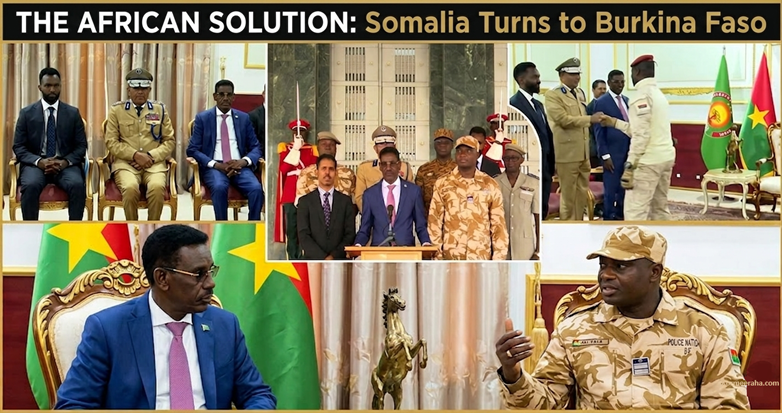
OUAGADOUGOU — The motorcade pulled into Thomas Sankara International Airport under the kind of harmattan haze that blurs the line between desert sky and military dust. When General Abdullahi Sheikh Ismail (Fartaag), Somalia’s Minister of Internal Security, stepped onto the tarmac on May 4, 2026, he wasn’t just making a diplomatic call. He was carrying a letter — and a lifeline.
The written message from Somali President Hassan Sheikh Mohamud to Burkina Faso’s interim leader, Captain Ibrahim Traoré, was brief but urgent: We face the same enemy. Let’s fight it together.
The Same War, Different Deserts
On the surface, Somalia and Burkina Faso couldn’t be further apart — one hugs the Indian Ocean, the other is landlocked in the Sahel. But analysts have been drawing a grim parallel for years. Both nations are besieged by al-Qaeda affiliates: al-Shabaab in Mogadishu, Jama’a Nusrat ul-Islam wa al-Muslimin (JNIM) in Ouagadougou. Both groups use siege tactics to choke capitals, run shadow governments in the countryside, and collect zakat like a parallel treasury.
Burkina Faso does not fight alone. It faces the same security challenge as its neighbours Mali and Niger — the three nations form the Alliance of Sahel States (AES), a bloc born from a collective break with Western-led counter-terrorism missions. That shared struggle has forged a distinctly non-Western military culture: Russian instructors, Turkish drones, and a “total defense” doctrine that prioritizes civilian militias over foreign bases. Somalia, though geographically distant, is now looking to tap into that same defiant playbook.
“They don’t just want territory,” a senior Burkinabè security official told us. “They want to replace the state.”
By May 2026, that shared reality had finally translated into formal cooperation. Fartaag’s delegation spent several days in Ouagadougou, meeting with Burkinabè Security Minister Mahamadou Sana and touring the national police academy. The agenda was razor-sharp: intelligence sharing, synchronized counter-terrorism operations, and institutional linkage between security agencies. The two sides also discussed linking their national police and intelligence services to track al-Qaeda’s cross-continental logistics.
The Turkish Thread
What binds these two nations beyond the bomb blasts? Ankara.
Turkey has become the unlikely security godfather for both countries. Burkina Faso’s military now fights with Bayraktar TB2 drones and Russian-trained parachute brigades. Somalia hosts Turkey’s largest overseas base (TURKSOM), where Gorgor commandos are forged. In April 2026, a Turkish drillship began deep-sea oil exploration off Mogadishu. In Ouagadougou, Turkish firms are building “mega projects” under President Traoré’s urban modernization drive.
“Turkey offers what the West won’t,” said a Somali defense analyst. “No lectures. Just drones.”
But the partnerships differ. In Somalia, Turkey maintains a permanent military base with combat troops and runs airports, seaports (taking 45% of port revenue), and a hospital named after Recep Tayyip Erdoğan. In Burkina Faso, the focus is on equipment, technical training, and humanitarian aid through TİKA and the Turkish Red Crescent. Still, the doctrine is the same: African solutions, Turkish hardware.
What Somalia is Learning from the Sahel
So why did Minister Fartaag come to Ouagadougou rather than Washington or Paris?
Because Burkina Faso — alongside its AES partners Mali and Niger — has developed counter-terrorism tactics that Somalia desperately wants to study. The Volunteers for the Defense of the Homeland (VDP), a state-legislated civilian militia force, has become a formal pillar of Burkinabè strategy. Somalia has its own clan-based Ma’awiisley vigilantes, but they operate organically, often fueling inter-clan blood feuds. The VDP model offers something Somalia lacks: integration into the formal military chain of command. But Somalia can also take “negative insight” from Burkina Faso’s experience, where inadequate oversight of militias has sometimes fueled ethnic violence — a critical lesson for Somalia’s fragile clan balance.
Burkina Faso has also perfected “sensor-to-shooter” drone integration, where ground teams with laser designators guide Turkish airstrikes in real time. And when roads become deathtraps, Burkinabè paratroopers simply fly over the ambushes — a tactic Somalia’s flat, open plains could readily adopt. Both armies now emphasize “decapitation” raids targeting high-value insurgent leaders, a tactic imported from Russian instructors with the Africa Corps.
“We are not here to copy,” Fartaag said during the visit. “We are here to collaborate.”
The Elephant in the Room
Let’s be honest about what makes this alliance awkward.
Burkina Faso is run by a military junta. Captain Traoré, in his mid-thirties, is the face of a new generation of African leaders who reject Western condescension. Somalia, by contrast, holds elections every four or five years — messy, violent, but quasi-democratic. President Hassan Sheikh controls little more than Mogadishu’s city limits; the rest of the country is a patchwork of federal states, clan territories, and al-Shabaab strongholds.
Then there’s the foreign military presence. Somalia hosts over a decade of international troops under the African Union Transition Mission (AUSSOM). The AES nations kicked out French forces and brought in Russian instructors. One nation is slowly shedding foreign boots. The other can’t imagine life without them. Yet both face the same brutal math: their own armies are overstretched, and insurgents control vast rural spaces.
What Comes Next
The May 2026 Ouagadougou talks didn’t produce a treaty. They produced something more fragile and more promising: a working relationship. Intelligence officers from both nations are now discussing real-time tracking of al-Qaeda logistics across the continent. Training exchanges are being drafted. And that letter from President Hassan Sheikh? It ended with a line that could serve as an epitaph for an entire era of counter-terrorism:
“No one will save us but us.”