
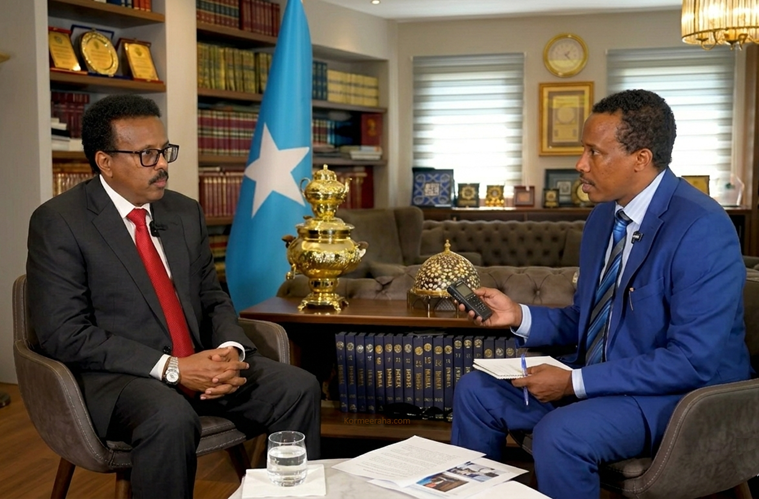
MOGADISHU — In a rare and revealing sit-down in late April 2026, Somalia’s 9th President, Mohamed Abdullahi Mohamed—better known as Farmaajo—broke his silence. Speaking with a young journalist from an alternative YouTube-based outlet, the former leader offered a masterclass in political counter-messaging, positioning himself as the principled antithesis to the current administration.
A Legacy of Activism and Exile
Farmaajo’s political DNA is rooted in the struggle for sovereignty. He speaks fondly of a “politically active” upbringing; his father was imprisoned by Italian colonial authorities for pro-independence activism, while his mother spearheaded fundraising for the cause. Interestingly, his rise occurred within a system historically dominated by his own sub-clan, particularly during the decade preceding the fall of Mohamed Siad Barre.
This trajectory from the heart of Somali nationalism to the cold reality of exile defines him. Before his 2010 appointment as Prime Minister, Farmaajo spent 34 years in public administration, split between pre-collapse Somalia and the United States. It was in Buffalo, New York, that he honed the values he claims to have brought back to Mogadishu: loyalty, justice, and accountability.
“Politics is the same wherever you live,” he remarked, dismissing those who once argued his long absence from the country made him unfit for leadership.
The “Art of Possibilities” vs. The “Art of Deception”
The interview took a sharp, analytical turn when discussing the nature of power. Farmaajo lamented that Somali politics has become synonymous with “tricking the public.” For him, politics is the “art of possibilities” and the fulfillment of societal expectations.
In contrast, he leveled a scathing assessment at incumbent President Hassan Sheikh Mohamud, accusing him of a “permissiveness to lie.” Farmaajo highlighted a culture where officials swear on the Quran to uphold the constitution, only to pivot once the seat is secured. “There is no bigger shame,” Farmaajo noted, “than to see a grown man with a PhD contradict himself on a daily basis,” referring to the president’s recent claims that he could simply “change his mind” on past promises.
Foreign Policy: Interests Over Slogans
During his tenure (2017–2022), Farmaajo was known for a “Somalia First” approach that often ruffled feathers in Abu Dhabi and Nairobi while building a controversial “Tripartite Agreement” with Ethiopia’s Abiy Ahmed and Eritrea’s Isaias Afwerki.
He dismissed Hassan Sheikh’s current slogan—“Somalis on good terms with each other and the world”—as fundamentally unrealistic, specifically regarding the latter half. In Farmaajo’s view, nations do not have permanent friends, only fluctuating interests. He views the current administration’s foreign policy as simplistic, lacking the strategic depth required to navigate a multipolar world.
The Case for Progress (Strengths)
On security, Farmaajo successfully reorganized and revitalized the national army, police force, and national intelligence services (NISA) to bolster domestic stability. He established a fiercely independent foreign policy that prioritized Somali interests, even when it led to polarizing diplomatic standoffs.
His administration oversaw the renovation of iconic national monuments and took direct action to repatriate hundreds of Somali migrants stranded in Libya. He began reorganizing the privately-run education system inherited from the civil war, initiating a move toward the free, government-funded system in which both he and the current president were raised.
On financial integrity, he launched a targeted campaign against systemic corruption and worked to clean up public finances to meet international standards.
The Unaddressed Challenges (Shadows)
Conducted in an atmosphere of noticeable complacency, the interview glossed over the major scandals and flashpoints that defined his presidency: namely, the controversial rendition of Qalbidhagax, the unresolved disappearance of intelligence officer Ikram Tahlil, and the heavy-handed security raids on the residences of Senator Abdi Hassan Qeybdiid and opposition leader Abdirahman Abdishakur, alongside several unaddressed assassinations of high-profile political figures.
Furthermore, the recent interview curiously omitted any mention of the strained, even paralyzed, relationship he had with his prime ministers, Hassan Ali Khayre and Mohamed Hussein Roble. He criticized Puntland and Jubaland leaders for reneging on the September 17th agreement, yet showed powerlessness countering their entrenched political tactics. In the end, these autonomous regions leaders successfully blocked his federal outreach.
Worst, his tenure was marked by a deepening rift with the United States, the European Union, and other key regional actors—a relationship that remains a major hurdle for his future political ambitions.
The People’s Endowment: An Outlier in Somali Politics
While the international community and clan-picked parliamentarians may have soured on his nationalistic rhetoric—leading to his 2022 exit—the Somali public’s enduring affection for Farmaajo remains a political anomaly.
To understand this bond, one must look at the collective trauma of the Somali public. Having once ousted a dictator who enriched his inner circle while ruining the country, Somalis have come to abhor everything that followed: separatism, terrorism, piracy, foreign intervention, and a (every man for himself) political culture. In their eyes, Farmaajo positioned himself above these systemic failures, offering a brand of clean, centralized leadership that felt like a return to order.
In a striking symbolic gesture, citizens recently crowdfunded and built a mansion for the former president—a “pension” provided by the people rather than the state. This grassroots support stands in sharp contrast to the current administration, which Farmaajo’s supporters accuse of “selling off public land to the highest bidder.” For a public weary of clan supremacy and deep-seated corruption, Farmaajo represents the rare leader whose actions appeared to match his patriotic posturing.
The Verdict
Farmaajo possesses extensive experience in civil service, yet his two decades of absence and the historical weight of his clan lineage perhaps make him too “proper” for a country where political rules are often non-existent. Many supporters have not forgiven his perceived indecisiveness and his tendency to backpedal when faced with hardline opposition. Despite having the army, the parliament, and the people on his side, he ultimately found himself isolated in the media and the diplomatic arena.
As Somalia grapples with heightened tensions following the recent annulment of elections, Farmaajo is positioning himself as a shadow president. He remains the “bourgeois nationalist”—discreet, affable, and waiting for the moment when the public’s frustration with the “art of deception” leads them back to his “art of possibilities.”