
With four days remaining in Somalia’s presidential term and no election in sight, tensions are reaching a boiling point in Mogadishu. The capital’s humid, salt-laden air—usually heavy with the scent of the Indian Ocean—now carries a sharper, more metallic tang: the smell of idling armored vehicles and the unspoken anxiety of a city that has seen this script before.
The date May 15, 2026, looms over the Villa Somalia like a deadline no one knows how to meet. For President Hassan Sheikh Mohamud, it represents a moment of precarious transition; for his detractors, it marks the end of his legal right to lead. As the clock ticks down, Mogadishu’s streets have become the primary stage for a high-stakes political drama that threatens to unravel the fragile progress of the last decade.
The “Hiil Shacab” Spark
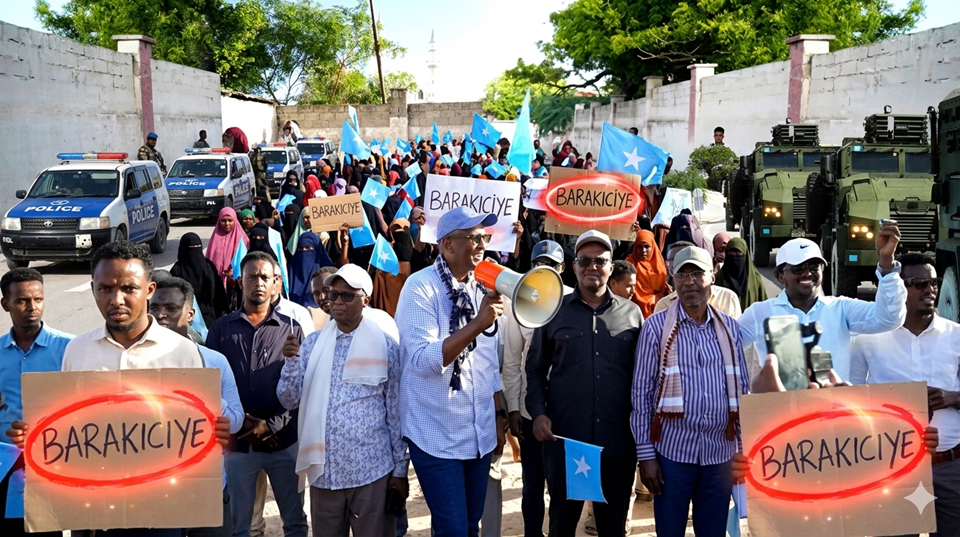
The tension reached a violent crescendo on May 10, when the Hiil Shacab (“Support of the People”) protest movement took to the streets. What began as a protest against land grabbing by those close to power and forced evictions quickly turned into a referendum on the presidency itself. Land grabbing and the embezzlement of public funds and assets by government officials are not uncommon in Mogadishu at the end of a presidential term.This time, thousands of Mogadishu residents, weary of political uncertainty and economic hardship, attempted to march in defiance of what they term “unilateral governance.”
The federal government’s response was swift and uncompromising. Security forces, including elite units usually reserved for counter-terrorism operations, sealed off major arteries. By midday, the sound of gunfire echoed through the Deyniile district. Reports confirmed at least one fatality—a grim reminder of how quickly political disputes in Somalia can turn lethal. By evening, the Daljirka Dahson monument, a symbol of the unknown soldier and national sacrifice, sat in the middle of a military exclusion zone.
The Mandate Trap
At the heart of the crisis lies a fundamental disagreement over the “rules of the game.” The Hassan Sheikh Mohamud administration has championed a series of constitutional amendments, passed by a parliament many argue is overstepping its bounds. These changes would shift Somalia from its traditional indirect clan-based system to a direct “one-person, one-vote” model—while simultaneously extending presidential and parliamentary terms from four to five years.
On paper, the move toward universal suffrage is a democratic ideal. In practice, the opposition sees it as a “Trojan horse” for a term extension. “You cannot change the rules of the race while you are running in it,” one opposition leader noted. The coalition of rivals, including former presidents and prime ministers, argues that the president’s mandate expires on May 15 under the 2012 Provisional Constitution. After that date, they warn, the administration will be viewed as a “usurper,” potentially triggering a parallel government or a total collapse of federal cooperation.
A House Divided
The tremors in Mogadishu are being felt far beyond the city limits. Somalia’s Federal Member States—the vital pillars of the country’s stability—are fracturing. Puntland has already effectively “paused” its participation in the federal system, citing the constitutional changes as a breach of the federal pact. Jubaland follows a similar, if slightly more cautious, orbit of dissent.
When the periphery and the center stop speaking the same language, the result is often a security vacuum. This is perhaps the most dangerous aspect of the current standoff. For the past two years, the Somali National Army, supported by local Macawisley militias, has been engaged in an existential struggle against Al-Shabaab. Military experts now fear that as elite units are pulled from the frontlines to garrison Mogadishu, the gains made in central Somalia could be reversed in a matter of weeks. The insurgency thrives on political chaos; every hour spent debating mandate extensions is an hour Al-Shabaab uses to regroup.
The Metaphor of the Silhouette
To look at a map of Somalia today is to see a silhouette of a nation trying to define itself against the backdrop of its own history. For years, the international community has poured billions into the “Somali Project,” hoping to see a transition from a failed state to a functional federation. But democracy is more than just a ballot box; it is a consensus on the peaceful transfer of power.
The imagery of recent days is telling: black smoke from burning tires rising against the pristine white walls of the city’s newer developments. It is a visual representation of modern Somalia’s duality—a country capable of immense growth and modernization, yet perpetually tethered to the ghosts of 1991.
The Path Forward
As May 15 approaches, the international community—led by the UN, the African Union, and key partners like Turkey and the UAE—is scrambling to broker a “technical agreement.” The goal is a middle ground: a recognized interim period that allows for inclusive elections without the stigma of an illegal extension.
However, for the mother in Deyniile or the shopkeeper in Bakara Market, these high-level negotiations feel distant. They see the roadblocks, the soldiers, and the rising price of grain as transporters fear to move through a city on edge.
Somalia is not just facing a constitutional crisis; it is facing a crisis of trust. Whether the coming days bring a breakthrough or a breakdown depends entirely on whether the leaders in Villa Somalia and their rivals in Mogadishu’s hotels value the survival of the state more than their own tenures in office. The boil has begun; the question is whether anyone can turn down the heat before the pot shatters.