
MOGADISHU — Ever since Somali President Hassan Sheikh Mahamoud appeared in a video with obvious signs of assault on his face, speculation has been rife regarding his safety and the true nature of a recent trip to Abu Dhabi.
The video, released by Villa Somalia, was intended to dispel concerns over the president’s isolation following his return from the United Arab Emirates on June 24. Instead, conflicting reports about the circumstances of the trip have fuelled further speculation regarding the origin of his bruising and swollen eye.
A Mysterious Departure
President Mahamoud left for the UAE on June 19 for what was described as a business trip. He was accompanied by only one person: Mahad Salad, the director of the National Intelligence and Security Agency (NISA). In an unusual break from protocol, the president left behind his personal bodyguard, who typically never leaves his side, especially during foreign travel.
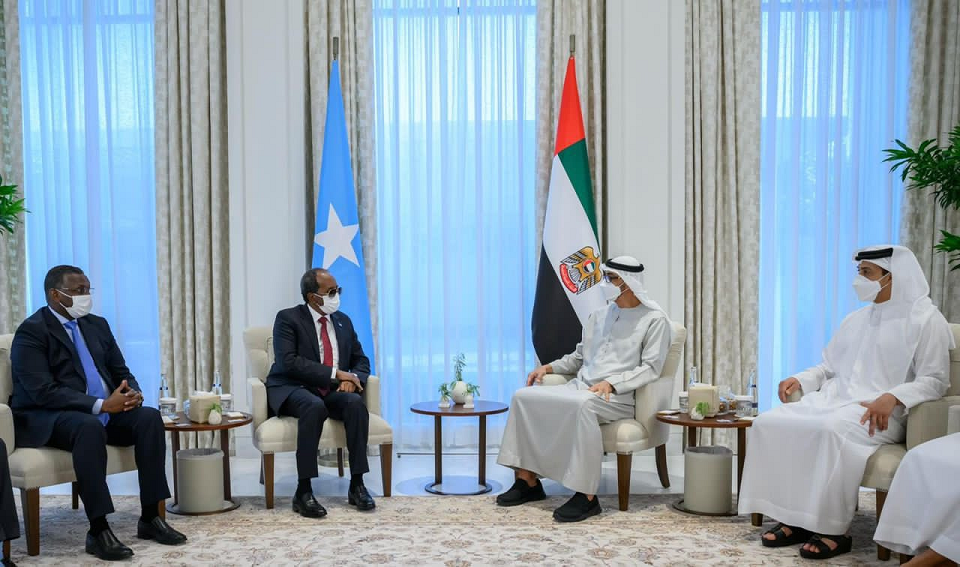
According to presidential spokesman Abdikarin Ali Kaar, the trip was prompted by a call from Emirati President Mohamed bin Zayed Al-Nahyan (MbZ), a man to whom he owes his position. The rushed journey came at a time when the new president had not yet formed a government.
Three Days of Silence
Upon arrival in Abu Dhabi, Mahamoud was met by an Emirati official at the airport and subsequently remained incommunicado until June 22. For several days, no one knew his whereabouts, prompting Somalis on social media to urge Villa Somalia to break its silence.
Kaar, who traveled to Abu Dhabi the day after the president, is typically forthcoming with details but communicated nothing during the three-day disappearance.
The lack of information led to a wave of speculation. Some Somali commentators stated he had taken a private plane to Tel Aviv, speculating that he intended to negotiate joining the Abraham Accords—diplomatic agreements normalizing relations between Arab countries and Israel, which has reportedly been courting Mohamoud. Others voiced more urgent concerns for the president’s physical safety.
Echoes of Regional Strong-Arm Tactics
Observers noted that it has become increasingly common in recent years to see Gulf powers use coercive methods against leaders of other Arab nations.
In November 2017, Saudi Arabia held Lebanese Prime Minister Saad Al-Hariri against his will and forced him to announce his resignation on video. The Prime Minister had traveled to Saudi Arabia on business and then disappeared. Lebanese politicians sensed something was wrong and rejected his resignation. Hariri was released only after French president Emmanuel Macron intervened.
In July 2021, Tunisian Prime Minister Hichem Mechichi, summoned by Tunisian President Kais Saied who had just dissolved the elected parliament and is about to sack the government, was assaulted to force him to resign. Mechichi was then confined to his home for several days. Reports indicated that Egyptian, Saudi, and Emirati agents were involved.
In Somalia, the assault narrative gained traction when the president reappeared three days later. A photo of him chatting with MbZ was shared by Villa Somalia showing him wearing dark sunglasses and a face mask.
A Return Marked by Secrecy and Visible Injuries
To the questions raised by concerned citizens, Mr. Kaar stated that the president was in quarantine during the days he was incommunicado. Back in Mogadishu, the president isolated himself and avoided any public or video appearances. The same spokesperson justified this isolation by the fact that the president contracted Covid-19.
Moreover, for the first time in Somalia’s history, a sitting president refused to participate in the June 26 independence celebration. The president delegated the parliament speaker to replace him during the public demonstration that day. His first public appearance at the July 1 Somali Union commemoration ceremony showed the scars of violence on his still-puffy left eye.
Always under public scrutiny about this mysterious trip to the United Arab Emirates, Villa Somalia produced on June 29 a video where the president wandered in the garden of the presidential palace with the prime minister, Hamza Barre. Even with the precautions to film the president on the right side, it was noticeable the president had a black eye.
There lies the doubt about the information filtering from the palace and the increase in questioning about the president of Somalia’s safety and about this trip to Abu Dhabi.
Questions of Complicity and National Sovereignty
If the Somali president suffered the same fate as Mechichi and Hariri, it is certain that Somalis including the head of the NISA who accompanied him were part of the plot. Mahad Salad, who is close to the Egyptian secret service, was imposed on Hassan Sheikh Mahamoud against the advice of the former intelligence chief.
For the Somali public, any agreement signed under duress during this controversial trip is not in line with Somalia’s interests and should be considered and rejected by parliament. In the absence of a transparent investigation to elucidate the circumstances surrounding the president’s trip, the mandate of this current administration is in jeopardy.
Historical Context of UAE-Somalia Tensions
Somalia under previous President Mohamed Abdullahi Farmajo had a difficult relationship with the UAE and Saudi Arabia after he refused to join Qatar’s isolation by MBS and MBZ and turned down 80 million in bribes. Relations deteriorated when the Somali government thwarted a destabilization attempt by corrupt politicians assisted by an army trained, equipped, and paid for by Abu Dhabi.
The UAE cut short all cooperation with the federal government but continued to maintain good relations with autonomous regions such as Somaliland and Puntland, taking over their ports, Berbera and Bosaso respectively. In the case of Puntland, it continues to maintain a local army.
Their all-out media and political war against Farmajo culminated in the selection of the current Hassan Sheikh Mahamoud on May 15. Mahamoud acted as their local conduit but made promises to all foreign forces opposing a staunch nationalist Farmajo.
What Was Secured in Abu Dhabi?
Mr. Kaar, has repeated on TV shows that the president did not return from Abu Dhabi empty-handed. He said MbZ had pledged $20 million in aid and various unspecified contracts.
The Emirati government has many interests in Somalia, starting with controlling the ports of the African nation with the longest coastline, in addition to geostrategic interests that link it to Egypt and Israel are at stake. As in Yemen or in Libya, among these Gulf Arabs, respect for the sovereignty of countries and the rights of local populations is not their forte.
As Somalia grapples with these revelations, it remains unclear how the nation will navigate a relationship that appears to give a potentially irreversible advantage to the interests of the Emirates and its Egyptian and Israeli allies.