

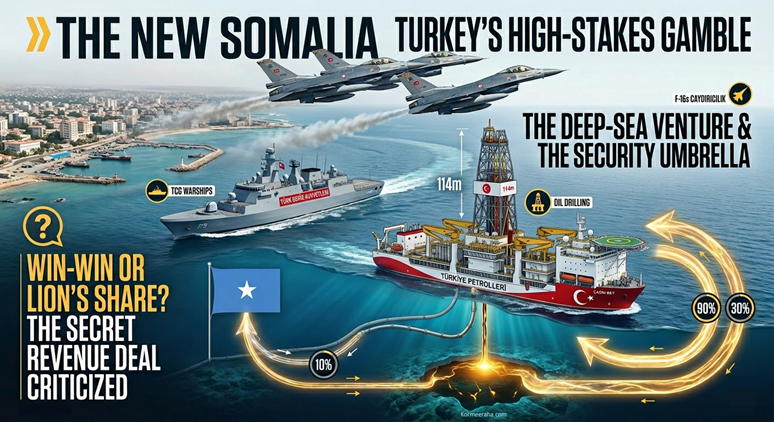
MOGADISHU – As the Turkish drillship Çağrı Bey bores into a potential 10-billion-barrel well off Somalia’s coast—escorted by Turkish F-16s and frigates—a fierce debate erupts: Is this a strategic alliance, or a new form of dependency?
The Drill & The Shield
Few days ago, the 228-meter Çağrı Bey began drilling the Curad-1 well, 370 kilometers offshore, aiming for a depth of 7,500 meters. Too tall for the Suez Canal, it sailed via the Cape of Good Hope. Now protected by Turkish warships enforcing a “Blue Homeland” doctrine, the operation marks Turkey’s first deep-sea drilling outside its borders.
The Deal’s Lopsided Mechanics
At the heart of the 2024 defense pact is SOMTURK, a Turkish-affiliated entity holding exclusive rights over Somalia’s 825,000 km² Exclusive Economic Zone. While Turkey bears all financial risk, critics allege the revenue terms strip Somalia of its “first fruits”:
- 90% cost recovery cap – Turkey can claim up to 90% of annual output to recoup investment before Somalia sees meaningful revenue. Regional norms hover around 70%. Critics warn the Somali treasury may see nothing for a decade.
- 5–10% royalty – Despite early reports of a 10% cut, leaked documents suggest the fixed royalty is as low as 5%. There are also no signature bonuses, development bonuses, or license fees—immediate cash payments common elsewhere.
- 30% security fee – In exchange for rebuilding Somalia’s navy and patrolling its coast, Turkey takes an additional 30% of all marine revenue, including fisheries and minerals.
Somali MP Abdirahman Abdishakur Warsame called the arrangement “unacceptable and shocking,” saying Turkey receives the “lion’s share” while Somalis are left with crumbs.
Trading Sovereignty for Protection
Critics argue this creates a “Turkish monopoly”: the protector is paid with the very resources it guards. By outsourcing control of its waters to a foreign joint venture, Somalia risks entering a state of “resource-backed dependency” rather than true independence. Regional states like Puntland have resisted, accusing the federal government of centralizing resource authority without local consent.
Regional Fallout & the Future
Turkey’s footprint now includes F-16s, M48/M60 tanks, and a planned spaceport and missile testing site near Kismayo—raising regional tensions. Israel is reportedly exploring a military presence in Somaliland to counterbalance Ankara. Meanwhile, Al-Shabab labels the partnership a “foreign occupation,” and election crises loom in Mogadishu.
Without parliamentary oversight or a transparent revenue management law, the “resource curse” looms large. As one Somali analyst put it: “The public has become a spectator in the sale of their own national future.” If oil flows, Somalia’s reconstruction could be funded—but only after years of Turkish cost recovery. The question remains: equal partnership, or a Turkish company town?
