
In Somalia’s fragile political landscape, few issues ignite as much debate as corruption. Today, the administration of President Hassan Sheikh Mohamud stands at the centre of an intensifying storm driven by persistent allegations from opposition lawmakers, growing public scrutiny, and deepening institutional tensions.
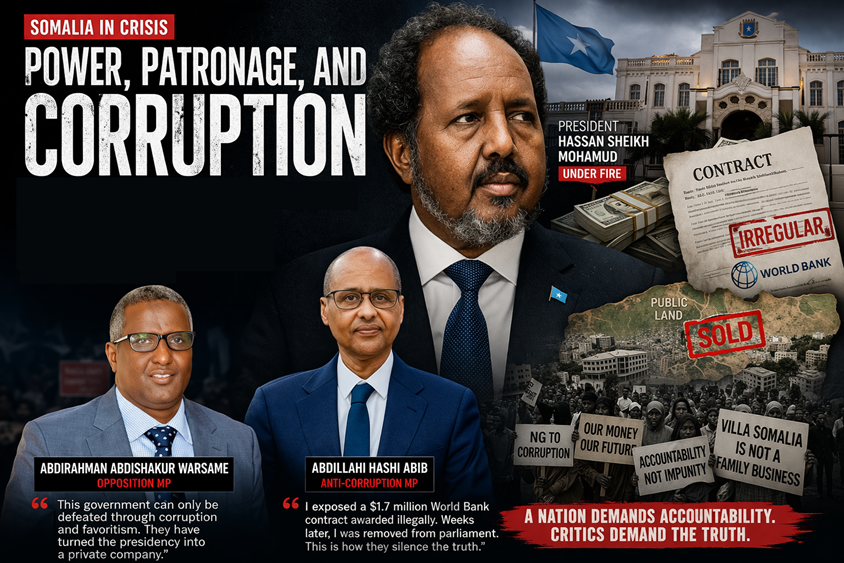
At the forefront of this challenge are two of the most vocal members of parliament, Abdirahman Abdishakur Warsame and Abdillahi Hashi Abib. Together, they have presented a narrative that portrays the administration as being entangled in systemic corruption, opaque governance, and political retaliation.
A System Built on Favouritism
Abdirahman Abdishakur has emerged as one of the most outspoken critics of the president. He has argued that the current leadership is driven more by favouritism and political survival than by national interest. In his view, public institutions are increasingly shaped by personal loyalty rather than merit, which he believes weakens state credibility. He has repeatedly accused the administration of allowing the unlawful appropriation of public land, claiming that such assets have been transferred to individuals with close ties to the presidency. He has also warned that rising political tensions could push the country toward election-related violence and renewed instability.
Despite his strong criticism of the current government, Abdishakur’s own political history remains contested. Critics often refer to his alleged involvement in the 2009 maritime agreement controversy, an episode in which Somali officials were accused by opponents of compromising national maritime interests. Although interpretations of that agreement differ, the issue continues to be raised in political debates and is used by detractors to question his credibility.
The Whistleblower and His Ouster
In contrast, Abdillahi Hashi Abib has built his reputation primarily as an anti-corruption advocate. He gained national attention after publicly exposing what he described as a corrupt contracting scheme linked to a World Bank-supported project. According to Abib, a contract valued at approximately 1.7 million dollars was awarded through irregular procedures that bypassed proper oversight and accountability mechanisms. He alleged that such practices reflected a broader pattern in which public funds were being misused through fraudulent contracts and weak financial controls.
Shortly after making these allegations public in early 2025, Abib was removed from parliament on March 15. The speed and manner of his removal generated widespread controversy. Critics argued that the decision lacked transparency and due process, and many interpreted it as a direct response to his anti-corruption activities. Supporters viewed his ouster as a warning to others who might attempt to expose similar issues within government institutions.
A Family Enterprise or a Functioning Government?
Both Abdishakur and Abib have also advanced a broader claim that the current administration operates in a manner resembling a family-centred power structure. They argue that key positions within government and access to major contracts are often granted to individuals with close personal or familial connections to the president. According to this perspective, such practices contribute to a system in which influence and access outweigh institutional rules.
Additional concerns raised by opposition figures include allegations surrounding the management of public land, the handling of natural resource agreements, and the transparency of government finances. Critics argue that some land transfers have taken place without clear legal procedures, while certain agreements in sectors such as oil and natural resources have been conducted without sufficient parliamentary oversight. These issues are often linked to wider concerns about constitutional processes, particularly regarding governance reforms and electoral frameworks.
The Government’s Defence
The administration of President Hassan Sheikh Mohamud has consistently rejected these allegations, describing them as politically motivated and lacking factual basis. Government officials maintain that their focus remains on rebuilding state institutions, improving security, and advancing economic recovery. They argue that reforms related to land management and development are part of broader national planning efforts.
In response to accusations of nepotism, the president has stated that family members are citizens with equal rights to participate in public service and should not be excluded solely because of their relationship to him.
A Nation at a Crossroads
The ongoing confrontation between the government and its critics reflects deeper structural challenges within Somalia’s political system. On one side are claims of corruption, lack of transparency, and retaliation against dissenting voices. On the other is a government that insists it is pursuing reform under difficult conditions.
The experiences of Abdirahman Abdishakur Warsame and Abdillahi Hashi Abib illustrate the complexity of this political moment. One is a seasoned opposition figure whose past remains part of the debate, while the other is a whistleblower whose political career was abruptly interrupted.