
As Washington moves to cut UN peacekeeping funds for Somalia by the end of this year, Mogadishu faces a familiar crisis—but this time, the usual fix may not work. The US withdrawal exposes a system that has spent two decades managing insecurity rather than building sovereignty. Yet assigning blame solely to foreign capitals misses the full picture. Somali political elites have actively perpetuated this dependency, using competing patrons to consolidate personal power while delaying the painful reforms that genuine independence demands.
The result is a trap that neither abrupt funding cuts nor new Turkish patrons can easily break.
The Rebranding Cycle
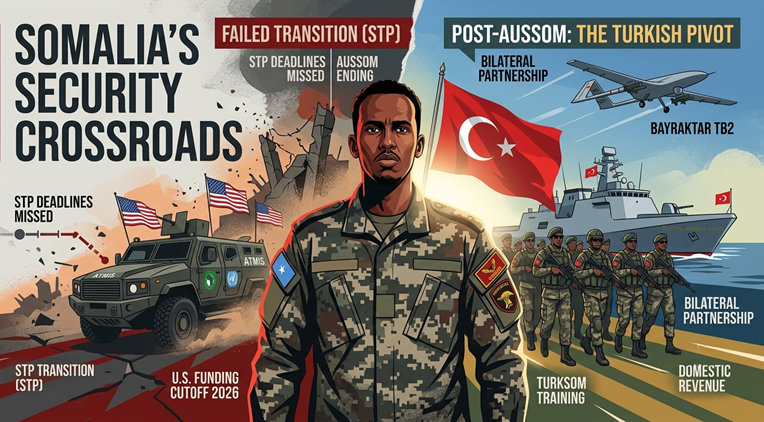
The Somali Transition Plan of 2018 promised to hand security from African Union forces to the Somali National Army by 2024. When it collapsed, the international community did not address root causes—fragmented command, logistical dependency, clan-based recruitment—it simply rebranded the mission. AMISOM became ATMIS, then AUSSOM in January 2025.
AUSSOM, with around 12,000 troops, represents a significant drawdown from the over 20,000-strong ATMIS force. Yet it is not a strategic pivot toward Somali ownership. According to the UN Secretary‑General’s April 2025 report, AUSSOM inherited 80% of ATMIS’s operational structures, with changes concentrated in “reporting lines” rather than “operational capabilities.” The mission is a continuation of the status quo on a smaller scale, designed to manage symptoms rather than cure the disease of dependency.
Meanwhile, Mogadishu’s leaders treat each rebranding as a chance to renegotiate patronage flows rather than as a genuine deadline for control.
Mixed Motives in the Region
African troop-contributing nations are not simply altruistic or mercenary—they are both. Uganda received roughly $180 million annually in reimbursements at the mission’s peak, a significant fiscal lifeline. But Ugandan and Kenyan forces have also suffered hundreds of casualties fighting Al-Shabaab, which threatens their own borders.
Regional powers like Ethiopia, Egypt, and Kenya also use Somali territory as a chessboard for their rivalries—from the Ethiopia-Somaliland port deal to Cairo’s military engagement as a counterweight to Addis Ababa.
The structural problem is that the current funding model rewards indefinite presence. Reimbursements tied to troop numbers rather than transition benchmarks create perverse incentives for all sides.
Phantom Sovereignty
The 2023 UN arms embargo lift looked like a victory for Somali sovereignty. In practice, financial dependency replaced legal prohibition. Somalia cannot afford weapons, cannot sustain its arsenal, and cannot pay its elite units—Danab, Gorgor, and Haram’ad—without foreign checks.
As one Mogadishu analyst put it: “We have permission to buy guns, but the countries that pay the bills still choose the rifles.” And Somali leaders have resisted unified procurement precisely because fragmented funding gives them more bargaining power with different patrons.
Patrons as Kingmakers
Turkey, the UAE, the US, the EU, and Egypt do not just write cheques—they compete. The UAE backs regional forces like Puntland and Jubaland’s Darawiish forces; Turkey trains presidential guard units; the US funds Danab bilaterally. Each patron creates parallel command chains. Somali politicians play these rivals against each other—threatening to tilt toward Ankara to extract more from Abu Dhabi, or offering port access for political backing.
This is not foreign manipulation alone; it is a symbiosis where external competition and internal fragmentation reinforce each other. Neither side has an incentive to consolidate power into a unified, accountable structure.
The American Exit
Washington’s decision to cut AUSSOM funding while preserving bilateral support for Danab misunderstands modern warfare. Danab relies on broader UN logistics—intelligence, fuel, air mobility, medical evacuation—for its surgical strikes. These hubs are part of the vast support system that sustains the entire 12,000-strong AUSSOM mission. Strip those enablers away, and the elite force becomes a static town-defence unit, stripped of its offensive edge.
Turkey’s drone programme may partially fill the gap, but the transition will leave dangerous operational gaps that Al‑Shabaab will exploit. Worse, preserving Danab as an “island of excellence” while defunding the rest entrenches fragmentation, ensuring resentment between units and further fracturing Somali security.
Swapping Patrons, Not Building Sovereignty
Mogadishu’s response is strategically astute: pivot to Turkey. Ankara offers coastal defence, drone coverage, and training for Gorgor and Haram’ad, alongside infrastructure investment. This model differs from the US approach—it is longer-term and more politically respectful.
Yet it remains a swap of patrons, not a move toward independence. Turkish support comes with conditions around port management and procurement. Gulf competition between Qatar, the UAE, and Saudi Arabia simply creates a new set of rivalries to navigate. The structural asymmetry persists.
A Path Forward
First, international donors should consolidate funding into a single, Somali-managed security trust fund with civilian oversight, ending the bilateral fragmentation that fuels internal rivalries.
Second, reimbursements should shift from troop numbers to measurable transition milestones—handing over bases, integrating regional forces, and achieving logistical self-sufficiency.
Third, Somali civil society and federal member states must have a binding seat at the table; security reform cannot be negotiated only with the presidency. Fourth, a decentralised, federated security model—reflecting Somalia’s clan-based reality—may be more sustainable than forced centralisation. Finally, judicial and police reform must receive as much funding as elite military units, because Al-Shabaab cannot be defeated by force alone.
The Bottom Line
The American funding cut is not a catalyst for Somali self-reliance; it is an abrupt unravelling of a deeply flawed system. But that system was co-produced by foreign capitals and Somali elites alike, each pursuing short-term survival over long-term sovereignty.
Foreign nations use Somali deployments for revenue and influence. Somali politicians use foreign patrons to consolidate power and evade accountability. International donors treat security as technical, divorced from politics. And Al-Shabaab exploits every gap.
Somalia does not need another rebranded mission or another conditional donor. It needs a patient, politically honest partnership that treats sovereignty as a long, contested process—not a checkbox to tick or an illusion to maintain. Until both international actors and Somali leaders embrace that reality, the crisis will continue to drown the Horn of Africa in instability.