
Every year, Somalis worldwide mark June 26th as the birth of modern Somalia. We gather, we chant, we dance, we wave the white-starred blue flag—and then we go home.
But what are we teaching our children about this day? What sacrifices were made to achieve it? Who drove the movement, and what was the true atmosphere of that historic moment? More importantly, what is its significance today in these troubled times, and what lessons must we carry forward?
To answer these questions requires deep reflection—far more than a few lines can capture.
The Search for a Shared History
I was born in the northern region of Somalia, in the remote province of Awdal. My family and I fled when the Somali National Movement (SNM) rampaged through the region, forcing me to continue my schooling abroad and rebuild my life far from my homeland. Yet, my attachment to the soil never faded. To make up for what I missed, I spent years listening to elder historians, seeking to piece together the fragments of our past.
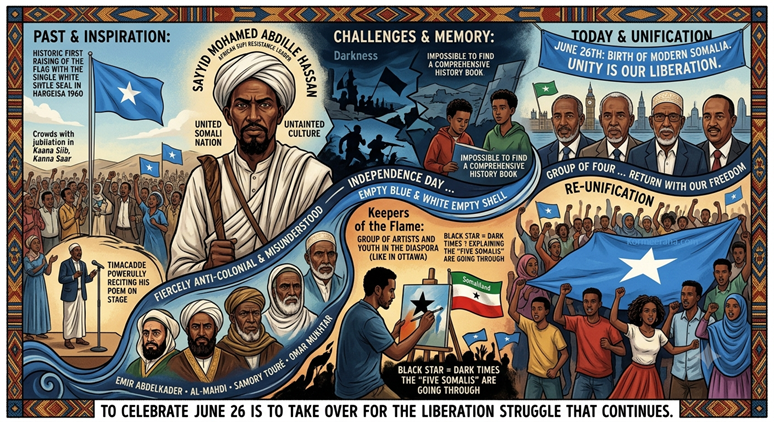
Unfortunately, for generations born outside of Somalia or raised during the collapse, finding a comprehensive history book written by a fellow Somali is nearly impossible. For the youth—and even for someone like me, who proudly claims descent from the famed Ahmed Gurey—our knowledge of modern Somali history leading up to independence remains frustratingly incomplete.
We know the names: Sayyid Mahamad Abdille Hassan and his heroic Dervishes, the Somali Youth League (SYL or Lego), Xaawa Taako, Dhagaxtuur, and the glorious Union Day on July 1st. But we rarely hear about the relevance of their struggle or how their nationwide reverberation should echo in the hearts of today’s youth.
For the generation born just before or during the civil war, who witnessed only the dismemberment of our country, Independence Day long felt like an empty blue-and-white shell. The flag itself aroused painful passions—a reminder of a happier, unified time they had never experienced.
Furthermore, the older generation remembers how, following the 1969 revolution, Mohamed Siyad Barre’s regime relegated June 26th to the background, pushing October 21st into the spotlight. Until 1991, the revolution was celebrated as the main event; unfortunately, my own childhood memories of that regime-led celebration are more vivid than any other.
Finding a Champion of Unity
I am still digesting historical facts and deciphering their interpretations. I first learned about the SYL roughly twenty years ago when I met one of its last surviving figures, Daahir Xaaji Cusmaan “Dhagaweyne,” in Ottawa, Canada, where he drew his last breath. Yet, as inspiring as he was, his specific historical path wasn’t one I completely identified with. I wanted something closer to my own worldview.
I found my champion in Sayyid Mohamed Abdille Hassan.
My Western education and my experience as a “visible minority” drew me directly to his fierce anti-colonial call, his undying African Sufi resistance, and his unyielding quest for a united Somali nation.
The Sayyid is only “controversial” if you view him strictly through the narrow lens of clan narratives. What is truly fascinating about him is that he bowed to no one. He refused to accept nonsense, cowardice, or foreign subjugation, regardless of clan affiliation. He was fiercely anti-colonial and never minced words. His ethos centered on an untainted version of Somali culture rooted in vernacular Islamic tradition.
His ultimate goal was a country united by language, culture, and faith, entirely free from foreign interference. He was rightly revolted by the artificial borders drawn by European and Ethiopian colonizers. He was a man far ahead of his time, often misunderstood by his contemporaries—an incomprehension that sadly persists today as anachronistic tribalism runs rampant. Yet, he left behind a legacy of absolute pride for any conscious human being who refuses to submit to oppression.
He rightfully belongs in the pantheon of great African Sufi resistance heroes, standing alongside Emir Abdelkader of Algeria, Al-Mahdi of Sudan, Samory Touré of Guinea, and Omar Mukhtar of Libya. All Sufis, all Africans, all anti-colonial freedom fighters—all misunderstood by sections of their own people, dispossessed of their lands, and dead for their belief in liberty. His defiance left a permanent mark on those who sought to make us bow, as well as on those who collaborated with them. His struggle deeply inspires those of us who place no weight on clannism when it comes to collective survival and equal opportunity.
A Tribute to the Architects of Freedom
On this anniversary, I want to pay tribute to the generations of Somalis who broke the shackles of European colonialism:
- To the Unifiers: I honor those proud Somalis who collaborated across artificial borders, transcending clan, region, and even religion to reunite a scattered nation—figures like Michael Mariano and Lewis Salool.
- To the Defiant: I salute the memory of everyone who was rightly outraged by the British betrayal of 1955, when Great Britain handed the Haud and the Reserve Area to Haile Selassie despite prior assurances to the Somali people. June 26th was the first major step toward reversing that injustice, fueling the sincere, collective effort to realize the Sayyid’s dream of a Greater Somalia—a struggle that culminated in the 1977 war.
- To the Statesmen: I pay tribute to the historic four-man delegation that traveled to London to secure our independence: Mohamed Ibrahim Igal, Haji Ibrahim Nur, Garad Ali Garad Jama, and Ahmed Haji Duale (Keyse). These men carried the heavy mantle of freedom and laid the groundwork for reunification.
- To the Keepers of the Flame: I honor those who kept the dream of unity alive through the last thirty years of darkness. I often recall Murad Mubarik, the artist who designed the Somaliland flag and symbols in Ottawa. He once explained to me that the black star in that flag was intended to symbolize the dark, fragmented era that the “Five Somalis” are currently enduring. According to Murad, it was Mohamed Ibrahim Igal himself who championed that profound interpretation.
The Call of June 26th
To celebrate June 26th is to remember the struggles of our fallen comrades and our founding fathers and mothers. Commemorating their legacy means refusing to forget them, and taking up our own roles in the ongoing struggle for true liberation. To honor their achievements demands that we actively fight against the toxic divisions of clannism, whether promoted from within or engineered from abroad.
This Independence Day, let us recapture the euphoria of 1960. Let us listen closely to the immortal words of Abdillahi Suldan Timacadde’s poetry, Kaana Siib, Kanna Saar (Take that one down, hang this one up).
Let us transport ourselves back to that atmosphere 62 years ago, when the blue flag with the single white star was raised high into the sky of Hargeisa to the absolute jubilation of a free people.
June 26th is the birthdate of our nationhood, and July 1st remains the seal that formalized our unity. Together, they represent the blueprint for a greater, free, and prosperous Somalia.
Insha’Allah.
Happy Somalia Day!!! Guul iyo gobanimo!!