
When FIFA selected Somali referee Omar Abdulkadir Artan to officiate at the 2026 FIFA World Cup, it marked a historic achievement for Somalia and African football. Artan, who had been named Africa’s Referee of the Year in 2025, became the first Somali official ever chosen for football’s biggest stage. His appointment was widely celebrated as a testament to perseverance, professionalism, and the growing presence of Somali talent in international sport.
What should have been the defining moment of his career, however, quickly turned into one of the tournament’s first major controversies.
After arriving in the United States, one of the host nations of the 2026 World Cup, Artan was denied entry by American authorities and subsequently returned to Somalia. Despite holding FIFA accreditation and being officially appointed by world football’s governing body, he was unable to participate in the competition. U.S. officials cited security vetting concerns, but no detailed public explanation was provided. FIFA later removed him from the tournament roster.
The decision immediately generated debate across the football world and provoked a strong reaction in Somalia, where many viewed the incident as both a personal injustice and a national disappointment.
From Mogadishu to the World Stage
Artan’s rise through football was remarkable not only because of his professional accomplishments but also because of what he represented. Coming from a country that has often been associated internationally with conflict and instability, he emerged as a symbol of excellence and determination.
Over the years, he officiated major continental matches and earned a reputation as one of Africa’s most respected referees. His selection for the World Cup was seen by many Somalis as recognition of both his individual achievements and Somalia’s gradual re-emergence in international sport.
For young Somalis in particular, Artan’s journey offered a powerful message: that talent and dedication could overcome even the most difficult circumstances. His appointment demonstrated that Somalis could compete and succeed at the highest levels of global sport.
That is why his exclusion resonated so deeply across the country.
A Hero’s Welcome Home
If Artan’s World Cup dream was interrupted in the United States, his return to Somalia produced a very different scene.
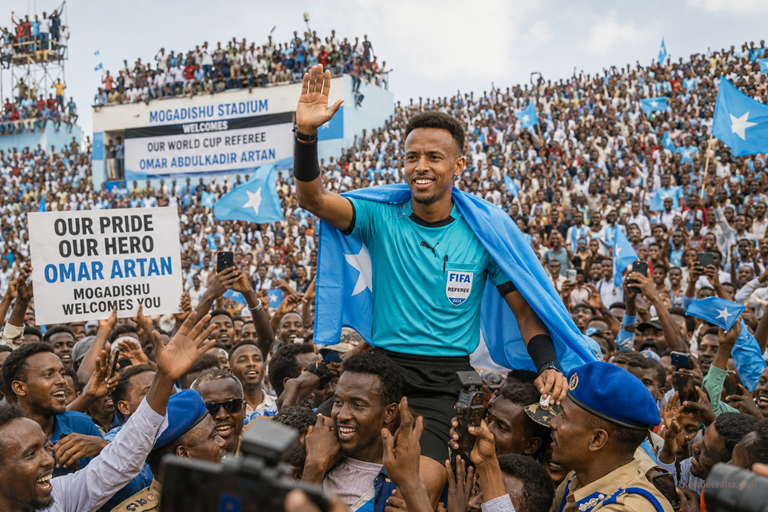
Thousands of people gathered in Mogadishu to welcome him home. Crowds waving Somali flags celebrated him as a national hero, while political leaders, sports officials, and ordinary citizens expressed solidarity with the referee whose historic opportunity had been taken away.
The reception transformed what might have been remembered as a personal setback into a broader expression of national pride. Rather than focusing on the disappointment of missing the World Cup, many Somalis chose to celebrate the achievement that had brought Artan to the tournament in the first place.
For supporters gathered in Mogadishu, his value was not diminished by the decision of foreign authorities. In their eyes, he remained a trailblazer whose accomplishments had already secured his place in Somali sporting history.
Questions for FIFA
The controversy also raised uncomfortable questions for FIFA.
The organization regularly promotes football as a universal language capable of transcending nationality, religion, race, and politics. World Cups are presented as celebrations of global unity, bringing together players, officials, journalists, and supporters from every corner of the world.
Yet one of FIFA’s own selected referees was unable to enter a host country and perform the duties for which he had been chosen. Critics argued that the incident exposed the vulnerability of international sporting events when immigration policies and security concerns collide with the ideals of global participation.
Supporters of the American decision, meanwhile, maintained that sovereign nations retain the right to determine who enters their territory and that security considerations cannot automatically be overridden because an individual is involved in sport.
Regardless of where one stands on that debate, Artan’s exclusion created a difficult dilemma for FIFA and highlighted the tension between national border policies and the organization’s commitment to inclusivity.
The Shadow Over the 2026 World Cup
The controversy surrounding Artan arrived amid broader concerns about travel restrictions and visa complications affecting participants from parts of Africa, Asia, and the Middle East.
The incident also unfolded against a charged political backdrop in the United States. In recent years, President Donald Trump has faced criticism for inflammatory rhetoric regarding immigrants and several African nations. Civil rights organizations and immigrant advocacy groups have argued that such language contributes to an atmosphere of exclusion and suspicion toward people from parts of Africa and the Muslim world.
Although there is no evidence that Artan’s exclusion was directly linked to any political statement, many Somalis viewed his treatment through that wider context. To them, the denial of entry to one of Africa’s most accomplished football officials appeared to reinforce concerns that Somali identity continues to face heightened scrutiny in parts of the West.
Human rights advocates also warned that athletes, officials, journalists, and supporters from certain regions could encounter additional obstacles when attempting to attend the tournament. As preparations for the World Cup continued, questions emerged about whether access to the competition would be equally attainable for all participants regardless of nationality or origin.
What began as the story of a single referee gradually evolved into a broader debate about fairness, mobility, and inclusion in international sport.
A Story Bigger Than Football
Throughout the controversy, Artan remained measured and composed. Rather than expressing bitterness, he encouraged young Somalis to continue pursuing their ambitions despite setbacks. His response only strengthened the admiration many people felt toward him.
In many respects, that reaction explains why his story resonated so widely. Artan’s ordeal touched on issues that extend far beyond football: identity, opportunity, migration, and belonging in an increasingly interconnected world.
History may remember the goals, victories, and champions of the 2026 World Cup. But it is also likely to remember the Somali referee who earned his place at football’s greatest tournament, only to be denied the opportunity to participate.
The images of thousands of supporters welcoming Omar Artan home to Mogadishu captured a powerful reality. While he may have been prevented from stepping onto a World Cup field, he returned to a nation that regarded him not as a rejected traveller but as a symbol of achievement, resilience, and national pride.
In that sense, Omar Artan’s greatest moment may not have occurred inside a stadium at all. It occurred in the streets of Mogadishu, where an entire country gathered to remind him that some victories transcend sport.
Thank you for your article about the unjust treatment of this referee, the failure of FIFA to live up to its motto .
Thank you for your support. It’s a difficult situation, and I appreciate you calling attention to the gap between official mottos and actual practices. In your opinion, what is the most important step organizations like FIFA could take to restore fairness?