
For years, the Horn of Africa has been viewed by global strategists as a peripheral theater—a region plagued by internal fragility but largely insulated from the direct, kinetic spillover of West Asia (Middle East) hegemonic struggles. That era is definitively over.
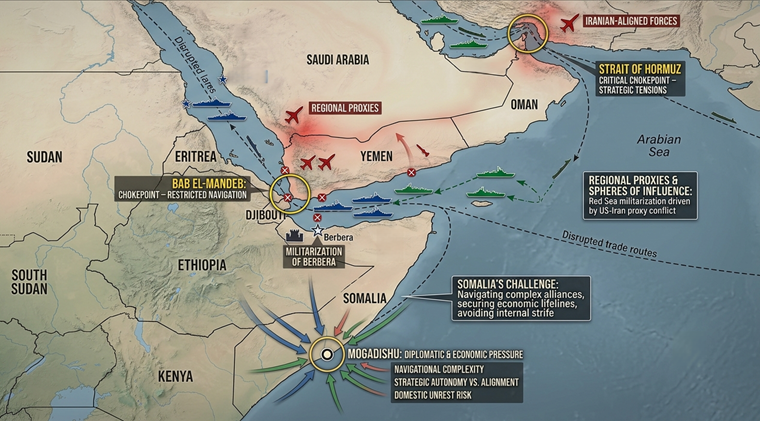
As the summer unfolds, a cascading series of geopolitical shocks has transformed the waters off the Somali coast into the most critical maritime chokepoint on the planet. The resumption of full-scale hostilities between Saudi Arabia and Ansarallah (the Houthis) in Yemen, coupled with a dangerously escalating broader war between the United States and Iran, has pushed the conflict’s center of gravity westward. Now, with reported Israeli military deployments in the Somaliland port of Berbera, Somalia finds itself at the nexus of a sprawling regional war, facing immense pressure to align its diplomacy with the Arab Gulf States.
The Chokepoint Crisis: A Dual Strangulation
The catalyst for the current regional realignment is the unprecedented strangulation of global maritime trade, driven by the broader outbreak of the U.S.-Iran conflict. The U.S. naval blockade of the Strait of Hormuz—aimed at crippling Iranian energy exports and projecting maximum pressure—has effectively turned the Persian Gulf into a contested basin. In response, Tehran’s axis of resistance has attempted to counter-strangle global commerce, with the Houthis bearing the brunt of this maritime warfare.
The Houthis’ maritime campaign is not new, but its current scope is. They initially launched drone and missile attacks against Israel-linked shipping in late 2023 as a leverage tactic, demanding an end to the genocidal war in Gaza and the unhindered entry of food and medicine into the Strip. That campaign ceased following the so-called 2025 peace plan, but the fragile calm shattered on July 20, when a Saudi-backed airstrike on Houthi-controlled Sanaa International Airport struck within the context of escalating tensions between Iran and U.S. allies. In retaliation, the Houthis aggressively resumed operations, escalating into a full closure of the Bab el-Mandeb strait specifically for Saudi vessels.
By turning the Red Sea’s southern entrance into a no-go zone for Riyadh, the Houthis severed Saudi maritime lifelines, forcing the Kingdom to rely on overland routes and alternative ports. This dual blockade—the U.S. choking Hormuz and the Houthis choking Bab el-Mandeb—has paralyzed global supply chains. As Gulf capitals are forced to urgently secure alternative logistical hubs, it is within this desperate strategic calculus that the Horn of Africa has suddenly become indispensable.
The Berbera Gambit: A New Red Sea Frontline
The most startling development of this current escalation is the reported presence of Israeli military assets in Berbera, the deep-water port in the breakaway region of Somaliland. While Tel Aviv has not officially confirmed a permanent boots-on-the-ground deployment, intelligence reports and satellite imagery suggest, according to Le Monde, a significant advisory and logistical footprint.
For Israel, Berbera offers a strategic vantage point to monitor and intercept Iranian supply lines to the Houthis across the Gulf of Aden, effectively flanking the Bab el-Mandeb closure. For the Gulf States, particularly the UAE and Saudi Arabia, Berbera serves as a crucial alternative logistics node to bypass the Houthi blockade.
However, this development drastically complicates the security architecture of the Horn. The presence of Israeli forces on the African coast transforms a localized proxy war in Yemen into a direct, trans-regional frontline. It brings the Iran-US-Israel conflict directly to the doorstep of the Somali mainland, threatening to drag the fragile Federal Government of Somalia in Mogadishu into a war it is ill-equipped to fight.
The Economic Lifeline: Why Mogadishu Cannot Afford Neutrality
For the Federal Government of Somalia, this regional conflagration presents an existential diplomatic dilemma—and the pressure runs through money, not just diplomacy. Somalia’s economy is unusually exposed to the Gulf. An estimated 30–50% of Somalia’s GNP derives from remittances, much of it earned by Somalis working in Gulf states, and roughly 40% of Somali households receive remittance income directly or indirectly.
Livestock exports, a pillar of the rural economy, depend heavily on the Gulf market, above all the annual Hajj trade with Saudi Arabia. Layered on top of that are banking-correspondent relationships that let Somali financial institutions clear transactions internationally, relationships that run largely through Gulf banks.
That dependence cuts two ways in a widening war. On one hand, analysts note that Gulf economic uncertainty could reduce remittance flows even as Horn banks face higher costs and tighter credit through their correspondent ties to Gulf institutions. Prolonged West Asia East conflict is already disrupting Red Sea trade routes, raising shipping and insurance costs, and pulling back Gulf investment in ports, infrastructure, and energy projects across the Horn.
On the other hand, that same dependence is precisely why Gulf capitals retain real leverage in Mogadishu: a government whose fiscal and social stability rests on these financial arteries cannot easily afford to be seen as neutral, let alone hostile, toward Riyadh, Doha, or Abu Dhabi.
The Geopolitical Price: Sovereignty and the Somaliland Conundrum
Consequently, Mogadishu is facing immense, albeit largely quiet, pressure to formally align its diplomatic and security posture with the Gulf States. This alignment would likely require painful, concrete concessions that cut to the heart of Somalia’s territorial integrity.
To secure Gulf backing, Mogadishu may be forced to look the other way when it comes to the de facto realities in Somaliland, effectively rewarding Hargeisa’s decades-long push for independence in exchange for regional stability. Furthermore, alignment demands that the federal government allow Gulf (and by extension, Israeli) naval operations in its claimed territorial waters, while actively restricting Iranian or Houthi-linked financial and logistical networks within its borders.
For a government that has long fought to reassert central control over its fragmented territory, accepting this new security architecture represents a profound surrender of sovereign prerogatives—a strategic trade-off that buys short-term survival at the cost of long-term statehood.
The Domestic Powder Keg: Public Sentiment and the Insurgency
Aligning closely with the Saudi-Israeli-Gulf axis carries severe domestic risks for President Hassan Sheikh Mohamud’s administration. The Somali public holds deep historical and ideological sympathies for the Palestinian cause and harbors significant skepticism toward Israeli military expansion in the region. A visible alignment with Tel Aviv’s strategic goals in Berbera could trigger widespread civil unrest, alienating urban populations and clan elders whose political support is crucial for the fragile government.
More dangerously, this perception of foreign subservience provides a potent propaganda weapon for insurgent groups like Al-Shabaab. The militant group has long framed the federal government as a puppet of external powers; overt cooperation with Israeli and Gulf military assets would validate that narrative, potentially boosting recruitment and galvanizing local resistance against Mogadishu’s authority in the very regions where the state is struggling to maintain a foothold.
The Regional Riptide: Turkey, Iran, and the Proxy Threat
Internationally, Mogadishu risks alienating other major partners by leaning too heavily into the Gulf axis. Turkey, a major security and economic partner to Somalia with a significant military base in Mogadishu, has its own complex relationship with the Gulf and Israel. Ankara’s interests in the Horn are growing, and a Mogadishu pivot toward Riyadh and Tel Aviv could strain bilateral ties, jeopardizing Turkish infrastructure projects and security cooperation.
Furthermore, pushing Somalia too firmly into the Gulf’s orbit invites asymmetric retaliation from Iran and its proxies. Tehran has demonstrated a willingness to strike far beyond the West Asia to protect its interests, and Somali waters or territory could easily become a theater for covert Iranian operations against Gulf shipping. By hitching its wagon to one side of a wider US-Iran war, Mogadishu risks transforming Somali soil into a target for drone strikes, cyberattacks, or proxy agitation, multiplying the security threats it already faces.
Conclusion: Navigating the Narrow Strait
As the US-Iran war rages and the waters of the Red Sea and Persian Gulf remain choked, the Horn of Africa is no longer a bystander. The resumption of the Saudi-Houthi war and the militarization of Berbera have ensured that Somalia’s fate is now inextricably linked to the broader West Asian conflict.
Mogadishu’s challenge in the coming months will be to navigate this treacherous diplomatic minefield. It must secure the economic and security lifelines provided by the Gulf States without completely surrendering its strategic autonomy or igniting domestic unrest. In a region where the Bab el-Mandeb and the Strait of Hormuz are effectively closed for business, the price of admission to the new Red Sea security order is steep—and Somalia is being asked to pay it. Whether Mogadishu can negotiate a discount, or will be forced to pay in full, will define the Horn’s geopolitical trajectory for a generation.