

An Analytical Assessment of U.S. Strategic Repositioning in the Horn of Africa
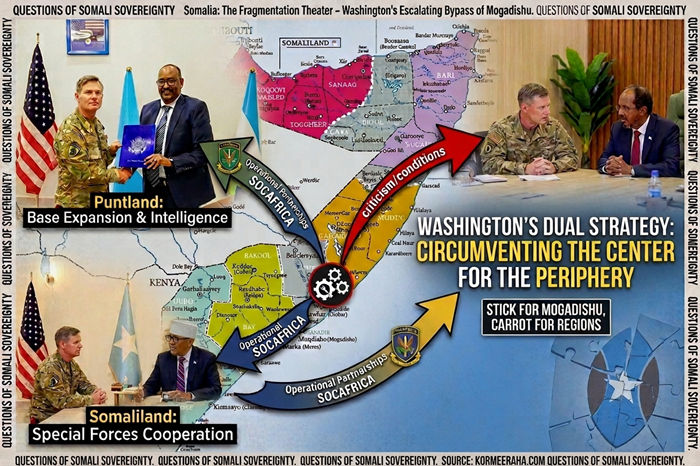
In late July and early August 2026, the architecture of U.S.–Somalia relations underwent a highly coordinated structural rupture, executed through a deliberate division of labor. While AFRICOM Commander General Dagvin R.M. Anderson visited Mogadishu on July 29–30, Major General Claude K. Tudor Jr., Commander of Special Operations Command Africa (SOCAFRICA), executed a parallel regional tour that completely avoided the capital.
Leading a high-level military delegation, Tudor conducted a sequence of bilateral engagements with Somalia’s peripheral leadership. On August 1, he met with Somaliland President Abdirahman Mohamed Abdullahi “Irro” in Hargeisa, focusing on maritime security along the Gulf of Aden and Red Sea shipping lanes. Then, on August 2, he traveled to Bosaso to sign a historic security agreement with Puntland President Said Abdullahi Deni, expanding the U.S. military footprint at the local base. Finally, on August 7, he held talks in Kismayo with Jubaland President Ahmed Madobe and regional intelligence officials to accelerate joint military operations.
Concurrently, Washington informed the African Union that it would cease funding the U.N. Support Office in Somalia (UNSOS) beyond December 2026, effectively pulling the logistical foundation from under the 12,000-member AUSSOM mission. The combined effect of these moves is unmistakable: the United States is constructing a parallel security architecture that redistributes military patronage to sub-national actors while withdrawing the institutional support that sustains the federal framework.
A Bifurcated Strategy: The Diplomatic Stick and the Operational Carrot
The dual visits by Generals Anderson and Tudor represent two halves of a cohesive, aggressive U.S. strategy. Anderson’s July 30 meetings in Mogadishu with the Commander of the Somali National Army, General Sahal Abdullahi Omar, served as the diplomatic stick. Despite nearly $2 billion in U.S. support for U.N. missions and three decades of unrestricted drone campaigns, Al-Shabaab persists. Anderson’s public remarks made clear that Washington views President Hassan Sheikh Mohamud’s administration—paralyzed by an election deadlock—as incapable of producing a credible security transition plan.
While Anderson managed the fraught relationship with the capital, Tudor’s regional tour served as the operational carrot for the periphery. The message embedded in this division of labor is stark: the center receives criticism and conditional engagement; the regions receive elite military partnerships, base expansions, and intelligence integration.
This is not to dismiss the legitimate substance of Washington’s critique. The FGS’s inability to integrate regional forces into a unified national command, recurring confrontations between federal and regional troops, and the unresolved electoral crisis have made internal security coordination inconsistent at best. These governance failures are real. However, leaping from acknowledging them to actively circumventing the sovereign government via elite military channels is a political choice that transforms Somalia from a state-building project into a fragmented security theater.
The Architecture of Circumvention: Why SOCAFRICA Matters
The deployment of SOCAFRICA—AFRICOM’s elite, specialized division responsible for the most sensitive kinetic operations, intelligence sharing, and specialized training on the continent—elevates this bypass from routine military diplomacy to deep operational integration. By sending its premier special operations command rather than conventional forces or State Department diplomats, Washington is signaling that its most critical security relationships in Somalia will henceforth flow through regional administrations rather than through Mogadishu’s national command structure.
This institutional workaround allows the Pentagon to sign base expansions, share tier-one intelligence, and embed special operations capabilities without navigating the formal diplomatic channels that require strict adherence to Somali sovereignty. The U.S. maintains a diplomatic fiction of territorial unity while operationally treating these regions as functional security partners. The fact that this architecture is driven by Special Operations Command rather than Foggy Bottom signals that Somalia is now managed primarily as a specialized security theater, hollowing out Mogadishu’s monopoly on the legitimate use of force—the foundational attribute of any sovereign state.
Operational Realities and Geopolitical Fault Lines
The specific agendas of Tudor’s regional tour reveal that counter-terrorism is intertwined with broader maritime and geopolitical imperatives in the Red Sea–Gulf of Aden corridor:
Somaliland and the Maritime Chokepoint. Tudor’s August 1 discussions with President Irro centered explicitly on maritime security along the Gulf of Aden and Red Sea shipping lanes. This ties directly into strategic anxieties surrounding the Bab el-Mandeb Strait and the sustained military activities of Yemeni forces. Integrating Somaliland into U.S. maritime intelligence networks places American assets near one of the world’s most critical chokepoints, independent of Mogadishu’s oversight.
Puntland and Physical Footprint. The August 2 agreement with President Deni solidifies a permanent, physical U.S. special operations presence on the Gulf of Aden. Bosaso’s expansion aligns closely with the UAE-Israel-Ethiopia corridor, which has heavily invested in Puntland’s port and security infrastructure. Washington’s willingness to operate through this axis suggests it has found partners whose operational priorities match American interests more closely than those of rival blocs.
Jubaland and Kinetic Operations. In Kismayo, Tudor’s focus on accelerating joint military operations embeds U.S. special operations directly into the kinetic fight in the south, creating a localized command structure that answers to Kismayo and AFRICOM rather than to the national command.
These regional pacts also function as a hedge against Turkey’s deepening military entrenchment in Mogadishu. Ankara has built a major training base in the capital, trained thousands of Somali soldiers, and positioned itself as the FGS’s most reliable external security partner. As the federal government drifts toward this Turkey-Saudi-Egypt orbit, cultivating elite-tier partners in Hargeisa, Bosaso, and Kismayo ensures Washington retains operational leverage regardless of who controls the capital.
The Funding Cliff and the Domestic Dilemma
The UNSOS funding withdrawal acts as a force multiplier for this fragmentation. Removing American financial support signals to AU troop-contributing countries that Washington will no longer underwrite the continental security architecture in Somalia. The impending vacuum pressures the FGS to assume responsibilities for which it is unprepared, thereby validating the narrative that Mogadishu cannot govern and justifying the very bilateral regional deals Tudor was dispatched to sign.
Domestically, President Hassan Sheikh’s reliance on Turkish military support, while pragmatically necessary, has narrowed his room for maneuver with Western partners. The more Mogadishu leans on Ankara, the more Washington is incentivised to empower regional leaders who remain outside that orbit. The federal government’s own political choices have thus narrowed the range of responses available to it, making the federal project more fragile than it needs to be.
Conclusion: The Death of “One Somalia”?
The ultimate question is whether the current U.S. administration has functionally abandoned the One Somalia policy. Reports of transactional rhetoric from the highest levels of the U.S. government reflect a worldview where state sovereignty is contingent on performance, utility, and alignment. In this framework, a federal government that cannot control its territory or deliver on security commitments is viewed not as a partner to be supported but as an obstacle to be worked around.
The operational evidence of August 2026 supports the hypothesis that the unified Somalia policy has been suspended in practice. The day-to-day reality of SOCAFRICA expanding bases in Bosaso, securing Red Sea shipping lanes with Hargeisa, and running joint kinetic operations with Kismayo constructs facts on the ground indifferent to the constitutional fiction of federal unity. This dual-track engagement mirrors strategies previously deployed in other fractured states, often with devastating consequences for long-term cohesion.
The stakes extend well beyond Somalia’s borders. By defunding AUSSOM and bilateralizing elite security relationships, the U.S. risks creating a more fragmented country in which Al-Shabaab thrives in the gaps between competing authorities. Three decades of counter-terrorism operations have demonstrated that military solutions unmoored from political settlement do not degrade insurgencies; they displace them.
What the United States is constructing is a parallel, special-operations security state. Whether driven by counter-terrorism fatigue, Red Sea maritime imperatives, or a desire to counter Turkish influence, the result is the systemic erosion of the Federal Government’s legitimacy. Somalia’s federal experiment requires sustained external support and strategic patience. The current U.S. posture withdraws both. Ultimately, the international community appears to be treating Mogadishu’s sovereignty not as a foundational principle, but as a diplomatic convenience—one that is rapidly running out of time before the funding cliff forces a permanent fracture.