
Somali politics is at a critical juncture where political opposition groups, led by certain regional states and the coalition of the Somali Future Council, are waging an intense campaign to return the country to the Transitional System. The recent open letter to the international community at Mogadishu’s Halane compound and to AUSSOM troop-contributing nations demonstrates a new level of “political self-sabotage”; that is, choosing to dismantle the constitutional institutions the country has built over the past 14 years in order to secure temporary political power. This analytical article examines all the dangerous consequences that could arise from this attempt, and how it will impact sovereignty, the economy, security, and the lives of the Somali people.
The Open Letter of July 27: A Document of Self-Sabotage
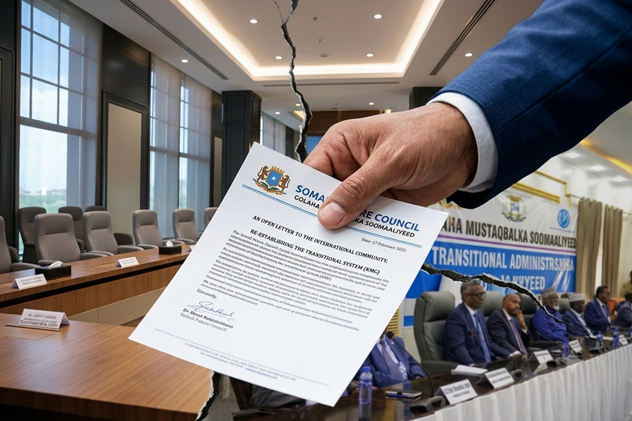
On July 27, the Somali Future Council issued an open letter directly addressed to international diplomats stationed at the Halane compound in Mogadishu and to the leaders of AUSSOM troop-contributing nations. The Council—which comprises Puntland, Jubaland, and the bulk of the federal opposition—timed the move deliberately for the lead-up to the Kampala Summit on July 31.
The letter’s central premise rested on two expired deadlines: the constitutional term of Parliament ended on April 14, and the presidential mandate of Hassan Sheikh Mohamud expired on May 15. From these dates, the opposition concluded that the Federal Government had lost all constitutional legitimacy and that Somalia must revert to a Transitional Government system.
However, rather than gaining traction, this move has exposed the opposition’s strategic isolation. The letter demanded three things: (1) that AUSSOM security support be conditioned on an inclusive political agreement rather than backing one side; (2) the formation of an inclusive Transitional Council to manage constitutional review and elections; and (3) a clear statement that they were not demanding the withdrawal of foreign troops, but rather wanted operations grounded in consensus.
What the opposition failed to anticipate was the international community’s sharp rejection of their core demand—the return to a TFG system.
Historical Precedent: Why the TFG System Must Never Return
To understand the danger of the opposition’s demand, one must examine the four stages of Somalia’s Transitional Governments between 2000 and 2012:
| Phase | What Happened | Why It Mattered |
|---|---|---|
| 2000–2003 | Arta Process created the first internationally recognized transitional government under President Abdiqasim Salad Hassan. | Marked the beginning of Somalia’s internationally backed state-building efforts after nearly a decade without a central government. |
| 2004–2008 | Mbagathi Conference established the Transitional Federal Government under President Abdullahi Yusuf Ahmed. | Introduced federalism as the framework for rebuilding the Somali state, although the government lacked territorial control. |
| 2009–2012 | National Reconciliation Government under President Sharif Sheikh Ahmed broadened political inclusion while AMISOM helped secure Mogadishu. | Shifted the balance against Al-Shabaab and created conditions for ending the transitional era. |
| 2011–2012 | Roadmap Process culminated in the Provisional Constitution and the inauguration of Somalia’s first post-transition Federal Government. | Officially ended the transitional period and laid the constitutional foundation for modern federal institutions. |
The TFG era was defined by a single reality: Somalia was not a sovereign state. Decisions were made in foreign capitals—Djibouti, Nairobi, and Addis Ababa. The national budget was managed by international donors. The arms embargo prevented the creation of a real national army. Warlords and clan factions held more power than ministers.
The opposition’s call to return to this system represents a willful erasure of everything achieved since September 2012—debt relief, the Provisional Constitution, the establishment of Federal Member States, and the creation of the Somali National Army (SNA).
How the Opposition Is Losing Support
Far from isolating Villa Somalia, the opposition’s campaign has triggered a series of setbacks that reveal their weakening position:
1. The International Community’s Rejection (Halane, July–August)
Diplomats at Halane responded to the July 27 letter with unprecedented pressure on the opposition and the government alike to reach a political agreement before the end of August 2026. Crucially, they explicitly rejected the return to a transitional system. Instead, they endorsed the Turkey-mediated talks (which produced a July 8 meeting facilitated by Turkish intelligence, MİT) as the only viable path forward.
The international community made its position clear: revert to KMG, and financial aid will be suspended. This is a catastrophic blow to the opposition’s strategy, which relied on using Western and African donor leverage to force Mogadishu into a corner.
2. The Split in Regional Administrations
The opposition’s claim to represent a unified front has collapsed under the weight of political reality. On one side stand the opposition-led federal states of Puntland under President Said Abdullahi Deni and Jubaland under President Ahmed Mohamed Islam (Madoobe). These two administrations have positioned themselves at the forefront of the Somali Future Council’s demands, insisting that President Hassan Sheikh Mohamud’s term expired on May 15, and that the country must therefore transition to a Transitional Council to prevent what they describe as constitutional overreach and power consolidation in Mogadishu. Deni has argued that Hassan Sheikh led the country into a dark path and that the Transitional Council represents the only safeguard against one-sided constitutional amendments. Madoobe has similarly rejected what he terms excessive centralization, warning that without an inclusive political agreement, the country faces collapse.
On the other side, the pro-Federal Government camp comprises three critical federal member states: South West, Galmudug, and Hirshabelle. The leaders of these administrations have publicly and unequivocally rejected the Transitional Council proposal, characterizing it as a destructive attempt to drag the nation back into regression and chaos. They have opted instead to implement the official election timetable issued by the Federal Government, viewing the existing constitutional framework as the only legitimate path forward. Their defection from the opposition narrative is politically decisive. Without a unified regional front, Puntland and Jubaland are increasingly isolated, appearing not as defenders of federalism but as factions willing to burn the federal house down because they no longer control its keys.
3. The Failed Economic Argument
The opposition’s warning that AUSSOM funding should be tied to political agreement has backfired. By threatening to condition security support on a return to TFG, they have alarmed the very international donors they sought to mobilize. The IMF, World Bank, and bilateral partners have invested heavily in Somalia’s HIPC debt relief completion and institutional reform. A return to TFG would void these agreements because a transitional administration cannot sign binding financial contracts.
The donors’ response—agreement by August 2026 or aid suspension—is directed at both sides, but it hurts the opposition more. The Federal Government can claim it is following a constitutional roadmap; the opposition must explain why they are willing to trigger an economic crisis to secure power.
4. The Security Paradox
The opposition’s July 27 letter explicitly stated they were not demanding troop withdrawal. This was a tactical retreat. They recognize that calling for AMISOM/AUSSOM withdrawal would alienate them completely from Western security partners. Yet by demanding that military operations be “grounded in consensus,” they are essentially asking foreign forces to stop supporting government offensives against Al-Shabaab until a political deal is reached.
Security analysts in Mogadishu have warned that this creates a window of opportunity for Al-Shabaab. Any pause in offensive operations—justified by opposition demands for “inclusive governance”—allows the insurgency to regroup. The Somali National Army, which has grown to tens of thousands of troops and depends on coordinated AUSSOM support, would see its command structure paralyzed by political infighting.
The opposition is therefore caught in a trap: they cannot demand troop withdrawal without losing international support, but their demand for “consensus-based operations” is functionally indistinguishable from a combat pause that benefits the enemy.
The Four Pillars of Destruction: What TFG Return Would Mean
If the opposition were to succeed—and all evidence suggests they are failing—the damage would be comprehensive:
1. Sovereignty: From State to Ward
A return to TFG means Somalia ceases to be a sovereign actor. Decisions on security, elections, and the economy would revert to Halane, the UN, and donor capitals. The very concept of a Somali government negotiating as an equal in the UN General Assembly or the African Union would evaporate. After 14 years of rebuilding international standing—culminating in debt relief and diplomatic recognition—the country would once again be an international protectorate.
2. Economy: Collapse of the HIPC Gains
Somalia’s debt relief under the Heavily Indebted Poor Countries initiative was contingent on having a recognized, constitutional government with stable institutions. A Transitional Council is not a government; it is a negotiating body without legal standing. The IMF and World Bank would suspend programs. Infrastructure projects would halt. The Somali shilling would face catastrophic devaluation as investors flee.
3. Security: The Army Disintegrates
The Somali National Army (SNA) was built under the assumption of a permanent federal state with a defense ministry, a chain of command, and international training partnerships. A TFG system removes the constitutional foundation for national defense. Clan factions would reclaim authority over armed units. The arms embargo, lifted because Somalia had a recognized government, would likely be reimposed by the Security Council on the grounds that weapons could flow to militias.
4. Federalism: The End of the Federal Experiment
The TFG charter had no regional states. Power was either centralized in Mogadishu or fragmented among warlords. The opposition’s demand for a Transitional Council ignores that Puntland, Jubaland, South West, Galmudug, and Hirshabelle exist because of the 2012 Provisional Constitution. A TFG system dissolves their constitutional status, returning Somalia to a winner-take-all struggle for Mogadishu that can only end in renewed civil conflict.
The Confrontation That Is Exposing the Opposition
The confrontation between the Federal Government and the opposition is systematically revealing which side truly holds the weaker hand. The Federal Government retains the institutional continuity of Villa Somalia, giving it the administrative and symbolic authority of the seat of government. It enjoys the active support of three federal member states—South West, Galmudug, and Hirshabelle—which together represent a significant portion of the country’s territory and population.
Furthermore, the international community’s explicit rejection of the TFG return has strengthened Mogadishu’s position, allowing it to frame itself as the defender of constitutional order and international partnerships. The government also maintains control over the official election timeline, presenting itself as the party following established legal procedures rather than manufacturing crises.
The opposition, by contrast, finds itself in an increasingly precarious position. It retains the backing of only two regional states, Puntland and Jubaland, and even this alliance is strained by the growing perception that their demands serve partisan rather than national interests. Their call for a return to transitional rule has been discredited not only by the Federal Government but by the very international actors they had hoped to mobilize.
The July 8, 2026 Turkey-mediated talks and the August 2026 deadline imposed by Halane have placed the opposition in an impossible bind: either they negotiate within the existing constitutional framework and accept the current political reality, or they expose themselves as obstructionists willing to trigger the suspension of international aid and the collapse of security cooperation purely for temporary political gain. As the deadline approaches, the opposition’s inability to offer a viable alternative to the existing federal structure—other than dismantling it—has left them politically exposed and strategically cornered.
Conclusion
The campaign to return Somalia to the Transitional Government system is not a strategy for reform; it is an act of political self-sabotage on a national scale. The opposition’s July 27, 2026 open letter, rather than isolating the Federal Government, has isolated its own authors. The international community has rejected the TFG option. Three federal member states have rejected it. The economic and security costs have been laid bare.
The historical record is unambiguous: between 2000 and 2012, Somalia was a ward of the international community, unable to govern itself, unable to secure itself, and unable to develop. The 14 years since 2012 have given the country a constitution, a federal structure, a national army, and debt relief. To throw this away for temporary political advantage is not statesmanship. It is the definition of self-sabotage—and the Somali people, not just the politicians, will bear the cost.