
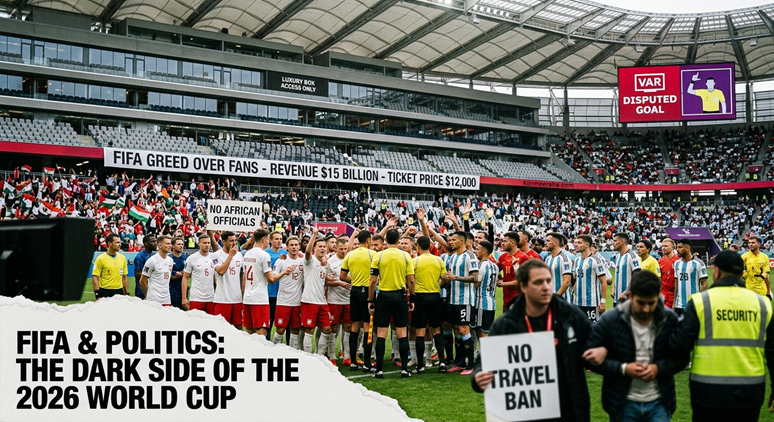
As the final whistle blew on the most financially lucrative FIFA Men’s World Cup in history—generating a staggering $15 billion in revenue—the on-field glory of Spain’s victory was deeply overshadowed by off-field controversies. From luxury-box FIFA excesses and the political weaponization of the tournament to systemic exclusions of African participants and explosive VAR disputes, the 2026 World Cup served as a lightning rod for corruption allegations and human rights concerns.
Here is a breakdown of the key flashpoints that defined a tumultuous tournament.
Sportswashing: A Tournament of Distraction
Even before kickoff, the 2026 World Cup was condemned as “sportswashing”—a vehicle for host nations, particularly the US, to burnish their image, project soft power, and deflect attention from aggressive immigration raids, controversial foreign military operations, and domestic unrest. The ongoing catastrophic situation in Gaza intensified these accusations to a fever pitch: critics decried the hypocrisy of celebrating “unity” while the US continued arming Israel’s offensive, and slammed FIFA’s blatant double standard for banning Russia over Ukraine while refusing to suspend Israel.
As the tournament unfolded, stadiums became unexpected platforms for protest, with fans from across the Global South flooding matches with Palestinian flags and anti-genocide chants, while the “Kick Israel Out of FIFA” campaigns erupted in host cities like Toronto. The allegations were sealed when FIFA President Gianni Infantino awarded the inaugural FIFA Peace Prize to President Trump—a move critics dismissed as explicit political cover for a leader at the helm of ongoing conflict.
Trump, Infantino, and the Trophy Ceremony Fiasco
The tournament’s closing ceremony was immediately marked by hostile optics. Former President Donald Trump was audibly booed by spectators as he walked onto the field alongside FIFA President Gianni Infantino for the postgame presentation.
Tension escalated when Infantino was seen physically trying to usher Trump away as he attempted to stand directly beside—and in front of—the Spanish squad while captain Rodri raised the trophy. The awkward moment perfectly captured the tense, transactional relationship between the host administration and soccer’s governing body.
The Political Chasm: Spain vs. Argentina
Beyond the tactical battle on the pitch, the final represented a clash of opposing worldviews. Spain’s collective playing style mirrored the progressive politics of Prime Minister Pedro Sanchez, who has advanced humane immigration policies, pushed green energy agendas, and even called for an investigation into Benjamin Netanyahu for war crimes related to the Gaza flotilla incidents.
In stark contrast, Argentina’s superstar-driven model—built entirely around Lionel Messi—reflected the extremist libertarian ideology of President Javier Milei, a fervent admirer of “zombie neoliberal capitalism.” Milei’s open alignment with Netanyahu further highlighted the deep geopolitical rift embodied by the two finalists, making the final a proxy battle over the very future of global governance.
FIFA’s “Too Big to Fail” Greed Machine
While FIFA initially projected $1 billion in revenue for the tournament, the final haul ballooned to a record $15 billion. Critics charge that this windfall was achieved by pricing out the working class. According to SeatGeek, the average ticket price for the final was $12,751, while sideline seats sold for as much as $1 million a piece.
This has led to accusations that FIFA is actively transforming “the people’s game into a game for the 1%,” catering to luxury boxes and backroom deal-making. The organization’s unchecked financial growth draws troubling parallels to the 2008 banking crisis, with critics warning that a “too big to fail” mentality creates a dangerous recipe for corruption and upward wealth transfer.
Trump’s Direct Political Interference in FIFA Matches
One of the most explosive allegations involves the rescinded red card issued to US forward Folarin Balogun during the match against Bosnia. Reports indicate that President Trump personally called his “BFF” Gianni Infantino to pressure him into overturning the penalty.
The intervention was successful—a move that drew immediate accusations of hypocrisy. When nations like Pakistan, Kenya, or Zimbabwe have politically interfered with FIFA, they face immediate suspension. Donald Trump, however, faced no consequences, highlighting the unequal power dynamics within the organization and reinforcing the perception that FIFA bends its rules to accommodate Western political interests.
Visa Denials and Systemic Exclusion of African Participants
The tournament was further tarnished by US immigration policies that disproportionately targeted African officials and supporters. Somali referee Omar Artan, who had recently been named CAF’s 2025 Men’s Official of the Year, was denied entry despite holding a valid diplomatic passport and visa, ultimately enduring an 11-hour interrogation before being deported to Turkey. Furthermore, supporters and delegates from Ivory Coast, Senegal, and other African nations faced severe travel restrictions that prevented them from attending, sparking widespread boycott debates across the continent over host nation discrimination.
Mistreatment of the Iranian Team
The Iranian national team faced systematic logistical hurdles that many interpreted as deliberate sabotage. The Iranian squad was forced to commute from Tijuana, Mexico, to their matches in Seattle and Los Angeles—a grueling cross-border journey that severely disrupted their preparation and recovery.
Hostility reached a fever pitch when Department of Homeland Security head Mark Wayne Mullen allegedly remarked that he “danced a happy dance” following Iran’s elimination—a comment widely interpreted as an extension of the administration’s broader antagonism toward Tehran, with which the US has been engaged in open conflict since February 28, 2026.
Egyptian Team’s VAR Grievance and Allegations of Bias
Egypt’s round-of-16 elimination at the hands of Argentina sparked explosive controversy. After taking a commanding 2-0 lead, Egypt lost 2-3, but the turning point came when VAR controversially canceled what would have been Egypt’s third goal, citing a minor foul in the buildup.
The Egyptian Football Association filed a formal complaint with FIFA, citing “serious errors” and “double standards” by French referee François Letexier. Egypt’s coach argued that his players had been “robbed,” alleging that Lionel Messi was protected from bookings while Egyptian players received cards for similar fouls. The incident fueled broader accusations that VAR favors traditional football powers over underdog nations.
VAR Issues and Technical Grievances
While the global soccer community grappled with the usual VAR (Video Assistant Referee) controversies—including disputed offside calls, handball decisions, and the subjective nature of “clear and obvious errors”—these technical grievances were largely drowned out by the political firestorms. However, the Egypt-Argentina match stood out as a flashpoint that reignited the debate over whether VAR favors commercial giants over underdog nations. Overall, VAR inconsistencies took a backseat this tournament as geopolitical and financial scandals dominated the headlines.
State Propaganda and the ICE Deportation Surge
The US Department of Homeland Security’s official X (formerly Twitter) feed sparked international outrage by posting a message reading: “One nation, one homeland, one team.” Critics drew direct parallels to Nazi propaganda from the 1940s, specifically the slogan “One people, one realm, one leader.” The tweet was condemned for using US men’s national team players as a political backdrop for anti-immigrant sentiment.
Concurrently, Immigration and Customs Enforcement (ICE) ramped up its deportation machine during the tournament. ICE detentions surged to an average of 2,000 per day—nearly double the rate before the tournament began. Many observers argued that the World Cup served as a “smokescreen,” deflecting public attention away from the administration’s brutal immigration crackdown.
Conclusion
The 2026 World Cup will be remembered not just for Spain’s historic double (holding both the men’s and women’s trophies), but for its role as a stage for unchecked FIFA greed, authoritarian political interference, systemic exclusion of African officials and fans, allegations of biased officiating against African teams like Egypt, and the weaponization of a global sporting event for domestic political gain.
The tournament ultimately failed to “wash” the image of its host or its governing body; instead, it laid bare the deep fractures of our era—from Gaza to immigration detention centers to VAR booths—proving that football, for all its unifying rhetoric, remains inextricably tangled in the world’s most intractable conflicts. With the United States set to host the 2028 Summer Olympics in Los Angeles, the world will be watching closely to see if these patterns of exploitation and division continue—or if the spirit of the “people’s game” can truly be reclaimed.