
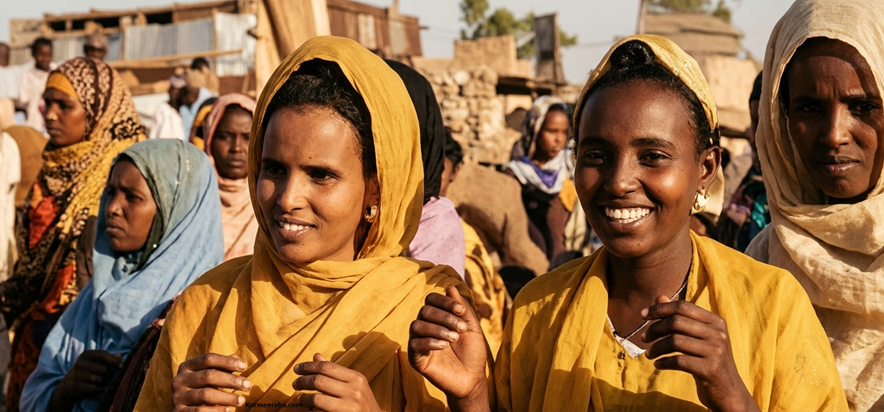
My grandmother prayed five times a day. She fasted every Ramadan, gave to the needy, and could recite long passages of the Qur’an from memory. She also walked through the markets of Mogadishu in a bright wrap-around dress (guntiino), her shoulders covered by a shawl (garbasaar) and a headscarf (shash) draped loosely over her hair. Nobody questioned her faith. Nobody would have thought to.
A thousand years of our own dress
Somali women’s traditional clothing grew organically out of the life they lived. The guntiino is a long piece of cloth tied over one shoulder and wrapped around the waist. It was the everyday dress, often made of white cotton or striped alindi cloth. For weddings and Eid, women wore the dirac, a light, flowing voile dress. Married women added the shash headscarf and the garbasaar shawl. Historically, the saddex-qayd in the north and the guntiino in the south perfectly suited the movement and hard work of pastoral life.
“None of this was ‘un-Islamic.’ It was simply Somali.”
Generations of women who wore these clothes kept the faith, raised devout children, and filled the mosques during Ramadan.
In the cities, especially after independence in 1960, women’s dress became even more varied. Under the Barre government (1969–1991), women could dress as they chose, and most women in the cities did not wear the strict hijab. Photographs of Mogadishu in the 1960s and 1970s show women in skirts, short sleeves, and modern hairstyles. It was a cosmopolitan city, and its people were still deeply Muslim.
What changed in 1991
When the state collapsed in 1991, it did not just take away the government; it took away security, schools, and the shared civic life that had protected cultural diversity. Into that vacuum came new religious movements, many funded from the Gulf.
Before the early 1990s, Somali women wore their veils lightly. That changed when the full-body veil arrived alongside the more rigid Wahhabism imported from Saudi Arabia.
The change happened fast. After the civil war began, most women in Mogadishu started wearing the strict hijab and jilbaab for the first time, and those who refused were often harassed. Crucially, women began dressing more conservatively in the 1990s partly to protect themselves from the rampant sexual violence of the war, and partly because Salafi influence was rapidly growing.
“The jilbaab did not spread because Somalis suddenly ‘discovered’ Islam. We had carried it for a millennium.”
It spread out of fear, through foreign money, and in a vacuum where armed men and imported preachers decided what was proper. Groups such as Al-Itihaad al-Islamiya, and later Al-Shabaab, then enforced those standards by the sword.
Two easy stories to avoid
Two simple narratives need to be rejected here.
The first, held by hardliners, is that Somalis before 1991 were ignorant or lax Muslims who had to be “corrected.” This insults our grandparents, our scholars, and the Sufi orders that kept Islam alive across the Horn of Africa for centuries.
The second story is just as misleading. It claims that strict Islamic dress is entirely foreign to Somalis and that every headscarf is a sign of “Arabization.” In reality, Islamic dress practices have deep roots in Somali society. Covering the hair with a shash or garbasaar was common long before 1991. Many women today choose the jilbaab freely and find deep meaning in it. That choice deserves absolute respect.
“The real issue is not one garment against another. It is choice against coercion, and Somali tradition against a single, imported template.”
Reclaiming the memory
A nation that forgets its own past becomes easy to reshape. When a young woman in Mogadishu today is told that her grandmother’s guntiino is shameful, she is being cut off from her own heritage. She is also being told that faith is something worn on the body, rather than held in the heart and shown through conduct.
Somalis do not need anyone’s permission to be Muslim. We have been Muslim since the early centuries of Islam, long before oil money, satellite preachers, or militias. Our modesty was expressed in our own cloth, our own colors, and our own customs.
Rebuilding Somalia must mean rebuilding that confidence, too. Schools, media, and religious leaders should teach the full history: Somali Islam was always sincere, and it was never measured by the length of a woman’s garment. Women should be free to wear the jilbaab, the dirac, or the guntiino without fear of harassment from anyone.
My grandmother’s faith was never in her fabric. Neither is ours.
Related
- Beyond the Pants: Will Minister Khadija’s Controversy Spark a Wider Debate? (September 25, 2022)
- Why the 1969 Revolution Still Matters Today (October 21, 2022)