
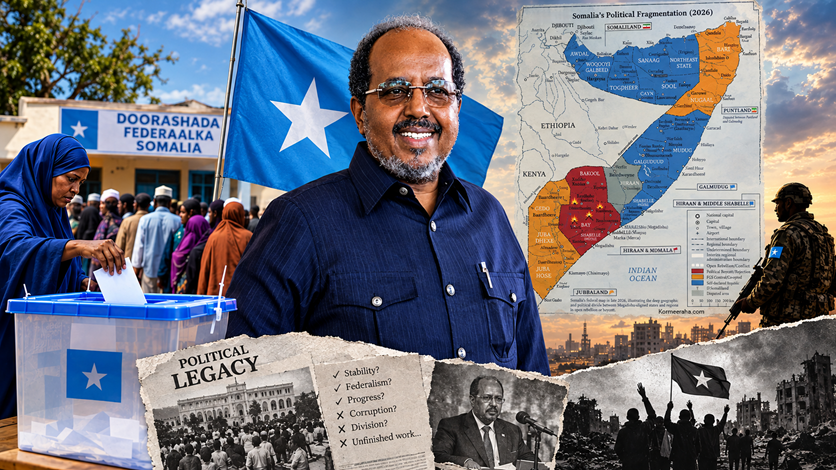
The overwhelming majority of Somalis reject the naïve sentiment that political loyalty should replace sound judgment. President Hassan Sheikh Mohamud (HSM) still has critical choices to make, and the decisions he makes today will dictate how history remembers his presidency. Ultimately, governing a nation is not an exercise in solitary authority, regardless of how convinced a president might be of his own indispensability.
Decoding the President’s Political Calculations
There are three possible explanations for HSM’s current political strategy.
First, a “final term” mindset. If this is his last time in office, he may feel free to act without electoral consequences. But having little to lose politically is not the same as having the wisdom to govern. A final term should cement institutional strength and national security—not serve as an excuse to experiment with Somalia’s future.
Second, the pursuit of another term. If he intends to run again, preserving the status quo seems politically convenient. Yet, Somalia cannot sacrifice institutional progress for personal political survival.
“The presidency is not a private investment whose returns must be guaranteed before the next election.”
Third, a genuine desire to leave a legacy. While wanting to be remembered is understandable, a legacy cannot be manufactured through political slogans or the illusion that the state depends on one man. It must be built through competent appointments, effective institutions, and lasting security.
The Micromanagement Trap: The Illusion of the One-Man Show
Perhaps HSM is concerned that, without personally controlling every major decision, his achievements might be credited to others. If so, this reflects a serious misunderstanding of leadership. A successful president should take pride in appointing seasoned professionals who exceed expectations.
If the president must perform everyone else’s duties, who exactly is running the country?
“Ministers cannot be treated as mere decorative furniture in the Council of Ministers.”
True leadership requires trusting and empowering your team.
Competence Over Cronyism: Building a Functional Cabinet
Experience matters. Governing Somalia requires more than ambition, political connections, and confidence in one’s own judgment. It demands seasoned, independent-minded officials who understand their responsibilities and can deliver results. While untested appointments may satisfy political allies, they cannot guarantee an effective cabinet, a secure country, or a sustainable economy.
Nobody wants a dysfunctional cabinet that weakens national security, undermines economic development, or pushes Somalia into unnecessary confrontation with the international community. Somalia already faces enough challenges without adding self-inflicted political crises to the list.
The people who work for a president ultimately shape his presidency. His cabinet is not simply a collection of names on paper; it is the machinery through which his policies become reality. If that machinery fails, the president cannot escape responsibility by blaming the very officials he appointed. A captain cannot claim credit for reaching port while blaming the entire crew when the ship sinks.
The Threat to Federalism and Electoral Integrity
What is the point of “one person, one vote” if the electoral framework undermines federalism? Somalia’s new Constitution risks stripping federal member states of their autonomy, regional constitutions, and independent electoral commissions, disproportionately concentrating power in Mogadishu. Furthermore, logistical realities threaten to marginalize vast regions: if ballot boxes are confined to only one or two locations, northern candidates may be forced to campaign remotely, raising legitimate fears that the voting process could be centralized and detached from local constituencies.
“Democracy in name, but centralization by design, with the principles of federalism quietly buried in the fine print.”
True Leadership: Accountability, Humility, and the National Interest
President HSM should welcome informed criticism and carefully consider sound advice, even when it comes from people who disagree with him politically.
“Leadership means listening before deciding—not confusing disagreement with disloyalty.”
Nevertheless, the final decision must be his, and so must the responsibility for its consequences.
The principal objective for Somalia’s future must remain peace, stability, and security. The goal is a country where institutions function, merit-based officials serve the public, and political disagreements do not threaten national unity. Those priorities must come before individual ambitions, personal rivalries, or the narrow interests of political circles.
Ultimately, the Somali people—not political insiders—must determine whether this presidency has delivered meaningful progress. Somalia will survive its current political challenges, just as it has survived many before. Those who expect the country to collapse under pressure may be disappointed.
A Final Word: Earning a Lasting Legacy
President HSM still has an opportunity to leave a positive legacy, and he must use it wisely. Somalia needs an effective, collaborative government, not one built around the flawed assumption that one man can do everything. Even presidents need skilled colleagues—and, occasionally, the humility to listen.
Related
- Fractured Federation: Somalia’s Political Polarization and the 2027 Electoral Crisis (October 19, 2026)
- The Politics of Dispossession: Hassan Sheikh’s Predatory Legacy (September 6, 2026)