

As Somalia remains deadlocked in a pivotal but uncertain electoral timetable, the administration of President Hassan Sheikh Mohamud faces a defining moment that will shape its historical legacy. While throughout this mandate—much like his previous term from 2012 to 2017—his management of the country has faced persistent criticism for inefficiency and corruption, the current trajectory suggests something far more alarming is taking shape. The administration appears to be constructing a legacy defined not by development or national reconciliation, but by a calculated and systematic disregard for the Somali public. The evidence emerging from Mogadishu indicates that Hassan Sheikh’s government is on track to be remembered as the most harmful and reviled administration for the Somali people, cynically prioritizing the interests of a wealthy donor elite over the basic rights and livelihoods of its citizens.
A Departure from Democratic Norms
In a functioning democracy, the end of a term is typically a period of accountability and outreach, where leaders seek to curry favor with the electorate. The Hassan Sheikh administration has discarded this principle. The electoral system, already rife with corruption, has become a tool of the highest bidder. Public opinion is not merely ignored; it is actively suppressed. The administration’s recent actions indicate a belief that the public has no legitimate say in its quest for another term, and that only the influential donors who stand to benefit from government largesse are worthy of consideration. This marks a dangerous evolution from mere unpopularity to a fundamental breakdown of the social contract.
The Weaponization of Displacement
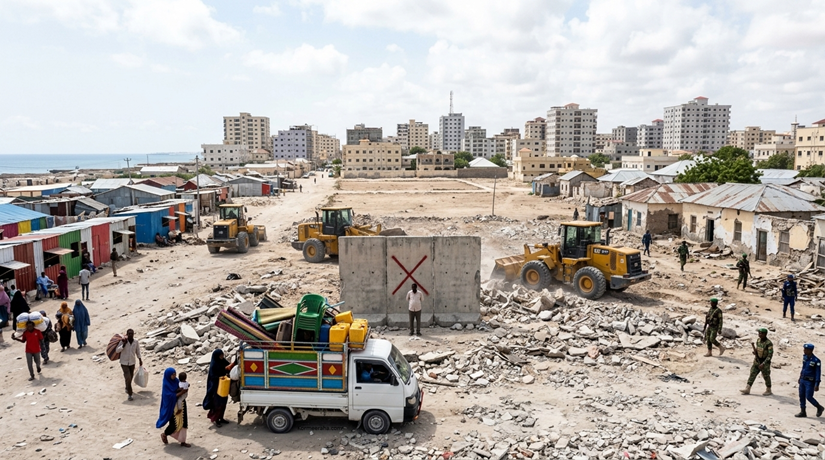
The core of this critique lies in the government’s campaign of mass evictions and land reclamation in Mogadishu. While the stated goal of recovering public land for development is superficially valid, the execution tells a story of institutionalized land-grabbing. The administration has targeted low-income families and internally displaced persons (IDPs) who have occupied these lands for over thirty years, since the collapse of the state in 1991. However, the pattern of enforcement, the targeting of specific wealthy neighborhoods, and the alleged transfer of these lands to powerful real estate developers for luxury apartments reveal a darker motivation.
Institutionalized Greed and Extortion
The government’s actions are not simply insensitive; they are predatory. Reports of residents being asked for exorbitant fees—between $15,000 and $20,000—to legitimize their land tenure are a damning indictment of the state’s intentions. These sums are deliberately placed far beyond the means of vulnerable families, effectively weaponizing the legal system to force them out. The judiciary, which should serve as a check on executive power, has been compromised, with state authorities and wealthy investors holding a significant advantage in securing eviction warrants. For the average Somali, the court system offers little more than a costly and corrupt barrier to justice.
A Sharp Contrast with the Past
A comparative look at the previous administration under President Farmaajo provides stark context. While the Farmaajo government faced significant criticism for its heavy-handed clearance of informal settlements, its operations were largely confined to recovering official state infrastructure—military barracks, hospitals, and administrative buildings. Rarely was it accused of transferring public assets to private commercial entities.
Under Hassan Sheikh, the strategy has shifted dramatically. The campaign has expanded into vast residential areas, driven by “capital modernization” and “urban beautification.” The beneficiaries are no longer the state, but powerful business entities. This privatization of public land represents a fundamental shift from state-building to elite enrichment. The security escalations under Hassan Sheikh have reached unprecedented levels, including armed clashes in key districts and the formation of a unified opposition coalition, highlighting the deep political fallout of these policies.
A Forgotten People
Perhaps the most chilling aspect of this administration’s approach is its deliberate neglect of humanitarian accountability. Human Rights Watch has noted the government’s failure to establish a centralized registry for displaced families. By refusing to officially log the names and lost property of evicted families, the government effectively denies them any avenue for legal redress or compensation. International agencies and civil society groups have been forced to fill this void, tracking the plight of over 160,000 displaced individuals, while the state actively works to make them invisible.
A Legacy of Harm
While the Hassan Sheikh administration defends its actions as necessary for the modernization of the capital, the evidence points to a deliberate strategy to dispossess the poorest in favor of the powerful. The opposition’s “Hiil Shacab” (People’s Support) movement, which registered over 28,000 victims, demonstrates a significant public backlash, yet it has been met with violent crackdowns and cyber-attacks.
History will judge leaders not only by their intentions but by their impact on the most vulnerable. By all metrics—humanitarian impact, the subversion of the judiciary, the silencing of dissent, and the brazen corruption of the electoral process—the Hassan Sheikh administration is building a legacy of harm that dwarfs its predecessors. It is a stark warning of what happens when a government views its own people not as citizens to be served, but as obstacles to be removed.