
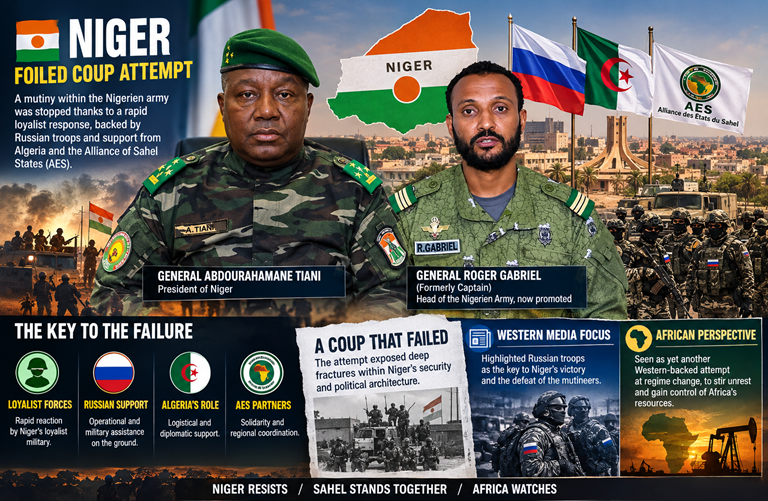
The recent foiled coup attempt in Niamey, the details of which were publicly exposed by Captain (now promoted to General) Roger Gabriel, has highlighted the deep fractures within Niger’s security and political architecture. This mutiny failed thanks to a rapid reaction by loyalist forces, decisively backed by the operational support of Russian troops, alongside crucial logistical and diplomatic assistance from Algeria and partners from the Alliance of Sahel States (AES). Beyond the military facts, this event has triggered a major information war, revealing a radical divergence in geopolitical narratives.
The Geopolitical Interests of the “Status Quo Ante”
To understand the suspicions surrounding this coup attempt, it is necessary to identify the actors who have suffered major strategic losses since General Abdourahamane Tiani took power in July 2023. A return to the previous situation, with Niger aligned with ECOWAS and as a military partner of the West, would present considerable advantages for several capitals.
France is the actor that has most visibly lost out. The departure of French troops deprived Paris of its last major rear base in the central Sahel, while compromising the security of uranium supplies for its nuclear industry. The United States had to evacuate its Agadez drone base, a crucial intelligence hub for AFRICOM, creating a surveillance vacuum in an area of intense jihadist activity.
The European Union, for its part, lost a key partner in its policy to control migration flows to the Mediterranean. Finally, coastal ECOWAS states such as Nigeria, Benin, and Ivory Coast have a vested interest in Niger becoming a stable “buffer” state once again, preventing the AES from consolidating its grip and exporting its sovereign rupture model to the Gulf of Guinea. This convergence of interests creates fertile ground for suspicions of external complicity.
The African Perception: A Neocolonial Plot in the Background
In the African public sphere, and particularly among AES supporters, the reading of events is unequivocal. General Gabriel’s revelations, mentioning contacts with the family of former President Mohamed Bazoum and cross-border ramifications, are perceived as confirmation of a well-rehearsed scenario. For a large part of public opinion, this mutiny is not a simple internal conflict, but a hybrid operation supported, directly or indirectly, by Western powers eager to regain control.
This narrative is rooted in a historical memory marked by foreign interference. It is a dynamic that Mali, a fellow AES member, recently experienced. Consequently, the overthrow of the regime is seen as an attempt to punish Niamey for its sovereign audacity: the nationalization of resources, the rejection of what are deemed unequal defense agreements, and the pivot toward new partners (Russia, Turkey, China). In this paradigm, sowing discord within the Nigerien army is a proven method to weaken the state from within and ultimately seize or secure access to the country’s mineral and energy wealth. The rapid promotion of Captain Gabriel is thus celebrated not only as a well-deserved reward but as a symbol of patriotic resistance against neocolonial destabilization attempts.
The Western Media Lens: The Russian Smokescreen
This is where the narrative divergence becomes most striking. While accusations of Western and regional interference circulate massively on pan-African media and social networks, the coverage by major Western news agencies and Western-influenced press outlets has adopted a radically different angle.
Instead of thoroughly investigating the allegations of compromised pro-Western networks or neighboring countries in the preparation of the putsch, Western media have massively focused their attention on a single element: the role of Russian troops (often associated with the former Wagner group, now Africa Corps) in helping the Nigerien army regain control of the mutinous elements. Headlines emphasize that it was Russian elements, alongside loyalist forces, who neutralized the mutineers and secured the presidential palace.
This focus is not incidental; it serves a dual strategic function for the Western narrative. First, it delegitimizes the Tiani regime by painting it not as a popular sovereignist government, but as a Moscow puppet, a substitute regime installed or maintained by a hostile foreign power. Second, and most crucially, this narrative acts as a smokescreen. By demonizing the Russian presence and making it the center of gravity of the event, Western media divert attention from the embarrassing accusations weighing on their own spheres of influence. This allows them to avoid answering the fundamental question raised by African public opinion: why were networks linked to the former regime and neighboring countries allied with the West involved in this overthrow attempt?
AES-Algeria-Russia Solidarity as a New Paradigm
The failure of the coup, made possible by this triangular support system (Russian, Algerian, and AES), marks a turning point. It demonstrates that Niger is no longer isolated and can rely on an alternative security architecture. Algeria, concerned about the stability of its southern border and its gas interests, provided vital diplomatic and logistical backing. The AES showed concrete military solidarity, while Russian support offered the immediate operational capability to lock down the situation on the ground. This synergy invalidated the calculations of those who hoped for a rapid collapse of the regime.
Conclusion
The foiled coup attempt in Niger is a revealing indicator of the tectonic tensions shaking the Sahel. On one side, traditional powers dreaming of a return to the status quo ante to preserve their strategic and economic interests. On the other, a regime and a population determined to break what they consider neocolonial chains, even at the cost of temporary diplomatic isolation, and now fortified by a new foundation of alliances.
As long as Western media persist in filtering these crises solely through the lens of rivalry with Russia, without questioning the historical responsibilities and actual motivations of regional actors, the gap in understanding will only widen. In this climate of mutual distrust, where each side accuses the other of manipulation, the risk of new destabilization attempts in Niger and across the AES will remain a permanent threat. However, the failure of this latest attempt proves that the balance of power in the Sahel has definitively changed.