
Just two months ago, Niger was a geographical footnote—a vast, arid country on the edge of the Sahara known more for its uranium mines than its geopolitical clout. Today, it is the world’s newest conflict theater. On July 26, 2023, Niger’s presidential guard seized power, detaining democratically elected President Mohamed Bazoum. Two days later, on national television, the head of the guard declared himself the new leader of the “National Council for the Safeguarding of the Homeland” (CNSP). His mission: to stabilize a nation plagued by widespread insecurity.
But as the coup enters its second month, the world is not just watching; it is choosing sides. From the air-conditioned offices of Paris to the bustling markets of Lagos, the narrative of Niger’s crisis reveals a deep fracture between the West and a rising generation of African anti-imperialists.
The Man in the Mirror: Who is General Tiani?
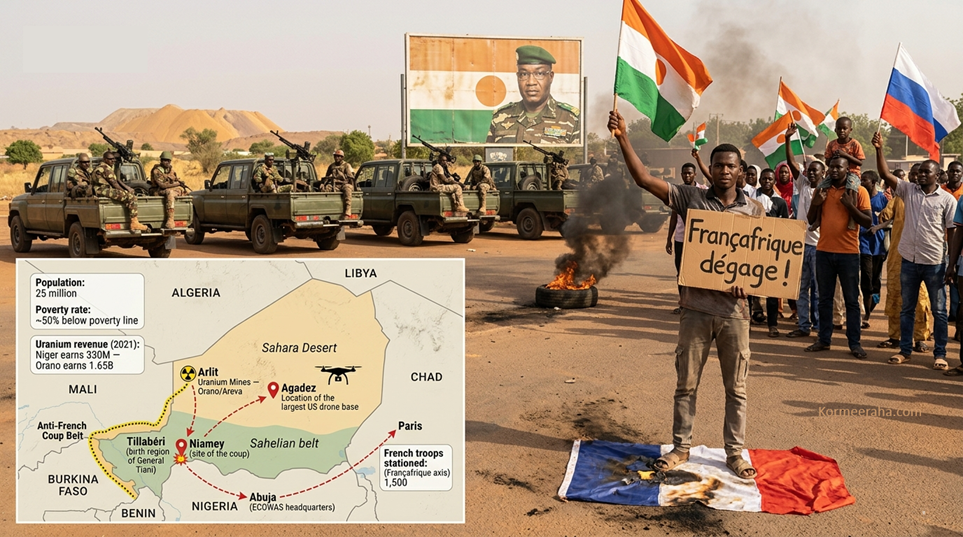
The face of the new Niger is General Abdourahamane Tiani (also spelled Tchiani), a career soldier from the Tillabéri region. Appointed head of the Presidential Guard in 2011 by former President Mahamadou Issoufou, Tiani has been the silent sentinel of Niamey’s power palace for over a decade.
But Tiani’s identity goes beyond his military resume. He hails from the Hausa nation—a vast, trans-border ethnic group that dominates northern Nigeria and scatters across the Sahel from Senegal to Eritrea. This heritage is critical. While Western diplomats scramble, the traditional Sokoto leader in northwestern Nigeria (the heart of Hausaland) has become a key mediator, leveraging kinship ties that ignore colonial borders. Even the Hausa diaspora in Saudi Arabia—despite Riyadh’s official opposition to Bazoum’s ouster—continues to invest heavily in their ancestral lands, lending the coup a layer of ethnic and economic legitimacy that the West struggles to counter.
The West’s Dilemma: Threats, Hypocrisy, and the Ghost of Françafrique
The response to the coup has been swift and aggressive. The Economic Community of West African States (ECOWAS), backed by the United States’ AFRICOM and outfitted by NATO countries, has threatened military intervention. On August 10, during an emergency summit in Abuja, ECOWAS leaders validated a project for armed intervention to reinstate President Bazoum.
France gave the junta an ultimatum: reinstate Bazoum by Sunday, or face war. Paris has 1,500 troops stationed in Niger—the last major bastion of its anti-jihadist operations after falling out with Mali, which forced French troops to relocate to what was considered “safe” Niger.
Yet the cracks in the Western alliance are showing. Observers note a bitter irony: The U.S. expressed deep concern over Bazoum’s food supply in his palace prison, a level of sympathy absent for Egypt’s democratically elected Mohamed Morsi. Furthermore, the same week as the Niger crisis, revelations surfaced about U.S. involvement in the ousting of Pakistan’s Prime Minister Imran Khan. As one commentator put it in late July, “The US is worried about one president’s meals while ignoring the democratic corpses left in its wake across three continents.”
The Tuareg Wildcard
With sanctions and war threats failing to break the revolution, Western intelligence is reportedly reactivating a former rebel from the Tuareg community. The irony is stark: Ousted President Bazoum himself hails from the Tuareg Arab community. By arming one faction of the Tuareg to fight the Hausa-led junta, critics argue France and the U.S. are replaying the destructive proxy wars that have scarred Libya and Mali.
The Coup Belt: France’s Unraveling Empire in West Africa
To understand the panic in Paris, one must look beyond Niger’s borders. Since 2020, a tidal wave of military takeovers has swept through France’s traditional sphere of influence. The list is staggering: Mali (August 2020 and May 2021), Chad (April 2021, following the death of Idriss Déby), Guinea (September 2021), Burkina Faso (January and September 2022), and now Niger (July 2023).
Each coup has chipped away at French military and political influence. Mali expelled French forces in 2022, forcing a humiliating retreat to Niger. Burkina Faso followed suit, suspending military agreements with Paris. But what truly frightens France and its allies is not merely the loss of compliant governments—it is the militant anti-French popular reaction that has erupted across the region.
In a coordinated show of defiance unprecedented since decolonization, the three neighboring Sahel countries—Mali, Burkina Faso, and Niger—have become the epicenter of an anti-French insurgency from below. Their streets are filled with crowds waving Russian flags, burning French passports, and demanding the closure of military bases. On August 8, 2023, Mali and Burkina Faso issued a joint statement warning that any military intervention in Niger would be considered a “declaration of war” against them as well. This is no longer a series of isolated putsches; it is a regional realignment.
The Uranium Factor: France’s Unspoken Red Line
Why does France care so much? Follow the yellowcake. Niger is a critical supplier of uranium for France’s nuclear power plants and military arsenal. State-owned Areva (now Orano) has a long, sordid history in the country, involving corruption cases and alleged complicity in past coups to secure illicit contracts.
For Paris, giving up this windfall is unthinkable. Yet analysts warn that a military conflict to retain Niger will only exacerbate the anti-French sentiment simmering in the former colonies. At the heart of the problem lies Françafrique, this opaque network of political, economic, and military ties that keeps the former colonies within Paris’s sphere of influence. As a Senegalese protester told Jeune Afrique in early August: “We find these neocolonial policies suffocating.”
The African Street vs. The African Union
While ECOWAS threatens war, the popular opinion on the streets of Niamey, Ouagadougou, and Bamako tells a different story. Thousands have rallied in support of the CNSP. This is not necessarily love for Moscow, but a clear rejection of Paris.
Crucially, Nigeria’s Senate has barred the government from participating in any military intervention. Without Abuja—the regional giant—chances that Senegal or Ivory Coast would lead the charge are slim to none. The AU Standby Forces, pushed by US AFRICOM, risk being seen as mercenaries doing NATO’s dirty work.
A Warning from History: Why the US Should Stay Clear
For the United States, Niger represents a strategic nightmare. It is home to the largest drone base in the region, vital for surveillance across the Sahel. Yet Washington faces a choice: disentangle from France’s toxic colonial baggage, or get bogged down.
The lesson of Vietnam hangs heavy. Like in Indochina, ignoring the deep need for African liberation leads only to quagmire. Furthermore, Western analysts admit that NATO’s 2011 destruction of Libya is the original sin that precipitated this moment—unleashing arms, mercenaries, and chaos across the Sahel.
The US has a track record of destabilizing Iraq, Syria, Afghanistan, Somalia, and Sudan. To add Niger to that list—to defend a “democratic” election marred by widespread fraud, violence, and abuse against opposition leaders—would be a bridge too far.
Conclusion: The Unraveling
As of mid-August 2023, the clock is ticking. The CNSP shows no sign of backing down. The economic sanctions are hurting, but the threat of invasion has only galvanized popular support across the “Coup Belt.” With Mali, Burkina Faso, and Niger now standing as a hostile anti-French bloc, Paris faces its most serious colonial crisis since the Algerian War. Whether this is the final gasp of Françafrique or the beginning of a wider Sahelian war, one thing is clear: Niger is no longer a footnote. It is the frontline.