

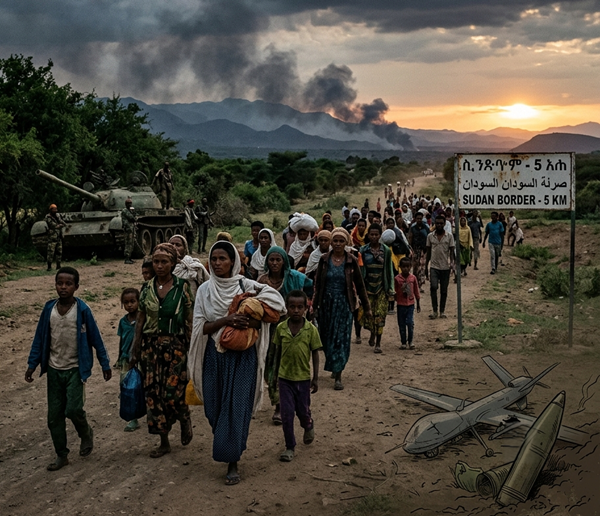
ADDIS ABABA/MEKELLE — The heavy fighting that erupted in western Tigray before dawn on Saturday has entered its fourth day, with the front line settling into an uneasy, fragile calm as of Tuesday morning. What began as a localized artillery exchange near the Sudanese border has solidified into the most significant breach of the November 2022 Pretoria Peace Agreement, raising the specter of a full-scale return to the devastating 2020–2022 civil war that claimed an estimated 600,000 lives. While direct clashes have subsided since Monday, observers describe the current atmosphere not as peace, but as a “cautious calm”—a dangerous lull in what may be the opening chapter of a renewed national conflict.
The Battle for Shererina and the “Army 70” Factor
Fighting broke out at approximately 6:00 a.m. on Saturday, August 1, around the village of Shererina in western Tigray, just miles from the Sudanese border. The engagement pitted Ethiopian National Defense Force (ENDF) troops—backed by heavy artillery, mechanized units, and drones—against a specialized TPLF unit known as “Army 70.”
The involvement of Army 70 represents a game-changing development in the region’s security architecture. Composed of several thousand well-equipped Tigray Defense Forces (TDF) combatants, the unit has been operating from rear bases in eastern Sudan. Reports indicate they have fought alongside the Sudanese Armed Forces (SAF) against the Rapid Support Forces (RSF) in Sudan’s own civil war. Ethiopia, maintaining a public posture of neutrality in Sudan’s conflict, has nonetheless been quietly providing logistical support to the RSF—a calculated double-game that now places Addis Ababa on the opposite side of its own Tigrayan adversaries in both theaters. This proxy entanglement means that the fighting in western Tigray is no longer an isolated border dispute but a dangerous convergence of two wars, with Ethiopian-supplied hardware potentially being used against forces that are themselves allied with the TPLF.
TPLF deputy leader Amanuel Assefa told AFP that federal forces had launched a “large-scale” offensive against the group’s positions. The violence continued through Sunday, with both sides exchanging heavy fire along the contested frontier. By Tuesday morning, reports indicated that direct clashes had paused, leaving observers to describe a “cautious calm.” However, the Ethiopian government has maintained official silence throughout, neither confirming nor denying the TPLF’s account of events, leaving the precise chain of command and responsibility for the initial strike unclear.
Analysis: The Post-Election Fallout and the Fracturing of a Nation
This latest eruption is not merely a failure of the Pretoria Accord; it is the violent aftershock of Prime Minister Abiy Ahmed’s political strategy since receiving the Nobel Peace Prize in 2019. While the international community lauded his initial overtures to Eritrea, his domestic policies have systematically dismantled the federalist safeguards that once kept Ethiopia’s diverse ethnic factions in check.
The June federal elections served as the definitive flashpoint. By orchestrating the cancellation of the TPLF’s party registration in May 2025—effectively disenfranchising a region of 6 million people—Abiy ensured that Tigray had no stake in the democratic process. The subsequent election results, which saw Abiy’s Prosperity Party consolidate power in urban centers while Tigray remained politically isolated, were viewed in Mekelle not as a democratic mandate, but as a formalized exclusion.
Analysts argue that the post-election period was never going to be stable. The decision to hold elections without Tigray’s dominant party was a calculated political purge disguised as democratic process. It demonstrated that Abiy’s vision of “unity” is conditional: it demands submission, not negotiation. For the TPLF leadership, the ballot box had been removed as a viable avenue for political expression, leaving the ammunition box as the only remaining tool for leverage.
Abiy’s rule has turned the country into a perpetual battlefield. His administration has successively militarized federalism, turning regional disputes—from the Amhara-Tigray border to the Oromo lowlands—into active war zones. The Pretoria deal was never a comprehensive peace; it was a tactical ceasefire that allowed the Prime Minister to reset his army while keeping Tigray economically starved and politically neutered. Saturday’s artillery fire is the sound of that ceasefire imploding under the weight of Addis Ababa’s post-election intransigence. By treating the June elections as a winner-takes-all contest rather than a national conversation, Abiy has ensured that the political settlement he sought has instead delivered a military escalation.
From Political Rift to Open War
Saturday’s clashes did not emerge in a vacuum. They represent the culmination of a slow-motion collapse of the 2022 agreement, which ended hostilities but left the conflict’s root causes unresolved.
The political rupture deepened in March 2025, when TPLF hardliners led by Chairman Debretsion Gebremichael ousted Getachew Reda, the interim president of Tigray who had been appointed by Prime Minister Abiy Ahmed. Getachew, now based in Addis Ababa, has since accused the TPLF of breaching the very deal he helped sign.
The new Tigray administration under Lieutenant General Tadesse Werede has taken a far more confrontational posture. Tensions spiked further in January 2026 when TPLF forces moved into the disputed Tselemti district, clashing with federal troops and Amhara militias before withdrawing under pressure. In recent months, the TPLF has intensified forced military recruitment, while state-run media in Addis Ababa launched a sustained campaign that many observers interpreted as laying the groundwork for military action.
Humanitarian Fallout and Regional Alliances
The renewed fighting has triggered an immediate humanitarian crisis. Over the past 48 hours, hundreds of civilians have fled across the border into Sudan, compounding an already dire situation in northern Ethiopia. The TPLF accuses Addis Ababa of maintaining a de facto blockade on cash, fuel, and aid, with experts warning that escalated hostilities could quickly plunge the region back into famine.
Tactically, the onset of the rainy season may have influenced the timing of the clashes, as the weather grounds the Ethiopian government’s drone fleet—a decisive advantage in previous engagements.
Strategically, the conflict is being reshaped by fluid regional alliances. Addis Ababa accuses the TPLF of forging a military pact with Eritrea and Sudanese army factions—a rapprochement dubbed Tsimdo that deeply alarms the federal government. TPLF Chairman Debretsion Gebremichael recently hinted at this expanded backing, stating, “We are not alone as we were in the past.”
In a striking internal shift, factions of the Tigray Peace Forces (TPF)—a breakaway militia previously backed by the federal government to fight the TPLF—have reportedly defected to join the TPLF against the national army, underscoring the fracturing nature of the conflict.
Failed Diplomacy and the Road Ahead
International efforts to prevent this scenario have proven unsuccessful. Diplomatic sources confirm that U.S. Ambassador to Ethiopia and African Union High Representative Olusegun Obasanjo traveled to Tigray in recent weeks to mediate, but those efforts failed to prevent Saturday’s outbreak of violence. UN High Commissioner for Human Rights Volker Türk had warned earlier this year that “both sides must step back from the brink,” but those warnings went unheeded.
For now, the guns have quieted in western Tigray—but with both sides fully mobilized, regional alliances entangled, and the rainy season reducing drone effectiveness, the lull may prove to be only the eye of a far larger storm. As one Crisis Group analyst noted earlier this year: “The conflict is more paused than resolved, and the risk of renewed large-scale hostilities remains real.”
For the exhausted population of Tigray, that risk has become today’s reality. And for Prime Minister Abiy Ahmed, the Nobel laureate who promised peace but delivered perpetual militarized politics, Saturday’s artillery fire is the sound of an electoral strategy backfiring—with the lives of millions hanging in the balance.