
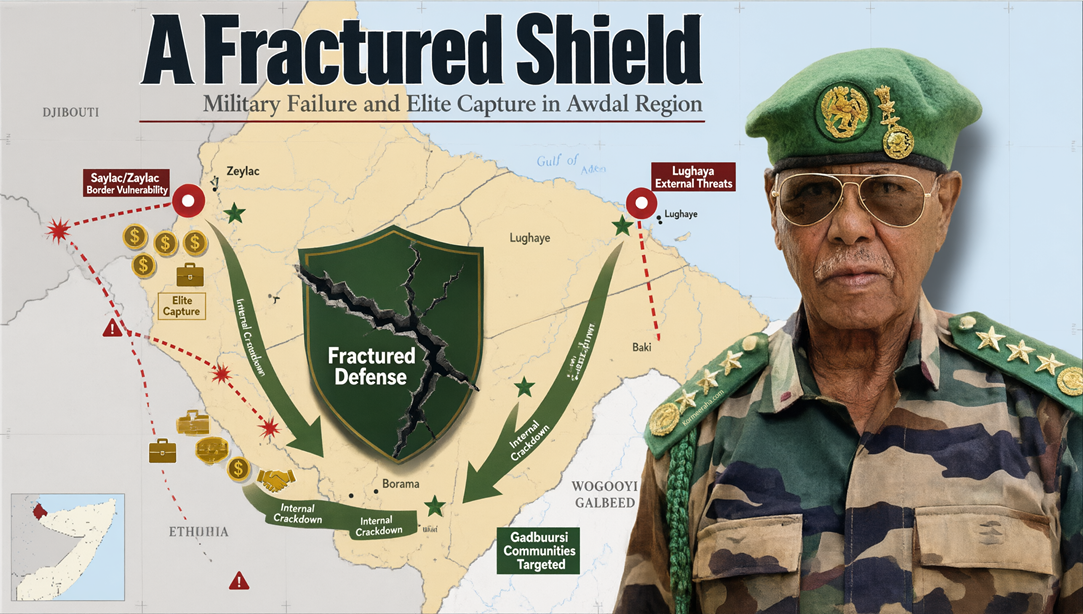
The contemporary geopolitical landscape of the Horn of Africa presents complex security dilemmas, but few are as acute—or as deeply concerning—as the unfolding crisis in the Awdal region. Specifically, the coastal and administrative zones of Saylac and Lughaya are currently at the center of a storm that demands rigorous scrutiny.
Recent administrative and military maneuvers by the current Somaliland’s Irro administration have sparked profound questions regarding civilian oversight, national defense priorities, and the suspected influence of private economic elites over state security architecture. At the heart of this controversy is the puzzling rejection of General Mohamud Xudhuun, widely regarded as a pivotal military figure capable of stabilizing the region. Coupled with troubling reports of domestic crackdowns amidst severe external territorial vulnerabilities, the situation in Awdal exposes a deep fracture in the state’s social contract.
The Security Deficit in Saylac and Lughaya
The Awdal region holds immense strategic and economic value, serving as a critical maritime gateway and a culturally rich territory. However, recent developments indicate an alarming vulnerability along its international borders. Credible field reports highlight incursions and destabilizing pressures by foreign militias originating from neighboring Ethiopia and Djibouti. In conventional statecraft, the primary mandate of a national defense force under such external threats is clear: ensure territorial integrity and defend the populace.
“Rather than fortifying the borders against external encroachments, elements of the national military have increasingly turned their focus inward.”
Yet, reports from local inhabitants reveal a paradoxical and dangerous deployment of the state’s security apparatus. The reported incarceration of Gadabuursi local youths, women, and civil inhabitants in these villages points to a dangerous securitization of domestic dissent. This heavy-handed approach not only alienates the very population whose cooperation is vital for effective counter-incursion strategies but also transforms local citizens into perceived enemies of the state.
The Strategic Imperative and the Rejection of General Xudhuun
To understand the leadership crisis in Awdal’s security sector, one must examine the rejection of General Xudhuun’s nomination. In military sociology, “leadership capital” is defined by a commander’s operational competence, regional familiarity, and local legitimacy. Security experts and local stakeholders frequently cite General Xudhuun as the singular military leader possessing the tactical acumen, moral authority, and deep-rooted trust necessary to harmonize fractured tribal dynamics and stabilize the volatile security vacuum in Saylac and Lughaya.
“When a government deliberately sidelines a competent military strategist during an active border crisis, it invites critical questions regarding its underlying strategic objectives.”
The Irro administration’s refusal to ratify or appoint General Xudhuun defies standard security logic. Is this decision driven by partisan politics, a fear of robust military independence, or external lobbying? By refusing to empower capable leadership, the state is directly correlating with the ongoing deterioration of regional security.
Plutocracy and National Security: The Influence of Business Elites
Perhaps the most troubling dimension of the current political crisis is the alleged interference of private commercial actors in matters of national defense. Reports indicate that prominent business magnates—specifically figures associated with the Dahabshiil Group and Mohamed Aw-Siciid—played a decisive role in vetoing General Xudhuun’s nomination.
The underlying rationale for this interference is deeply concerning. These elites allegedly fear that a robust, Gadabuursi-led security apparatus in Awdal would disrupt their lucrative cross-border interests and wealth accumulation in Djibouti, particularly if local forces push back against IOG (Ismael Omar Guelleh)-affiliated militias.
This raises critical theoretical questions about governance, sovereignty, and “elite capture.” In political economy, elite capture occurs when a small group of wealthy individuals redirects public policy and state resources to serve private economic interests rather than the public good.
“National security is a quintessential public good; it cannot be treated as a commodity subject to the veto of private mercantile classes.”
When business elites usurp executive decision-making regarding military leadership, it transforms the state into a de facto plutocracy. This dynamic suggests a governance model where capital accumulation and private cartel interests supersede the constitutional right of citizens to safety and territorial protection. Allowing non-state, profit-driven actors to dictate military appointments not only demoralizes the armed forces but also delegitimizes the regime.
Conclusion: Reclaiming the State
The unfolding crisis in Saylac and Lughaya under the Irro administration is emblematic of a deeper systemic failure in governance and security management. By sidelining a uniquely qualified military leader like General Xudhuun—allegedly to appease the cross-border business interests of elites like Dahabshiil and Mohamed Aw-Siciid—the administration has demonstrated a troubling prioritization of plutocratic influence over national defense.
Furthermore, diverting military might toward the domestic suppression of local Gadabuursi youths and women, while foreign militias from Ethiopia and Djibouti compromise the borders, represents a profound betrayal of the state’s core duties. Reversing these trajectories requires an immediate return to professional military standards, the uncompromising prioritization of border defense, and the complete insulation of national security policy from private commercial manipulation.
“If Awdal is to be secured, the state must remember who it is meant to serve: the people, not the plutocrats.”
Related
- Awdal to Break Free from Somaliland (January 29, 2023)
- Awdal’s Fault Lines: How May 18 Exposed Somaliland’s Deepest Crisis (May 18, 2026)
- Prof. Samatar’s Interview Exposes Fault Lines in Somaliland’s Clan-Based Politics (October 10, 2026)