
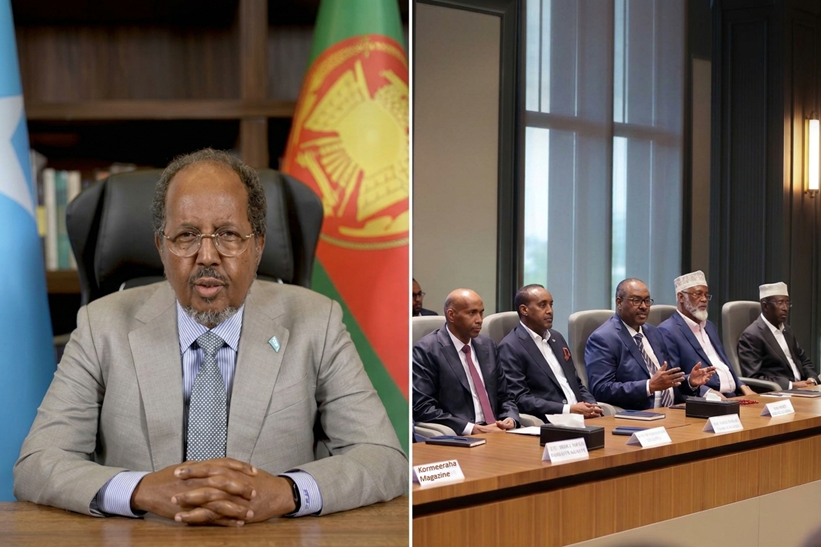
In the lexicon of Somali politics, the shir (conference) is both a sacred mechanism for consensus and a frequent theater for political maneuvering. President Hassan Sheikh Mohamud has renewed his call for dialogue with the opposition, inviting stakeholders to a forum in Mogadishu from November 14 to 18. But after years of governing as if dissent were high treason, pushing through constitutional amendments without consensus, and dismissing his critics, this sudden invitation rings hollow.
It is too little, and it is too late. And everyone in Somalia knows it.
The invitation did not arrive because the President suddenly discovered the virtues of listening. It arrived because he has run out of road.
The Illusion of a Timetable
On October 15, the national electoral commission published a timetable: parliamentary elections on April 15, 2027, and a presidential vote on May 15, 2027. The opposition rejected it outright. The regional votes Villa Somalia now cites as proof of democratic progress—in South West, Galmudug, and Hirshabelle—were conducted under a unilateral process the opposition never agreed to.
The President has a calendar, but he does not have consensus. And in Somali politics, a calendar without consensus is not an election; it is a timetable for a crisis.
That reality is what prompted this November invitation. A president who could once ignore the opposition now needs at least the appearance of their participation. An election held over their objections will be contested before a single ballot is cast, and may well produce the very parallel political processes he claims to fear. Dialogue, in this calculation, is not a change of direction. It is damage control.
Wadatashi is Not Wadahadal
Look closely at what is actually being offered, and the limits become clear. In his national address on October 25, Hassan Sheikh said the door to dialogue was open, that his government was ready to listen and to compromise. In the same breath, he drew the line that gives the game away: “the power to decide cannot be left in the middle.”
That line must be answered plainly. The President cannot unilaterally suspend the constitutional rights of the citizenry, nor can he treat them as negotiable commodities in a consultation forum.
What is being offered here is not wadahadal (binding negotiation); it is wadatashi (consultation). It is a forum where the opposition may speak, while the government decides. It is a room where proposals can be heard and then set aside, where disagreement can be noted and then overruled. A president who invites you to talk after he has already decided is not inviting you to decide with him. He is inviting you to endorse him.
“A president who invites you to talk after he has already decided is not inviting you to decide with him. He is inviting you to endorse him.”
This is the recurring pattern of the current crisis. First, act unilaterally. Then, when the political consequences arrive, offer dialogue. There were invitations before—in May, and in separate meetings in July—but they produced no agreement because they were built on the same flawed premise: the government would listen, but it would not change course. The opposition learned that lesson, which is why this latest invitation is being met not with enthusiasm, but with deep skepticism.
The Trap of the November Forum
“Too little, too late” is not merely a catchy slogan; it is a precise diagnostic of the current standoff.
It is too little because consultation is not negotiation, and a five-day forum cannot undo years of unilateral decisions regarding the constitution, the electoral model, and the national timetable. It is too late because the timetable is already published, the regional results are already banked, and the trust required for a genuine settlement has already been spent.
A genuine invitation would look very different. It would put the timetable itself on the table, rather than merely discussing it, and accept that no side can impose a settlement and expect it to hold. It would treat the opposition not as an audience to be managed, but as equal partners whose agreement is a prerequisite for any election to be legitimate.
Hassan Sheikh has not offered that. He has offered a forum, on his terms, after his decisions, in the hope that attendance will be mistaken for agreement.
The opposition now faces a classic political trap. Attending a consultation that changes nothing would only lend a veneer of legitimacy to a process they have rightly rejected. Refusing to attend, on the other hand, risks being painted by the government and its international backers as the obstacle to dialogue. That is the genius of a too-little, too-late invitation: it is designed to shift blame, not to share power.
Somalia does not need another managed meeting. It needs a negotiation—real, equal, and conducted before the timetable becomes an irreversible fact on the ground. Until Hassan Sheikh Mohamud is willing to offer that, his invitation should be seen for exactly what it is: not the beginning of consensus, but the last attempt to dress up its absence.
Related
- Fractured Federation: Somalia’s Political Polarization and the 2027 Electoral Crisis (October 19, 2026)
- Somalia’s Political Crisis Deepens: Inside the Collapsed Talks Over the 2026 Vote (February 25, 2026)