
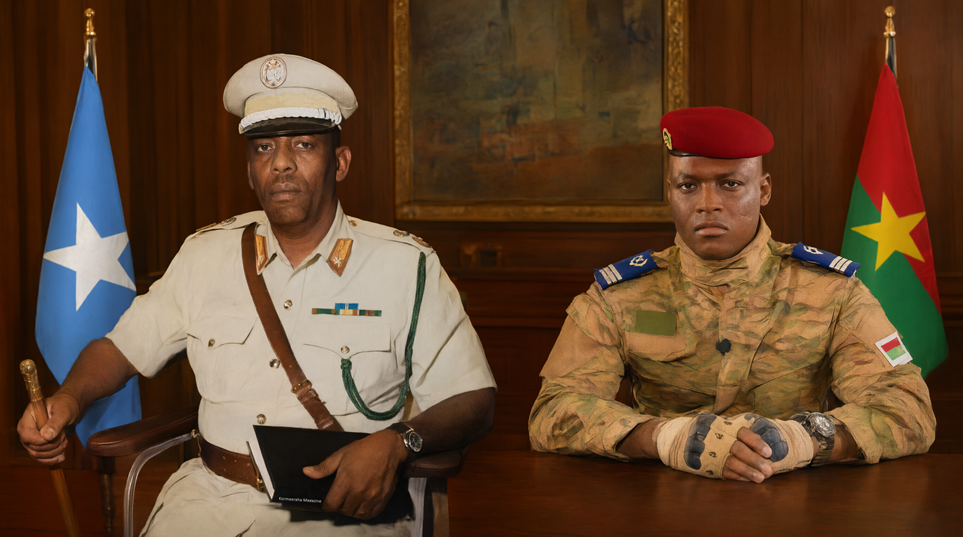
Africa’s pursuit of full sovereignty is rarely a linear march; it is a turbulent rhythm of ebbs and flows, where the promise of liberation frequently collides with the harsh realities of governance. Today, Captain Ibrahim Traoré of Burkina Faso is celebrated by a new generation of African youth as the vanguard of this sovereignty. Yet, to understand the trajectory of his revolution, one must look back to the Horn of Africa in 1969.
The early years of Siad Barre’s Somalia (1969–1977) offer a striking structural parallel to Traoré’s Burkina Faso. Both emerged from military coups promising a radical break with a discredited past, pursued sovereignty-driven economic programs, and cultivated reputations as anti-imperialist champions. However, Barre’s “positive experience” ultimately unravelled in the crucible of war. His story serves as a compelling, cautionary template for Traoré, illustrating the high cost of revolutionary ambition and the fragile nature of unconsolidated power.
The Blueprint of Rupture: Ideology and Social Engineering
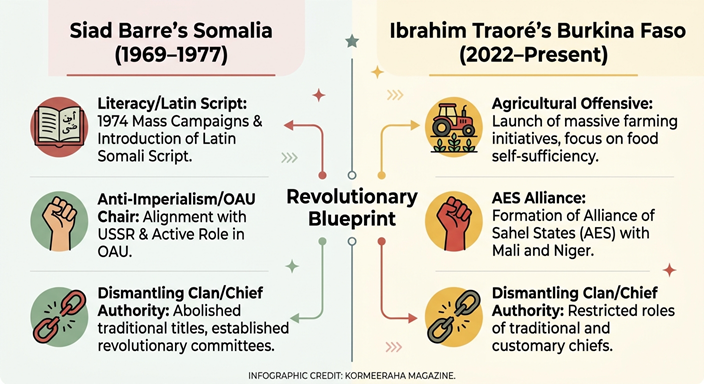
Both leaders understood that a military takeover is insufficient without ideological rupture. Both regimes recognized that a military coup is insufficient without profound ideological rupture. Barre’s Supreme Revolutionary Council proclaimed “Scientific Socialism,” while Traoré invokes a modernized Sankarist doctrine. Both nationalized key economic sectors, prohibited the privatization of strategic enterprises, and championed self-reliance.
This ideological fervor manifested in massive social engineering campaigns. In 1972, Barre introduced the Somali Latin script, launching a nationwide literacy campaign that sent students into nomadic regions, boosting primary enrollment from 40,000 to 300,000. Similarly, Traoré has launched an “Agricultural Offensive,” investing heavily in state-funded irrigation and mechanization to achieve food sovereignty, operating on the maxim: “Produce what we eat, process what we produce, and consume what we process.” In both contexts, rural communities are not merely beneficiaries, but active political actors in the revolution.
“In both contexts, rural communities are not merely beneficiaries, but active political actors in the revolution.”
Furthermore, both leaders sought to forge a unified revolutionary identity by dismantling entrenched traditional and religious hierarchies. Barre brutally suppressed clan solidarity by dispersing nomads into collective settlements. When conservative clerics opposed his gender emancipation policies in 1975, the regime executed eleven religious leaders, sending an unmistakable message that the state would not tolerate competing moral authority. Traoré has not resorted to such extreme violence, but the tension is palpable. His government has moved to regulate religious institutions, arresting prominent imams to enforce state secularism, while deliberately marginalizing traditional chiefs—labeling them retrograde forces—and empowering youth through the Volunteers for the Defence of the Homeland (VDP).
Linguistically, both regimes enforced a cultural reset. Barre mandated the use of “Jaalle” (Comrade), echoing Traoré’s insistence on the title “Camarade” in official discourse to deliberately erase the vocabulary of hierarchy and deference.
Projecting Sovereignty: The Continental Stage
A revolutionary state isolated domestically often seeks validation on the continental stage to legitimize its rule. In 1974, at the height of his popularity, Siad Barre assumed the chairmanship of the Organization of African Unity (OAU). This platform allowed him to project an image of pan-African leadership, championing decolonization in Portuguese Africa and condemning apartheid, effectively masking the domestic centralization of his power.
Traoré’s equivalent is the Alliance of Sahel States (AES), a confederation forged with Mali and Niger. By withdrawing from the Economic Community of West African States (ECOWAS) and establishing a joint military force, an investment bank, and a shared media network, Traoré has transformed a landlocked, impoverished state into the nucleus of a defiant geopolitical bloc. Like Barre at the OAU, Traoré uses regional institutions to project a sovereign image that his domestic record is still struggling to sustain. Yet, this external posturing often masks the internal fragility of the revolutionary project.
“Like Barre at the OAU, Traoré uses regional institutions to project a sovereign image that his domestic record is still struggling to sustain.”
The Crucible of War: External Ambition vs. Internal Attrition
The ultimate test of any revolutionary model is how it handles conflict, and here lies the decisive divergence between the two leaders. Barre’s revolution was undone by a war of choice. In July 1977, driven by the nationalist ambition to unify ethnic Somalis, he invaded Ethiopia’s Western Somali region. Barre fatally miscalculated, assuming his Soviet patrons would support him. Instead, the USSR backed Ethiopia’s Derg regime, airlifting massive aid and coordinating up to 12,000 Cuban troops. By 1978, Somalia’s army was shattered, and the socialist revolution effectively died on the Ogaden plains.
Traoré, conversely, did not choose his war; he inherited an internal jihadist insurgency that had already metastasized across the Sahel before he took power. He is not fighting a conventional neighbouring army, but a dispersed, asymmetric enemy embedded within rural communities. While Barre’s external war initially rallied patriotic sentiment before collapsing under geopolitical betrayal, Traoré’s internal war is a gruelling war of attrition. Independent assessments indicate that conflict deaths have tripled under his rule.
The danger for Traoré is not a sudden, catastrophic military defeat like Barre’s, but a slow, corrosive bleed. If his “endogenous” security strategy fails to protect civilians, the very youth who now celebrate his defiance may turn against him. Barre’s popularity in 1975 was real; by 1980, it was a memory.
The Peril of Unchecked Power
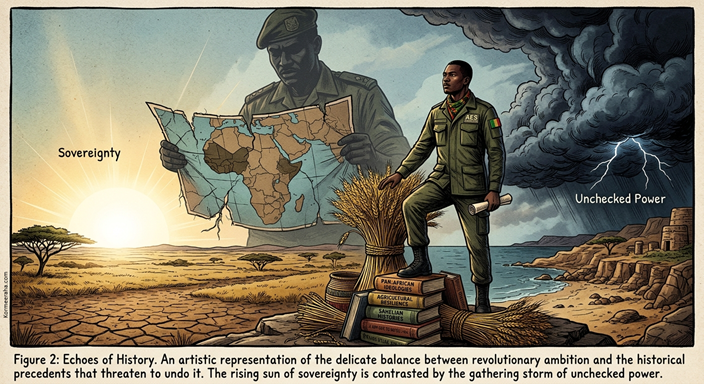
The most sobering lesson from Barre’s Somalia is the structural flaw inherent in both revolutions: the absolute concentration of power. The absence of institutional checks—no independent press, no opposition parties, no civilian oversight—meant that when Barre decided to invade the Ogaden, no mechanism could stop his catastrophic miscalculation.
“The absence of institutional checks… meant that when Barre decided to invade the Ogaden, no mechanism could stop his catastrophic miscalculation.”
Traoré’s Burkina Faso has mirrored this consolidation. Over 100 political parties have been dissolved, the electoral commission abolished, and military rule extended indefinitely. The “camarade” revolution has created a system where the leader’s judgment is the sole check on his ambition. The Somali precedent demonstrates that this is not a blueprint for durable sovereignty, but a recipe for a dramatic rise followed by a devastating fall.
Lessons for a New Generation
The romantic narrative surrounding Captain Traoré captures the genuine yearning of African youth for dignity, self-reliance, and an end to neo-colonial exploitation. Siad Barre, too, was once viewed as an honest, young officer breaking with a corrupt past, achieving genuine early victories in literacy and national pride. But the same concentration of power that enabled those rapid changes ultimately enabled his ruin.
Africa’s journey toward full sovereignty requires more than the fiery rhetoric of anti-imperialism and the swift nationalization of resources; it requires the arduous, unglamorous work of building resilient, inclusive institutions. As Traoré navigates the treacherous ebbs and flows of his revolution, the ghost of Barre’s Somalia looms large. The African youth cheering from the sidelines must ask themselves whether they are witnessing the dawn of a new, sustainable liberation, or merely the opening act of a revolutionary tragedy they have seen before.
Time will tell if Traoré can avoid the traps that ensnared his predecessors, or if his ideals will fizzle out, drawn into misadventure or cut short by assassination. But history warns that sovereignty, when stripped of accountability, is a fragile prize.
Related
- The African Solution: Why Somalia Is Looking to Burkina Faso to Fight Terror (May 7, 2026)
- Why the 1969 Revolution Still Matters Today (October 21, 2022)