

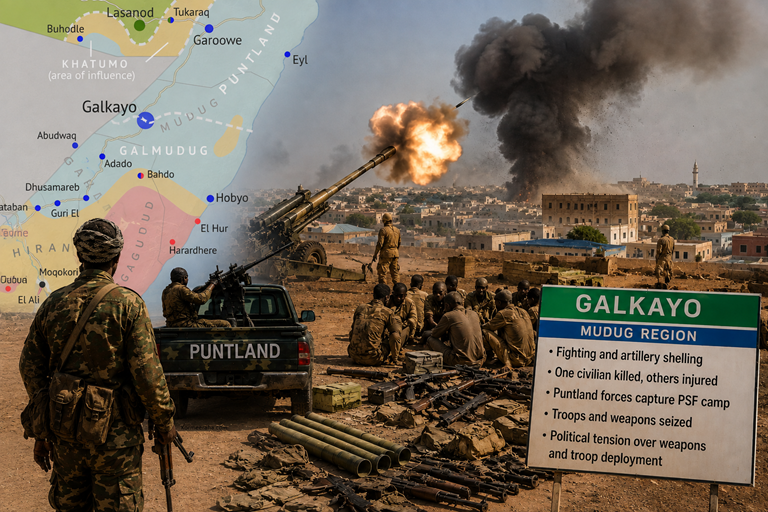
Galkayo – The city of Galkayo, the capital of the Mudug region, which has historically been an arena for political and clan power struggles, this week hosted one of the most severe military crises to hit the region in recent times. An armed clash between the Puntland Defence Forces and a faction of the PSF (Puntland Security Force) that recently declared allegiance to the Federal Government of Somalia (FGS) brought the city to the brink of a full-scale conflict.
The back-to-back events of August 4 and 5, 2026, highlighted the escalating dispute between Puntland President Said Abdullahi Deni and Somali President Hassan Sheikh Mohamud, rooted in control over the armed forces and the distribution of weapons. However, to understand why these events unfolded the way they did, one must look at the deep-rooted history of the city of Galkayo.
The Division of the City and the History of Blood and Peace
The city of Galkayo has historically been divided by a line that, while invisible, politically and security-wise splits it into two administrations. Northern Galkayo is inhabited by the Majeerteen clan, specifically the Omar Maxamuud sub-clan, and serves as the seat of the Puntland administration. Southern Galkayo, on the other hand, is inhabited by the Habar Gidir clan, specifically the Sacad sub-clan, and falls under the Galmudug administration.
The relationship between these two clans has gone through various phases. Following the collapse of the central government in 1991, extremely fierce fighting broke out in the Mudug region, causing massive loss of life and displacement. However, the city’s history also remembers the 1993 Peace Agreement, signed by the late Abdullahi Yusuf Ahmed of the Majeerteen and General Mohamed Farah Aidid of the Habar Gidir. That agreement opened the path to peace in Galkayo.
Although minor clashes broke out within the city in 2015–2016, rooted in land disputes, the expansion of the airport, and the markets, the two sides subsequently achieved strong economic integration. Trade, markets, and currency flow freely across the dividing line, and in recent years joint forces have been formed to counter Al-Shabaab.
Protecting the Peace: The Reason Behind the Southern Roadblock
This deep history of conflict and peace was the main cause of the incident on Tuesday, August 4, 2026. Armed militiamen from the Sacad faction of the Habar Gidir clan, residing in southern Galkayo, set up a roadblock against two cargo trucks escorted by Galmudug police. The trucks were carrying weapons and military supplies that the Federal Government was transporting to the PSF forces in eastern Galkayo. After a clash, the local militia seized one of the trucks by force.
The reason behind the seizure was clear. According to local sources, the clan militia opposed the transport of federal government weapons through their territory, fearing it would be used to attack or wage war in the neighbouring Puntland region. They feared the weapons would ignite a new war that would destroy the peace agreement they share with their Majeerteen neighbours in the north of the city. This action significantly weakened the PSF forces in eastern Galkayo, who were already under siege.
Puntland’s Offensive and the Collapse of the PSF Base
The following day, Wednesday, August 5, 2026, Puntland forces launched a heavy attack accompanied by mortar fire on the PSF base at Barda-dheere in eastern Galkayo. The fighting caused casualties in both lives and property, with at least one civilian killed and others wounded by stray mortar shells that fell on residential neighbourhoods.
It is noteworthy that Puntland did not attack the official bases of the Somali National Army (SNA) or the Danab Commandos located in southern Galkayo under Galmudug control, but targeted only the PSF base that the federal government had been using to stockpile weapons.
The outcome of the battle saw Puntland forces take full control of the base and seize a significant haul of personnel and equipment. Among those captured were 101 PSF soldiers, including the PSF commander of Galkayo, Giijaale Abdi Baydhabo, as well as 60 wounded soldiers currently being treated at Puntland facilities. In addition to the prisoners, Puntland forces captured combat vehicles, automatic rifles, ammunition, and a vast array of security equipment. According to Garowe Online, special equipment including police uniforms, boots, and handcuffs, donated by Chinese government to the Somali Police Force, were found there, raising questions about how government weapons and donations are being diverted into political disputes.
The PSF’s defeat in Galkayo had immediate consequences beyond the city. With the cooperation of clan elders, Puntland forces moved to take control of the largest PSF base in Bosaso. In addition to the clashes in Laag on July 20, which resulted in the PSF stationed there being overpowered, this latest development marks the end of the PSF’s existence in Puntland’s territories.
Galmudug’s Position and International Concern
The Galmudug administration played a crucial role in containing the crisis. Galmudug officials and Darawiish officers clearly refused to allow their territory to be used as a corridor to destabilize Puntland’s security, warning the Federal Government not to pass through Galmudug territory in order to establish relations with military factions in dispute with Puntland.
On the other hand, this incident has triggered international concern. The U.S. Africa Command (AFRICOM), in a statement issued on Saturday, August 8, expressed serious concern over the collapse of the PSF forces. The United States warned that the vanished military capability could provide an opportunity for extremist groups such as Al-Shabaab and ISIS to exploit the dispute between the administrations.
Temporary Stability and Legal Measures
Today, the city of Galkayo is calm. The markets and movement between the north and the south are functioning normally, and clan elders from both sides, Majeerteen and Habar Gidir, have jointly confirmed that the dispute is political and will not affect the coexistence of the community.
However, the Puntland Council of Ministers has announced that all politicians and military officers who supported or sheltered the forces that rebelled against the administration will be brought to trial. The disarmament order issued to the remnants of the PSF who fled to Galmudug appears to be closing the chapter on that force.
Although the city escaped a full-scale civil war, the political dispute between Puntland and the Federal Government over control of the armed forces and the distribution of weapons remains unresolved, which could directly affect the country’s security and political future.