
Recent clashes in Baidoa have reignited a full-scale political and military crisis in Southwest State (SWS), fundamentally shifting the balance of power within Somalia’s fragile federal architecture. While Somalia has served as a chessboard for competing foreign interests since the collapse of the central government in 1991, the conflict currently unfolding in Baidoa is far more than a localized dispute over regional governance. It represents a direct confrontation between President Hassan Sheikh Mohamud’s centralization agenda and an assertive opposition coalition, amplified by deep-seated regional proxy rivalries involving Turkiye, the United Arab Emirates (UAE), and Ethiopia.
The Federal Government & Turkiye: The Pro-Mogadishu Axis
At the centre of the crisis is President Hassan Sheikh Mohamud’s ambition to consolidate central authority and enforce nationwide electoral reforms, specifically a transition to direct universal suffrage. Viewing Southwest State as an essential political bloc for his administration’s stability and future electoral prospects, Mogadishu has pursued an unyielding strategy to bring Baidoa under strict federal alignment.
This strategy culminated in early 2026, when federal authorities moved against the entrenched SWS President, Abdiaziz Hassan Mohamed “Laftagareen.” The intervention relied heavily on elite Turkish-trained units—most notably the Gorgor brigade—supported by tactical surveillance and strikes from Turkish-supplied drones. Laftagareen was forcibly ousted and replaced by Aden Madobe, the former Speaker of the Federal Parliament, following a heavily contested regional process that opposition factions denounced as an unconstitutional takeover.
Ankara’s substantial security footprint and diplomatic involvement drew immediate condemnation from opposition political figures and civil society. Allegations that Turkish military assistance was being diverted from anti-Al-Shabaab operations to settle domestic political disputes reached a boiling point in April 2026, when the Future Council of Somalia formally decried Turkish Ambassador Alper Aktaş. The ensuing political fallout prompted Ankara to reassign Ambassador Aktaş in June 2026, replacing him with Ferhat Alkan in a clear effort to manage diplomatic blowback and recalibrate its posture in Mogadishu.
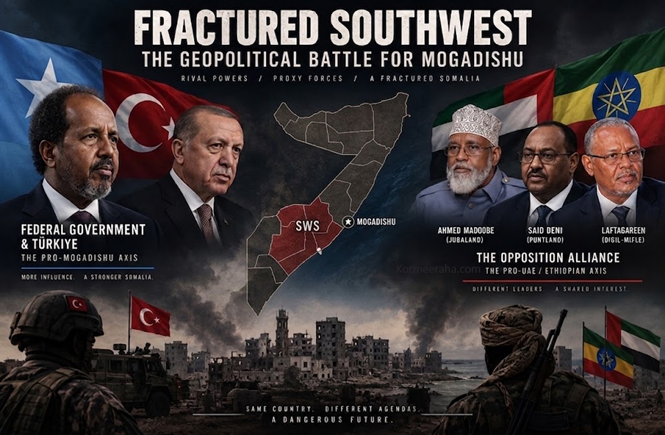
This operational standoff pits two heavily backed coalitions directly against each other. On one side, the Mogadishu Axis brings together the Federal Government led by Hassan Sheikh Mohamud, direct military support from Turkiye through drone strikes and the Gorgor brigade, and the newly installed SWS administration under Aden Madobe. On the opposing side stands a broad Opposition Alliance, combining key regional leaders like Said Deni and Ahmed Madobe, financial backing from the UAE, Laftagareen’s insurgent “Free Forces,” and tacit support from Ethiopia.
The Opposition Alliance: The UAE–Ethiopian Axis
In response to Mogadishu’s assertive moves, an expansive counter-coalition emerged, linking key Federal Member State (FMS) leaders—specifically Said Deni of Puntland and Ahmed Madobe of Jubaland—with Laftagareen’s displaced faction.
This alignment is driven by strategic necessity rather than clan affinity. While Deni and Ahmed Madobe are Darod, Laftagareen belongs to the Digil-Mirifle (Rahanweyn) clan family. By backing Laftagareen, the opposition alliance has framed the resistance in Baidoa as a local struggle against federal overreach and foreign-backed coercion.
This internal opposition intersects directly with broader Horn of Africa dynamics:
- United Arab Emirates: Abu Dhabi has maintained strong political and security ties with regional authorities in Puntland and Jubaland. As Mogadishu’s security ties with Ankara deepened, UAE-aligned networks provided financial and political backing to the opposition bloc, leveraging Laftagareen’s forces to challenge the federal government’s expanding authority.
- Ethiopia: Addis Ababa historically viewed Laftagareen’s administration in SWS as a vital security buffer along its southern border. Following bilateral tensions between Mogadishu and Addis Ababa over regional security arrangements and diplomatic realignments, Ethiopia shifted toward tacit support for Laftagareen’s resurgence, seeking to preserve its traditional sphere of influence in SWS.
The Ground Reality and Security Vacuum
The military escalation in late mid-2026 saw Laftagareen’s loyalist forces—operating as the “South West Darawish” or “Free Forces”—launch sustained counter-offensives against federal positions in and around Baidoa. In tandem with these military engagements, opposition elements declared the creation of a breakaway “South East State of Somalia,” claiming jurisdiction over parts of Lower Shabelle in an effort to fragment the federal government’s administrative hold.
This ongoing clash has created a deeply fractured security environment across the region:
- Federal Forces and the SWS Administration: Currently holding primary urban centers in Baidoa under Aden Madobe, their focus has shifted heavily toward urban defense through the deployment of national units.
- Laftagareen’s “Free Forces”: Actively operating across rural Bay and Bakool, this faction has declared the “South East State” and routinely conducts ambushes and territorial incursions targeting federal troop positions.
- Al-Shabaab: Taking immediate advantage of these security perimeter gaps, the militant group has re-established influence and checkpoints along vital supply routes and rural zones throughout Southwest State.
- Ethiopian and Regional Contingents: Positioned primarily near border zones, these forces remain focused on maintaining a strategic security buffer and operate largely outside direct federal command structures.
The operational friction between federal forces and regional militias has created a dangerous vacuum. Resources and personnel previously dedicated to joint counter-insurgency operations against Al-Shabaab have been redirected toward political containment in Baidoa.
Political Outlook
The conflict in Southwest State underlines the fragile balance between Somalia’s central government and its federal member states. Mogadishu’s push to enforce central authority through military and electoral reforms has unified disparate regional actors and exposed the nation to external geopolitical leverage.
If federal authorities and the opposition alliance fail to establish a negotiated political framework regarding constitutional revisions and regional governance, the crisis in Baidoa risks permanently fracturing the Southwest State. Such destabilization would undermine years of institutional progress in Mogadishu while severely degrading the broader security architecture required to contain Al-Shabaab across southern Somalia.