

A strategic relationship under scrutiny as Turkey deepens its footprint in the Horn of Africa
When President Recep Tayyip Erdoğan touched down at Mogadishu’s battered airport in 2011, few could have predicted the transformation that would follow. What began as a humanitarian overture amid famine has since evolved into one of Africa’s most consequential bilateral relationships—a multifaceted partnership spanning military bases, offshore energy exploration, and infrastructure reconstruction.
Yet beneath the ribbon-cuttings and joint press conferences lies a relationship increasingly defined by contradiction. For every hospital Turkey builds, there is a secretive oil contract. For every Somali soldier trained, there is an allegation of Turkish drones being deployed in internal political feuds. This article examines the Ankara-Mogadishu axis through an analytical lens, separating rhetoric from reality.
The Architecture of Influence
Defense and Security: The TURKSOM Factor
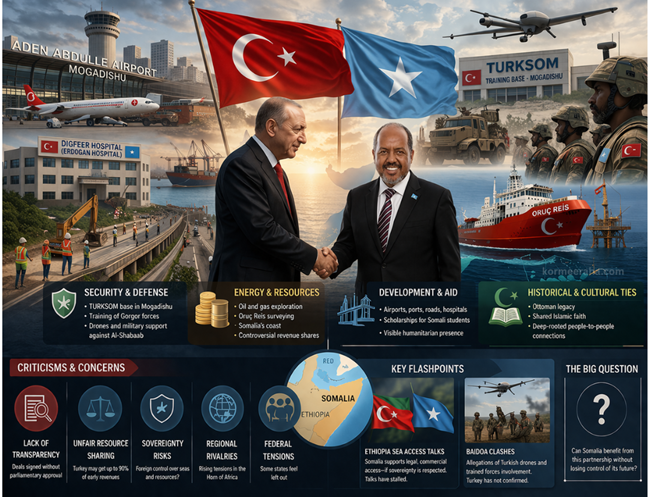
Turkey’s most visible asset in Somalia is the TURKSOM military base in Mogadishu—its largest overseas facility. Here, Turkish officers train Somalia’s elite Gorgor commandos, units that have become the federal government’s primary striking force against Al-Shabaab.
The 2024 defense agreement marked a significant escalation. Turkey committed to protecting Somalia’s exclusive economic zone, deploying naval assets and, crucially, Bayraktar TB2 drones. These unmanned aerial vehicles have altered the battlefield calculus against the insurgency—but they have also appeared in places Mogadishu’s opponents did not expect.
Energy Exploration: The Oruç Reis Gambit
The arrival of the Turkish vessel Oruç Reis off Somalia’s coast signaled Ankara’s long-term economic ambitions. The subsequent oil and gas agreement, signed by two ministers without parliamentary ratification, has become the partnership’s most controversial element.
Under the terms—portions of which remain classified—Turkish Petroleum (TPAO) reportedly recovers up to 90% of extraction costs before revenue sharing begins. Somalia’s initial share: approximately 5%. Whether this represents standard industry practice or neo-colonial extraction depends entirely on whom one asks.
Infrastructure and Aid: Visible Transformation
Turkey’s development footprint is unmistakable: the renovated Mogadishu airport terminal, the port facilities, the Digfeer (Erdoğan) Hospital, and miles of rehabilitated roads. Thousands of Somali students have studied at Turkish universities on scholarships. For ordinary Somalis, Turkey often represents a rare example of a Muslim nation delivering tangible results where Western donors have hesitated.
The Critique—What’s Hidden Beneath the Surface?
Transparency Deficit
The most persistent criticism concerns opacity. Key agreements—including the 2024 maritime defense pact and the oil exploration deal—were signed without legislative oversight. Opposition parliamentarians have demanded full disclosure, arguing that binding Somalia to international obligations without parliamentary consent violates the federal constitution.
The response from Mogadishu has been dismissive: national security and commercial confidentiality preclude public disclosure. Critics counter that this logic has been stretched beyond credible limits.
Resource Sharing: A Lopsided Arrangement?
The oil agreement’s financial structure has become a lightning rod. Even accounting for standard production-sharing agreements (PSAs) where investor nations recoup costs before profit-sharing, the reported 90-5 split in Turkey’s favor during initial phases appears unusually tilted.
Economic analysts in Mogadishu note that Somalia, emerging from decades of civil war, lacks both capital and negotiating expertise. Whether Turkey exploited this asymmetry—or merely offered the best terms available—remains debated. What is indisputable is that domestic political opposition to the deal has grown, not subsided.
Sovereignty Questions
Beyond economics, critics point to provisions requiring dispute resolution in Istanbul courts rather than Somali or international tribunals. Combined with Turkey’s expansive role in maritime security—effectively outsourcing a core state function—questions arise about the erosion of Somali decision-making autonomy.
“We are trading short-term security for long-term dependency,” one Somali academic, speaking on condition of anonymity, told this writer. “Turkey’s ambassador in Mogadishu now carries more weight than half the cabinet.”
The Ethiopia Conundrum
Ankara’s Balancing Act
Turkey maintains robust ties with both Somalia and Ethiopia—two neighbors with increasingly strained relations. Ethiopia’s January 2024 memorandum with the breakaway region of Somaliland, granting Addis Ababa naval base access in exchange for potential recognition, infuriated Mogadishu.
Turkey’s response was twofold. First, it brokered the “Ankara Declaration” (December 2024), under which Somalia conditionally accepted Ethiopian commercial sea access—but only through Somali-controlled ports, under Somali law. Second, and more controversially, Ankara has reportedly signaled willingness to facilitate broader Ethiopian access.
Somalia’s Dilemma
Mogadishu’s position is precarious. Officials privately acknowledge that only Turkey has sufficient leverage with Ethiopia to prevent full implementation of the Somaliland deal. Yet each Turkish concession to Addis Ababa erodes domestic support for the partnership.
By February 2026, when Turkey publicly pledged to assist Ethiopia’s Red Sea access, Somali political circles erupted. Many interpreted this as Ankara tilting toward its larger, wealthier neighbor—where Turkish investments exceed $2.5 billion—at Somalia’s expense. Negotiations have since stalled, with Somalia insisting on port facilities under its direct jurisdiction and Ethiopia seeking alternatives.
The core question remains unresolved: Can Turkey be an honest broker when its own commercial interests align more closely with Ethiopia?
Baidoa—When the Trainer Becomes the Player
The Allegations
In March and April 2026, the South West State administration leveled explosive accusations: Turkish drones were providing air support to federal forces fighting in and around Baidoa, the regional capital. The target, according to officials, was South West President Abdiaziz Laftagareen, whom Mogadishu accused of conducting an illegitimate election.
Eyewitness accounts, while unverified, describe drone strikes on Daynuunay on Baidoa’s outskirts, resulting in civilian casualties. The Gorgor forces—trained and equipped by Ankara—were confirmed to be leading the federal advance.
Turkey’s Silence
Ankara has not officially responded. Previous statements limiting Turkish military support to counterterrorism against Al-Shabaab now appear, at minimum, incomplete. If the allegations are substantiated, Turkey would be directly implicated in Somalia’s internal political conflicts—a significant escalation from its stated mandate.
Analytical Assessment
No evidence suggests Turkish ground troops are fighting. However, drone support and the deployment of Turkish-trained units for political objectives would represent a qualitative shift. For a government that presents itself as Somalia’s neutral partner, such involvement risks irreparable reputational damage.
The Presidential Assets Question—Rumour vs. Evidence
What Is Confirmed
President Hassan Sheikh Mohamud’s family members—including his son, Mohamed Hassan Sheikh—have resided in Turkey using diplomatic passports, according to Associated Press reporting. The vehicles involved in a 2023 Istanbul traffic incident belonged to the Somali embassy, not private individuals.
What Remains Unproven
Opposition figures have repeatedly alleged that the president owns real estate and substantial investments in Turkey. To date, no independent investigation has produced documentation confirming these claims. No court has adjudicated them. No whistleblower has produced bank records or property deeds directly linked to the president or his family yet.
Analytical Caution
In Somalia’s polarized political environment, unsubstantiated asset allegations could be deployed strategically against incumbents. The absence of evidence does not equal evidence of absence, but responsible analysis requires distinguishing verified facts from political warfare. Currently, the former category contains little beyond family residency and diplomatic vehicle usage.
Conclusion: Strategic Partnership or Asymmetric Dependency?
The Turkey-Somalia relationship has delivered tangible benefits: enhanced security, rebuilt infrastructure, and a reliable international partner when others retreated. These achievements are real and should not be dismissed.
Yet the partnership’s trajectory raises uncomfortable questions. Opaque agreements, lopsided resource terms, potential involvement in internal conflicts, and the Ethiopia balancing act all suggest a relationship where power and information flow asymmetrically.
For Somalia, the challenge is to institutionalize accountability mechanisms—parliamentary oversight, independent legal review, transparent negotiation processes—without jeopardizing Turkish goodwill. For Turkey, the choice is whether to accept such constraints as the price of long-term partnership or to continue operating in grey zones that ultimately undermine its credibility.
The coming years will determine whether Ankara-Mogadishu becomes a model for South-South cooperation or a cautionary tale about unequal alliances. The early evidence, on balance, remains mixed.
