
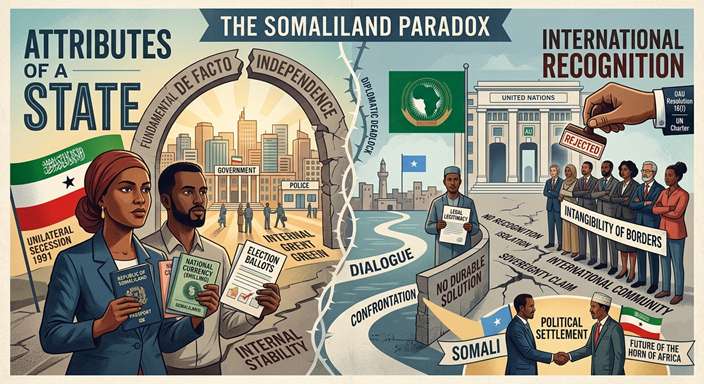
More than thirty-four years after its unilateral declaration of independence in May 1991, Somaliland remains one of the most complex and singular cases in contemporary international law. Equipped with its own institutions, a government, a parliament, security forces, and a functional administration, this territory in northwestern Somalia has exercised the attributes of a state for several decades.
Yet, despite this political reality, no United Nations member state has officially recognized its independence, with the exception of Israel. This contradiction lies at the heart of the Somaliland paradox: while Hargeisa acts as the capital of a sovereign state, international law continues to regard Somaliland as an integral part of the Federal Republic of Somalia.
As Somaliland authorities develop their diplomatic, economic, and security relations with foreign actors, a fundamental question arises: what means does Somalia retain to defend its sovereignty in accordance with international law?
A Political Reality Without International Recognition
Few observers dispute the progress made by Somaliland since 1991. In a region often marked by instability, the territory has managed to maintain a relative level of security, organize several elections, and establish functional institutions.
However, the effectiveness of power alone is not sufficient to create a recognized state. To date, the United Nations, the African Union, the Arab League, IGAD (Intergovernmental Authority on Development), and all member states of the international community continue to recognize Somalia’s sovereignty over Somaliland.
This position is firmly rooted in Article 2(4) of the United Nations Charter, which prohibits any action that undermines the territorial integrity or political independence of any state. It is further reinforced by the Constitutive Act of the African Union and, historically, by Resolution AHG/Res.16(I) of the Organization of African Unity (1964). This landmark resolution established the principle of the intangibility of borders inherited from colonization, a cornerstone of post-colonial African stability. Since 1963, African states have chosen to preserve existing borders to prevent a multiplication of territorial conflicts on a continent where colonial lines often separated populations sharing the same language, culture, or traditions.
For many African governments, the question of Somaliland therefore goes far beyond the sole Somali framework. Unilateral recognition could set a precedent likely to encourage other separatist claims across the continent, violating the consensus enshrined in these foundational texts.
The Fragilities of De Facto Sovereignty
The lack of international recognition continues to limit Somaliland’s ambitions.
The first fragility is diplomatic. Despite its constant efforts, Somaliland remains excluded from major international organizations and does not benefit from the prerogatives recognized for sovereign states.
The second fragility is territorial and political. The clashes observed in recent years in the Sool region and Las Anod have reminded us that certain areas contest Hargeisa’s authority and maintain political ties with Mogadishu. These tensions show that the consolidation of territorial authority remains an unfinished process. Indeed, the unilateral declaration of independence is still contested even within Somaliland itself. While the region has successfully organized free and democratic elections, a formal referendum within its borders has the potential to reveal muted voices and internal divisions. Yet, such a referendum could also provide leaders with the legitimacy needed to negotiate secession.
The third fragility is legal. As Somaliland authorities develop relations with foreign partners, the question of the legal status of concluded agreements becomes inevitable. To what extent can an unrecognized entity conclude diplomatic, military, or strategic agreements binding a territory that remains, in the eyes of international law, an integral part of a recognized sovereign state? This question takes on particular importance in a region as strategic as the Red Sea and the Gulf of Aden, where the interests of regional and international powers intersect.
Somalia’s Legal and Diplomatic Options
Faced with these developments, Somalia still has several instruments compliant with international law, supported by consistent jurisprudence from the International Court of Justice (ICJ) regarding territorial sovereignty.
The first option is diplomatic. Mogadishu can continue to mobilize support from the United Nations, the African Union, IGAD, and the Arab League to reaffirm the principle of its territorial integrity. Recent communiqués from IGAD have explicitly reiterated support for Somalia’s sovereignty and territorial integrity. Similarly, the Arab League has passed resolutions affirming the unity of Somalia. M.A. Youssouf, President of the African Union Commission, has reaffirmed that Somaliland remains an integral part of the Federal Republic of Somalia and has rejected any unilateral recognition likely to undermine Somalia’s territorial integrity.
Furthermore, a group of Arab, African, and Muslim countries, including notably Djibouti, Egypt, Turkey, Saudi Arabia, Qatar, Algeria, Nigeria, and Pakistan, published a joint statement condemning Israeli recognition of Somaliland and reaffirming their support for Somali sovereignty. As long as these organizations maintain their current position, Somalia retains solid international legitimacy.
The second option consists of officially challenging initiatives it deems contrary to its sovereignty. Each time Somaliland concludes agreements with states or foreign actors, the federal government can issue diplomatic protests, citing official declarations of the Federal Government of Somalia and relevant international legal frameworks. This strategy allows Somalia to defend its interests without resorting to verbal or military escalation.
A third option relates to the domestic constitutional order. From the perspective of Somali constitutional law, Somaliland remains a component of the Somali state. Therefore, Mogadishu considers that certain initiatives taken by the authorities in Hargeisa—particularly in diplomatic, military, or security matters—fall under competencies reserved exclusively for the federal government. By undertaking such actions, they violate national law. While the practical enforcement of such laws is limited by the lack of federal control on the ground, maintaining this legal stance reinforces Somalia’s position in international forums.
The Limits of Precedent: Why Somaliland is Not Eritrea or South Sudan
Proponents of Somaliland’s recognition often cite the precedents of Eritrea and South Sudan. However, these cases are fundamentally different from the Somaliland situation.
Eritrea did not willingly join Ethiopia; it was annexed, and its separation followed a long, internationally mediated war and a referendum agreed upon by both parties. South Sudan is ethnically and religiously distinct from Sudan, and its independence was the result of a comprehensive peace agreement ending a decades-long civil war, culminating in a mutually accepted referendum.
In contrast, Somaliland is populated by the same ethnic and religious groups as the rest of Somalia. Its unilateral declaration of independence occurred when the central government collapsed, creating a power vacuum that Hargeisa filled unchallenged for two decades. Unlike Eritrea or South Sudan, Somaliland has refused to negotiate its secession with Mogadishu. Historical attempts at secession in Africa, such as Biafra in Nigeria or Katanga in Zaire (now DRC), failed militarily and were rejected by the international community precisely because they threatened the integrity of post-colonial states without mutual consent. Somaliland’s case lacks the consensual basis that characterized the splits in Sudan and Ethiopia/Eritrea.
Mogadishu’s Main Asset: International Legitimacy Despite Internal Weakness
Somalia’s strength lies not currently in coercion but in law. The federal government benefits from the support of the international community and the African Union’s constant attachment to the principle of the intangibility of borders.
Critics may argue that Somalia’s internal weakness undermines its claim. It is true that Mogadishu does not control the entire territory. However, many recognized states, including Ethiopia, the Democratic Republic of Congo, or Sudan itself, have faced civil wars where the government did not control the whole country. This lack of total control does not render their legitimacy in international fora irrelevant. Sovereignty is not solely defined by the monopoly on violence but by legal recognition and institutional continuity.
Furthermore, projecting power has its limitations when facing foreign powers who meddle in internal affairs. One need only look at China’s inability to bring Taiwan into its fold despite overwhelming economic and military superiority to understand that international recognition is a political and legal construct, not just a matter of force. Somalia leverages this legal high ground to resist external pressures that might otherwise favor fragmentation.
Between International Legality and Political Realities
No judicial procedure nor any legal argument alone can resolve such a complex issue. History shows that conflicts related to sovereignty, self-determination, and territorial integrity rarely find a durable solution through legal means alone.
For Somalia, the challenge consists not only of defending its territorial integrity but also of demonstrating that a unified Somali state can meet the expectations and concerns of Somali populations in both the North and the South.
For Somaliland, the challenge is equally significant. Successes in governance are not enough to guarantee international recognition, which remains above all a political decision taken by states. Recognition by individual states, such as Israel, does not automatically confer broad international legitimacy or membership in global institutions.
Conclusion
Thirty-four years after its unilateral secession, Somaliland remains prisoner of a fundamental paradox: it possesses many attributes of a state without having the international recognition that alone confers full and complete sovereignty.
This situation does not result from a simple diplomatic deadlock. It reflects the persistent will of the international community and the African Union to preserve the principle of the intangibility of borders inherited from colonization, as codified in OAU Resolution 16(I) and the UN Charter. The specific context of Somaliland—sharing the same population as Somalia, declaring independence unilaterally during a state collapse, and refusing negotiation—distinguishes it from other successful secessions and aligns it more closely with rejected attempts like Biafra or Katanga.
In this context, Somalia retains not only its legal legitimacy over the territory of Somaliland but also the right to challenge and oppose any initiative likely to harm its sovereignty. However, no durable solution can emerge from a logic of confrontation. The strength of law must be accompanied by the strength of dialogue.
Somaliland has no choice but to engage in dialogue with Mogadishu, whatever the final agreement may be. Conversely, Mogadishu can use the high ground provided by this internationally accepted legal framework to engage with the secessionist region from a position of strength, aiming for a political settlement that reconciles local aspirations with regional stability and international law. The future of the Horn of Africa depends on the ability of actors to build such a framework.