
Ebola Is Never Just a Virus
Every Ebola outbreak exposes more than a pathogen; it exposes power.
The 2026 Bundibugyo outbreak in the DRC—over 7,500 cases, 3,600 deaths—places African lives at the center of a global drama. The West responds with securitization, charity, and extraction. African bodies are quarantined, data harvested, minerals eyed.
This is not accidental neglect; it is colonial logic in medical form. To understand Ebola is to understand neocolonialism—and how Africa breaks free.
The Colonial Grammar of Outbreak Response
Why does “Ebola” still carry its geographic name, while “swine flu” was neutralized into H1N1 and COVID-19 received a generic acronym? Ebola was named in 1976 after a DRC river, tying a deadly disease to Africa itself. Yet COVID-19, identified in Wuhan, was never officially called the “Wuhan flu”—except by American politicians nostalgic for colonial times, like Donald Trump.
It is no coincidence that China’s global rise contributed to the WHO’s updated naming guidelines. Historically, the West held a monopoly on naming other regions’ diseases; otherwise, HIV/AIDS or “Mad Cow” disease would have been named after the regions where they were first identified. Despite current WHO guidelines forbidding geographic names, the failure to apply them retroactively to Ebola ensures every flare-up triggers racialized stigma. African immigrants face harassment, and tourism plummets across nations thousands of miles away. This is racial cartography, collapsing diverse countries into one stigmatized zone.
The valuation of lives is equally damning. During the 2014–2016 West African epidemic, the world waited five months to declare an emergency. Funding materialized only after Western workers contracted the virus. Local African health workers took disproportionate risks without the experimental treatments reserved for Western personnel. African lives are valued less; Africa is treated as a problem to be contained, not a partner to be trusted.
Securitization and Border Apartheid
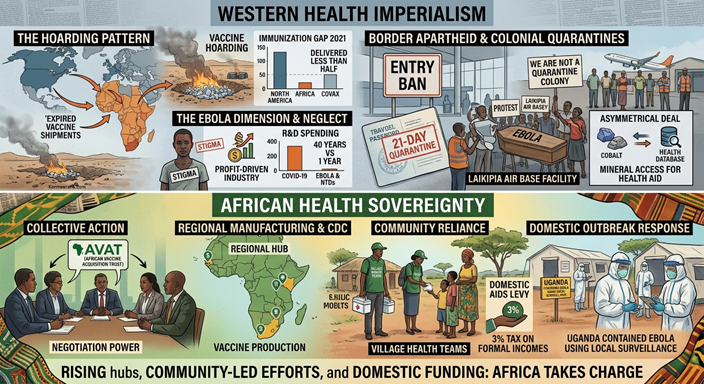
When the 2026 Bundibugyo outbreak emerged, Western nations responded not with solidarity, but with bans. The U.S. enforced a CDC entry ban through mid-October, prohibiting foreign nationals who had visited the DRC, Uganda, or South Sudan within 21 days, and barred returning U.S. citizens from commercial flights. Canada suspended immigration documents and imposed mandatory 21-day quarantines on returning citizens. Grounded in racialized fear rather than epidemiology, these policies treat Africans as vectors, imposing collective punishment in stark contrast to WHO advice against border closures.
The asymmetry is starkest in the U.S.-Kenya deal to establish a 50-bed Ebola bio-isolation facility at Laikipia Air Base. The U.S. goal: ensure no cases enter America. Rather than repatriating exposed aid workers, Washington used leverage to keep them on African soil. Kenya, which has never recorded an Ebola case, was asked to assume massive biological risk. Kenyans protested; police killed at least three. The High Court halted construction, yet it continued. This is health imperialism: African sovereignty stops at Western convenience. Meanwhile, Africans face restrictive visa regimes while Westerners enjoy visa-free access. This is border apartheid.
Vaccine Apartheid and the Hoarding Playbook
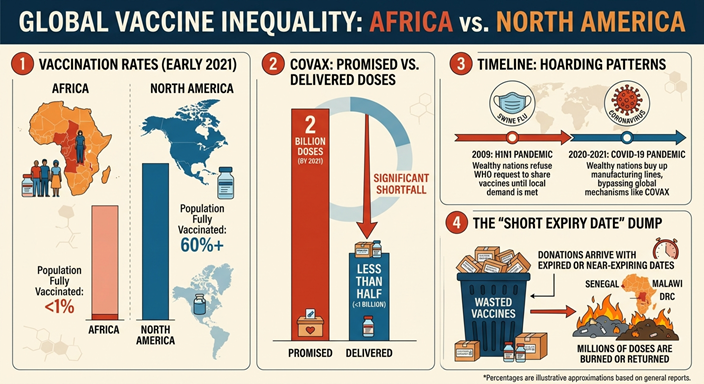
This neocolonial playbook extends to the medicines meant to save lives. During the 2009 H1N1 and 2020 COVID-19 emergencies, Western vaccine hoarding severely undermined Africa’s recovery. High-income countries used advance market agreements to purchase supply volumes vastly exceeding their domestic needs.
Global equity mechanisms collapsed. COVAX pledged 2 billion doses to developing regions by 2021 but delivered less than half. In 2009, the WHO begged wealthy nations to share 10% of H1N1 vaccines; most refused. Consequently, by early 2021, less than 1% of Africa was immunized against COVID-19, compared to over 60% in North America.
When the West finally donated excess stockpiles, it created a new crisis: the “short expiry date” dump. Lacking ultra-cold storage, nations like Senegal and the DRC were forced to publicly burn millions of donated doses. When Africa tried to manufacture its own vaccines, the West blocked them. The EU and UK aggressively blocked a WTO TRIPS intellectual property waiver, prioritizing Western pharmaceutical profits over local manufacturing.
Market Failure, PPPs, and Extractive Deals
This hoarding is rooted in market economics. Ebola R&D receives less than $100 million annually, while COVID-19 R&D spiked to $4.22 billion. A profit-driven industry ignores markets that cannot pay. To fix this, Public-Private Partnerships (PPPs) like CEPI and Gavi subsidize private corporate risk with public tax dollars. The public pays; the private sector profits.
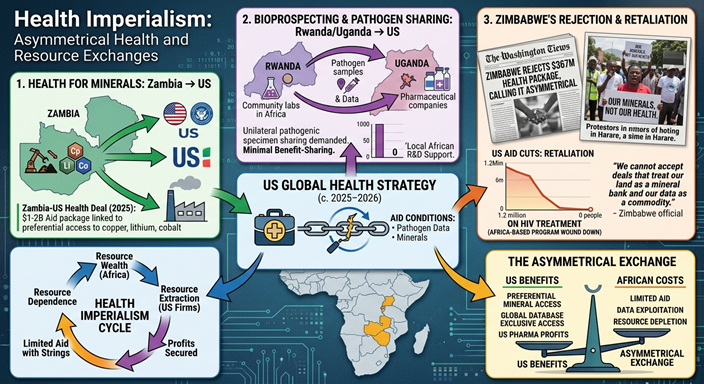
This neocolonial logic extends to bilateral health agreements. Following USAID’s restructuring, U.S. agreements revealed an extractive agenda. In Zambia, a health framework was tied to a Critical Minerals Agreement, granting U.S. companies preferential access to copper and lithium. In Rwanda and Uganda, agreements mandated unilateral pathogen and genomic data sharing with no reciprocal benefit-sharing. The U.S. receives raw data for profitable vaccines; host nations receive no guarantees of affordable access.
Recognizing this asymmetry, Zimbabwe walked away from a $367 million deal, prompting the U.S. to retaliate by cutting HIV aid. Ghana and Zambia also rejected similar deals. They are not anti-health; they are anti-neocolonial.
African Tools of Sovereignty
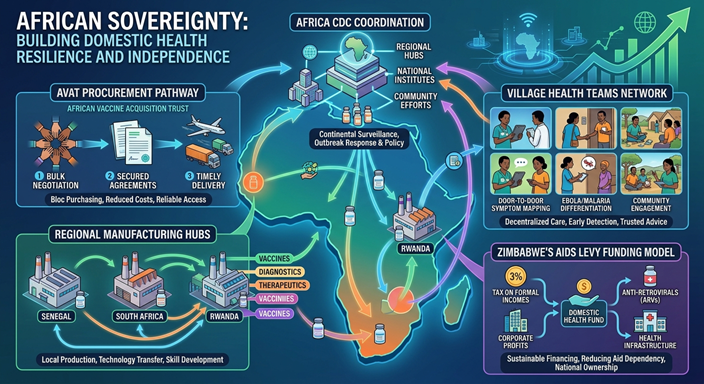
Locked out of the global supply chain, Africa is not waiting. Systematic exclusion catalyzed a decisive shift toward self-reliance. The African Union launched the African Vaccine Acquisition Trust (AVAT) to independently negotiate direct purchasing agreements. Concurrently, the continent is building independent regional manufacturing hubs in Senegal, South Africa, and Rwanda.
On the ground, the Africa CDC coordinates the 2026 Ebola response, standardizing border health and genomic tracking. Village Health Teams serve as the primary early-warning system, conducting door-to-door mapping and culturally respectful safe burials to overcome institutional mistrust.
Domestically, Zimbabwe’s National AIDS Trust Fund—a mandatory 3% tax on incomes and profits—provides a blueprint for survival, expanded via sugar and mobile airtime levies. Regionally, the East African Community is drafting a micro-levy on flights to fund Africa CDC Rapid Response Pools. These are instruments of pharmaceutical sovereignty.
The African Mindset
Tools alone are insufficient; sovereignty requires a mindset shift. Health is a public good, not a commodity. African lives are not bargaining chips for minerals, and African data is not raw material for Western patents.
This mindset must be Pan-African, recognizing that outbreaks cross borders and solidarity must follow. It must be accountable, utilizing transparent, ring-fenced domestic financing. Zimbabwe’s rejection of extractive deals, Zambia’s halt over data privacy, and Kenya’s court challenges are acts of resistance that must become the norm.
The continent is moving from aid dependency to self-determination. By controlling its own health architecture, Africa is proving that it can protect its people without asking permission. This decolonial approach ensures that future crises are met with African solutions, funded by African resources, and guided by African values.
The Virus Does Not Discriminate. Systems Do.
Ebola is a mirror reflecting a world where African outbreaks are ignored until Westerners are at risk, where vaccines are hoarded, and where local manufacturing is blockaded. But it also reflects possibility. AVAT negotiates, Africa CDC coordinates, and regional hubs manufacture. The continent is building a health architecture on its own terms.
The West will continue to securitize, extract, and condition, calling it charity. But neocolonialism by any other name is still neocolonialism. Africa’s response must be sovereignty: the right to name its diseases, own its data, manufacture its medicines, and protect its people without asking permission.
The 2026 Bundibugyo outbreak is an opening. History suggests Africa can walk through it. Justice demands it.