
When Somaliland President Abdirahman Mohamed Abdullahi “Irro” arrived in Washington in September, his objective was clear: persuade the U.S. to treat Hargeisa as a recognized sovereign state. This is a monumental diplomatic hurdle. The United States maintains a steadfast “One Somalia” policy, and under international law, Somaliland remains de jure part of the Federal Republic of Somalia, despite functioning as a self-governing entity for over three decades.
The visit granted Irro access to members of Congress, policy institutions, and influential foreign-policy figures. He appeared at the Hudson Institute, met with lawmakers, and pitched Somaliland as a strategically located partner on the Gulf of Aden and the Red Sea. He asked Washington to look past its rigid legal stance in favor of pragmatic realities on the ground, arguing that Hargeisa’s effective control warrants formal diplomatic engagement.
The Broader Strategic Offer: Ports and Minerals
Seen alongside his other Washington statements, the trip was part of a broader strategy to present Somaliland as a comprehensive security and economic partner. In interviews with The Jerusalem Post and Semafor, Irro discussed what Somaliland could offer the U.S., including port access, mineral resources, and potentially military facilities. He stressed that any arrangement must be reciprocal, rather than a one-sided concession.
The message was explicit: recognition could be accompanied by immense strategic value. Berbera offers critical geographic and maritime advantages near one of the world’s most important shipping corridors. For supporters, this is pragmatic diplomacy that leverages Somaliland’s unique assets. For critics, it raises uncomfortable questions about how far Hargeisa is prepared to go—and what price it is willing to pay—to fracture the internationally recognized borders that Washington is firmly committed to upholding.
The Gaza Proposal: Trading Security for Recognition
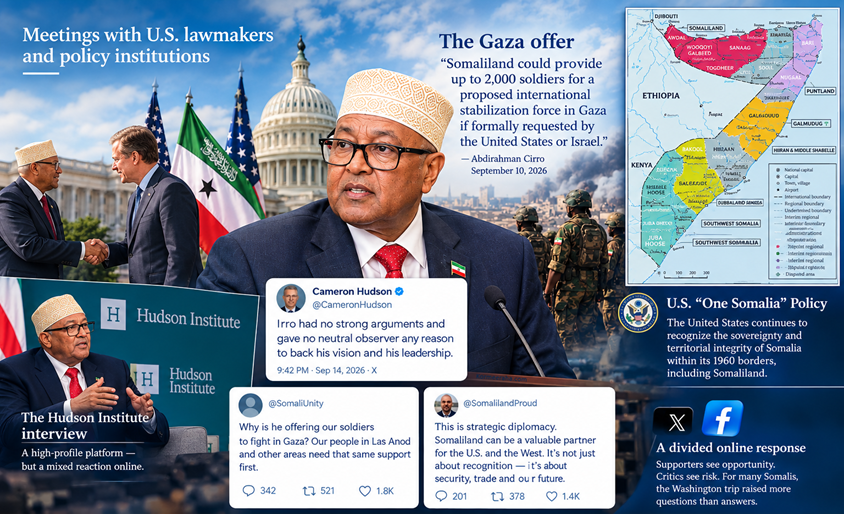
The most consequential statement of the trip occurred on September 10 at the Middle East–America Dialogue conference. Irro announced Somaliland was prepared to provide up to 2,000 soldiers for a proposed international stabilization force in Gaza, provided the U.S. or Israel formally requested them.
“If they ask, we can provide,” Irro said, emphasizing Somaliland was not independently volunteering. The proposed force is envisioned at roughly 20,000 personnel tasked with security and humanitarian aid. Irro noted Somaliland maintains an army of 25,000 and a coast guard of 1,500. By offering troops, Somaliland attempted to act as a sovereign state, directly challenging its de jure status and the U.S. “One Somalia” policy, hoping that undeniable strategic utility might eventually soften America’s diplomatic rigidity.
“Somaliland’s message was no longer solely about securing political recognition; it was about offering itself as a tangible security partner to Washington and Jerusalem.”
Domestic Backlash from the Kaah Opposition
For supporters, the Gaza proposal demonstrated Somaliland’s utility to Western powers, leveraging its trained security personnel to bypass diplomatic stalemates. For critics, however, it raised a glaring question: why offer thousands of soldiers for a highly contentious foreign conflict when the region faces unresolved domestic security and political crises?
This question resonated sharply within Somaliland’s own political arena. On September 10, a spokesman for the opposition Kaah party criticized the proposal, arguing that Somaliland’s soldiers are desperately needed for domestic priorities, specifically citing the need to free soldiers held prisoners by the Northeast State in Las Anod. This illustrated that opposition to the Gaza proposal was not confined to Somalia-unity advocates; it was deeply felt inside Somaliland’s domestic political opposition, highlighting the friction between foreign policy ambitions and local realities.
The Social-Media Firestorm and Semantic Battles
The Gaza proposal quickly ignited a social-media firestorm. Reactions on platforms like Reddit’s Somali discussion forum ranged from fears of Israeli exploitation to criticism that Irro raised the offer unprompted, to fears of soldiers being drawn into the conflict. A recurring argument was that Hargeisa was attempting to exchange strategic military cooperation for political recognition.
The semantic distinction Irro made—that Somaliland was merely standing ready if asked—became a major point of contention. No formal U.S. or Israeli request had been made at the time. Yet, critics treated the statement as a voluntary offer because Irro publicly announced his willingness. For supporters, this demonstrated strategic readiness; for critics, dangerous eagerness. The same sentence acquired completely different meanings depending on the reader’s political lens.
The Hudson Institute Interview and Polarized Reactions
Despite the Gaza statement’s significance, the online debate soon pivoted to Irro’s September 14 appearance at the Hudson Institute. The think tank provided a major platform to articulate why Somaliland should be viewed as a vital Horn of Africa partner. Instead of a diplomatic triumph, short, heavily edited clips from the interview began circulating across Somali social media.
Outlets like Somali Report highlighted criticism of Irro’s answers regarding minerals, Sudan, and Somaliland’s case for U.S. recognition. The debate quickly polarized. Somalia-unity accounts weaponized the clips as evidence that Irro had failed to make a compelling case against the backdrop of America’s established policy. Meanwhile, supporters argued opponents were cherry-picking clips to ignore the broader diplomatic access and high-level meetings Irro had successfully secured during his visit.
“Irro had no strong arguments and gave no neutral observer any reason to back his vision and his leadership.”
Cameron Hudson on X
Access Versus Recognition: Measuring the Trip’s Success
This brings the debate to a fundamental question: what did Irro actually achieve in Washington? There is no dispute that he gained access, meeting with lawmakers and major foreign-policy institutions to discuss security and investment. But access is not the same as recognition.
This distinction became the crux of criticism from Somalia-unity accounts. The U.S. anchors its Horn of Africa strategy on the “One Somalia” policy, officially recognizing Somaliland as an autonomous region. Engaging with Hargeisa as an independent partner directly challenges the territorial framework Washington is committed to preserving. For Somaliland supporters, however, diplomatic recognition is rarely instantaneous. They view building relationships as a long-term process to eventually override the “One Somalia” consensus, meaning the two sides measured the trip by entirely different standards.
Competing Visions for Somaliland’s Future
The reaction to Irro’s trip exposes several competing visions for Somaliland’s future. One vision emphasizes securing international recognition through strategic, militarized partnerships, effectively asking the world to ignore its de jure status. Another argues Somaliland must first consolidate its domestic political and security position before projecting power abroad. A third rejects the independence premise entirely, relying on the fact that international law and U.S. policy stand firmly with Mogadishu.
None of these narratives reduce to a simple victory or defeat. The Gaza proposal has not produced a troop deployment, and the Washington meetings did not shift the “One Somalia” doctrine. However, the trip demonstrated a clear shift in Hargeisa’s foreign policy.
“The true test is whether he can translate Washington access into concrete diplomatic gains without creating new political liabilities at home.”