
When a contested property transaction ignites a regional war, the resulting exodus exposes the deep fractures of Ethiopia’s ethnic federalism and the high price of an unfinished ethnic map.
To understand the tragedy unfolding in Moyale, one must first understand that it is not merely a town; it is a cartographic ghost. Straddling the porous boundary between Ethiopia and Kenya, Moyale is a place where the map refuses to align with the territory. Today, that misalignment is being paid for in blood, displacement, and shattered livelihoods.
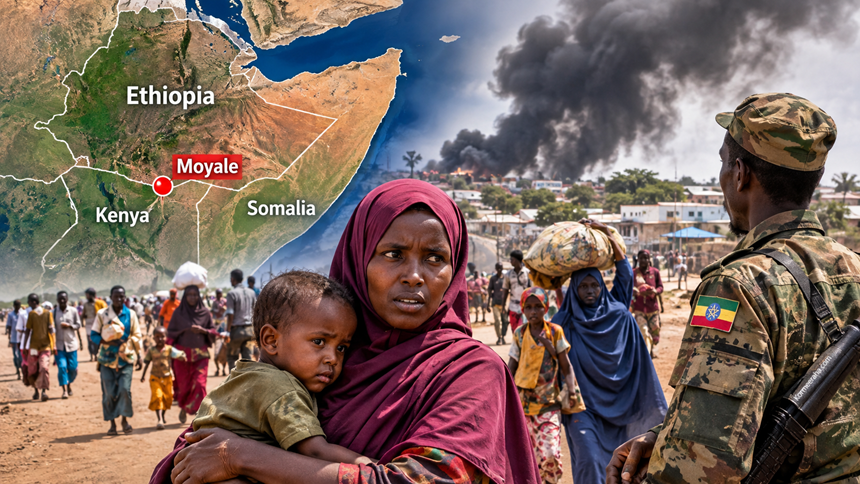
What began as a localized dispute over real estate in mid-October has metastasized into a severe security and humanitarian catastrophe. As 50,000 flee the crossfire of a disputed border town, the crisis lays bare the fatal intersections of demographic shifts, ethnic federalism, and geopolitical maneuvering in the Horn of Africa. For the Somali community, local intellectuals, and international policy watchers, the crisis in Moyale is not an isolated border skirmish. It is a glaring stress test of Ethiopia’s ethnic federalism, a mirror reflecting the fragility of the Horn’s geopolitics, and a stark reminder of the human cost of deferred political truths.
“In Moyale, the map refuses to align with the territory. Today, that misalignment is being paid for in blood.”
The Spark and the Inferno
Historically a predominantly Somali locality, Moyale has recently seen a significant influx of Oromo migrants from the broader Oromia region, reigniting long-standing grievances over local administration. The flashpoint was deeply spatial: a contested real estate transaction. When a building originally owned by an Oromo family was sold, local Oromo residents mobilized, pressuring the owner to cancel the sale.
On October 18, 2026, officials from the Ethiopian Somali Regional State transformed this property dispute into a question of sovereignty. They opened an administrative office in the contested building and hoisted the Somali regional flag. The symbolism was explosive. For the Somali administration, this was an assertion of its jurisdictional authority. For the city’s Oromo community, it was a provocation. They reject Somali authority and viewed the move as an illegitimate consolidation of dominance within a rapidly changing neighborhood.
The retaliation was swift. By October 22, the dispute had metastasized into full-scale urban warfare across seven districts, pitting Oromia regional militias and police directly against the Somali regional state’s special forces. The human toll has been catastrophic. Over 50,000 people have fled the Ethiopian side into Kenya. The humanitarian metrics are grim. The IOM reports that 71% of displaced families lack sufficient food, with 80% citing it as their most urgent existential need, as they grapple with severe water shortages and a collapsing healthcare infrastructure.
The Cartographic Trap: A Border Drawn in Sand
To the international observer, the violence may seem inexplicable. To the local intellectual, it is the inevitable result of a legal fiction.
Legally and administratively, Moyale is a paradox. The Ethiopian federal government recognizes it as a “jointly administered town,” split into two distinct districts (woredas) bearing the exact same name. On one side, it is a district in the Somali Regional State’s Dawa Zone. On the other, it sits in the Oromia Regional State’s Borena Zone. Both have their own mayors, police forces, and administrative structures.
In this legal limbo, a raised flag or a sold building is instantly interpreted as an illegal land grab. The lack of a boundary has transformed administrative rivalry into an existential threat.”
The physical border between these two jurisdictions is largely invisible. In many neighborhoods, the administrative divide is marked by nothing more than a single dirt road. This ambiguity is the direct legacy of the 2004 National Election Board of Ethiopia (NEBE) border referendum. Over 420 disputed kebeles were voted on to settle the boundary. However, nine kebeles in Moyale were deliberately excluded due to intractable disputes over voter registration and displaced populations.
Because the federal demarcation was never finalized, digital maps like Google often place Moyale entirely within Oromia, while the federal constitution mandates dual administration. This legal limbo means any new government office, building sale, or raised flag is instantly interpreted by the “other” side as an illegal land grab. The lack of a legal boundary has transformed administrative rivalry into an existential threat.
The Calculus of Federal Silence
Perhaps the most damaging element of the Moyale crisis is not just the crossfire, but the calculated silence from Addis Ababa. The Ethiopian federal government’s response has been widely characterized as sluggish, failing to deliver a sustainable solution despite eventual military and diplomatic interventions.
In the critical early days, the federal government issued no official statements. Locals reported to the BBC that a severe lack of federal security deployment allowed the violence to spiral, drawing heavy criticism of Prime Minister Abiy Ahmed’s administration. It was not until late October, as the fighting spilled into neighboring areas like Hudet and Arero, that the Ethiopian National Defense Force (ENDF) finally intervened to contain the regional forces.
This delay has fueled intense allegations that Abiy Ahmed is exhibiting ethnic bias, quietly siding with his Oromo kin. Somali politicians point to deeply troubling indicators. The mayor of the Somali-side of Moyale accused the federal government of deliberately cutting off water, electricity, and telecommunications to Somali neighborhoods. Critics argue the federal troops employ a “double standard,” intervening only when Somali forces gain the upper hand, while turning a blind eye when Somali areas are attacked. Furthermore, figures like Kenyan MP Farah Moalim and politician Faisal Roble have accused Oromo political forces of pursuing a systematic territorial expansion against Somalis since 2018.
“In the Horn of Africa, the optics of inaction are often as politically explosive as the action itself.”
However, the hard truth is more complex. Independent monitors and the Ethiopian Human Rights Commission have found no concrete evidence that the federal government directly orchestrated or funded the attacks. Security analysts note that the ENDF’s delayed response is heavily tied to the severe military overstretch caused by ongoing conflicts in the Amhara and Tigray regions. Nevertheless, in the Horn of Africa, the optics of inaction are often as politically explosive as the action itself.
Narrative Warfare: Jawar Mohammed and the Diaspora Backlash
As the bullets flew, a fierce battle of narratives erupted, spearheaded by prominent Oromo politician Jawar Mohammed. Attempting to de-escalate the ethnic framing, Jawar argued that the conflict was not a broad Somali-Oromo war, but a localized, historical clan dispute between the Borana and Garre—communities that share deep linguistic and cultural ties.
Jawar did not hold back against his own political establishment. In a November 2026 interview, he called it a “shame” that Prosperity Party leaders—including Abiy Ahmed, Aden Farah, and Mustafe Cagjar—were watching citizens kill each other, accusing them of forgetting their shared historical struggles.
More provocatively, Jawar introduced a geopolitical dimension, accusing the Eritrean government (allegedly backed by Egypt) of stoking the violence to open an eastern front against Ethiopia. He also sharply criticized Kenya-based politicians, specifically naming Farah Maalim, accusing them of using social media to spread inciting rhetoric and fabricated images. He vehemently denied any narrative of Oromo territorial expansion.
For the Somali diaspora and local intellectuals, Jawar’s framing was viewed as a masterclass in deflection. Somali writers and politicians fiercely pushed back, accusing him of attempting to sanitize the reality on the ground, victim-blaming, and reducing the systematic burning of Somali homes and businesses to a mere “clan dispute.”
The Regional Echoes: Diaspora Mobilization and Kenyan Anxiety
The crisis has sent shockwaves through the broader Somali community in the Horn of Africa and the global diaspora. On the Kenyan side, the response has been deeply communal. Residents in Mandera and Wajir have opened their homes, absorbing the initial shock of the 50,000 refugees. Kenyan Somali politicians have amplified the crisis, demanding that Nairobi secure the border and pressure Addis Ababa to halt what they term “planned displacement.”
Globally, the diaspora has mobilized. From Columbus, Ohio, to Minneapolis, and across Europe and the Middle East, emergency fundraising drives have been launched to provide food, water, and shelter. On social media, the #Moyale campaign has been deployed to bypass traditional media gatekeepers, forcing international human rights organizations to look at the crisis. Meanwhile, Somali cultural elders and Ulama (religious scholars) have walked a delicate line: issuing urgent baaqyos (appeals) for humanitarian relief and neighborly peace, while simultaneously demanding that the Ethiopian federal government intervene with absolute impartiality.
The Bleeding Edge: A Weekend of Renewed Blood
Any hopes that the situation had stabilized were shattered over the weekend. As of today, November 17, 2026, the fragile lull in Moyale has collapsed into a renewed and intensified phase of violence.
In the early hours of November 16, heavy fighting erupted once more, with fresh reports alleging that military personnel and militias from Ethiopia’s Oromia Region launched targeted operations against homes and businesses in the contested zones. The human toll continues to mount with deadly predictability. Over the past few days, up to eight people have been killed in suspected militia attacks near the border. The violence has also exacted a direct toll on Kenyan soil; Friday night clashes left two Kenyan civilians dead and 20 others injured from stray ammunition.
The Governor of Marsabit County has issued stark warnings that this cross-border bleeding is not only a severe security threat but is pushing local resources to the breaking point. Inside Kenya, the humanitarian crisis has reached a critical bottleneck. The 50,000 Ethiopians who fled the initial onslaught are now joined by a fresh wave of displaced families. While the Kenya Red Cross and UNHCR are working tirelessly to distribute essential supplies, multi-agency assessments confirm that the needs for food, clean water, and emergency shelter remain desperately unmet.
Diplomatically, the gears are turning, but they are grinding against the reality of the battlefield. Kenyan authorities continue to engage the Ethiopian federal government to mediate an end to the conflict, yet a formal, lasting ceasefire remains elusive. The root cause—the unresolved legal and demographic contestation of the town—remains entirely unaddressed.
The Hard Truth
The tragedy of Moyale is that it is a crisis entirely of human making, sustained by political convenience, demographic friction, and historical neglect. Until the Ethiopian federal government summons the political courage to finalize the 2004 border demarcation, and until regional leaders abandon the weaponization of identity and real estate for territorial gain, Moyale will remain a bleeding wound on the map of the Horn.
For the 50,000 souls sleeping on the floors of Kenyan schools and makeshift camps, the map is not an abstract legal concept. It is the difference between a home and a graveyard.
And for the international community watching, Moyale stands as a stark warning: in the Horn of Africa, unfinished borders do not wait forever to be resolved. Eventually, they demand to be settled in blood.
Editor’s Note: The situation in Moyale is highly fluid. This analysis reflects verified developments on the ground as of November 17, 2026. For real-time updates on ceasefire negotiations, border reopenings, and humanitarian aid distribution, readers are encouraged to consult verified regional monitors and international aid agencies.
Related
- The Calculus of Medemer: What the Somali Region Stands to Lose in Ethiopia’s Centralizing Project (November 16, 2026)