

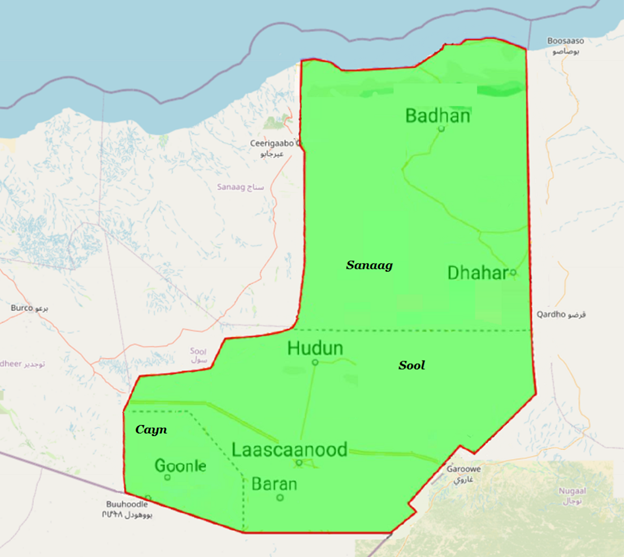
On July 30, 2025, a new chapter began in northern Somalia. Following a constitutional convention with 417 delegates in Las Anod, the former SSC-Khatumo state was officially renamed and expanded into the North-East State of Somalia. This formalizes a new, autonomous federal member state within Somalia.
Geographic and Clan Composition
The new entity encompasses the territory of the CSS-Khatumo interim administration and the areas claimed by militants in Makhir State. Wedged between two autonomous rebel territories, Somaliland and Puntland, the Northeast State, which also stretches from the Ethiopian border to the Indian Ocean, comprises two regions – Sool, Cayn and Sanaag – inhabited mainly by the Dhulbahante and Warsangeli sub-clans, two branches of the Harti Darod clan.
The Struggle for Autonomy: Conflict and Liberation
The path to statehood was forged in conflict. In December 2022, Somaliland forces fired on unarmed protesters in Las Anod, killing civilians. When local leaders declared independence from Somaliland on February 6, 2023, the city endured a seven-month siege and shelling campaign, resulting in hundreds of civilian deaths and massive displacement.
The turning point came on August 25, 2023, with the Goojacadde victory. SSC-Khatumo forces decisively defeated Somaliland troops, decimating nearly a third of their forces. This military success shocked observers and fundamentally altered the status quo in the disputed regions.
Overlapping Claims and Local Dissatisfaction
The region had long been contested. Somaliland claimed it as part of the former British Somaliland protectorate, while Puntland claimed it based on Harti Darod clan kinship since its creation in 1998. For the local population, these overlapping claims resulted only in lawlessness, insecurity, and acute underdevelopment.
During the war, the Puntland administration under President Said Abdullahi Deni refused official direct assistance. However, his own Majerteen sub-clan, driven by clan solidarity, sent various armed militias from Puntland to lend a hand to their embattled kinsmen, which proved crucial to the SSC-Khatumo’s victory.
Political Maneuvering and Reluctant Recognition
After liberation, SSC-Khatumo refused to be absorbed by Puntland, insisting on its own autonomy. The Federal Government of Somalia (FGS), led by President Hassan Sheikh Mohamud, was initially reluctant to grant full recognition.
This reluctance stemmed from several factors:
- A hope that withholding recognition might draw Somaliland back to unification talks.
- A desire to use conditional recognition as leverage in power struggles with Puntland.
- A concern about upsetting Somalia’s perceived clan balance: adding another Darod-led state (alongside Puntland and Jubaland) was seen as disruptive to the existing political equilibrium.
A pivotal moment illustrating Mogadishu’s initial cold shoulder occurred on October 19, 2023. SSC-Khatumo’s interim leader, Abdiqadir Ahmed Aw-Ali “Firdhiye”, submitted his request for recognition in person. Instead of meeting the President, he was received only by the Interior Minister, Ahmed Moalim Fiqi. As a noted champion of a unified Somali state, Fiqi’s intermediary role at this critical juncture underscored the administration’s cautious, and some argued dismissive, stance toward the nascent state’s ambitions.
Recognition Achieved: A New Political Reality

The political landscape has since shifted. As federal elections approach, President Hassan Sheikh’s administration has alienated Puntland and Jubaland. Fully aligning with the stable and independent North-East State now offers valuable political support.
For its part, the North-East State demonstrated steadfast stability, maintaining independence from both Somaliland and Puntland while cultivating allies in Mogadishu. This earned it the right to full recognition.
Conclusion: The Seventh Member State
The North-East State of Somalia is now formally welcomed as the 7th member state of Somalia’s federal structure. Its new constitution promises inclusive governance, with a parliament designed to represent both the majority Harti clan and local minority clans.
The resolution of this long-disputed territory heralds a new era of stability and federal authority in northern Somalia, marking a significant step in the country’s ongoing state-building process.
