

When Somalia announced, on January 12, it was annulling all agreements with the United Arab Emirates, the language from Mogadishu was unmistakable: sovereignty had been violated, national unity undermined, and foreign actors had crossed a red line.
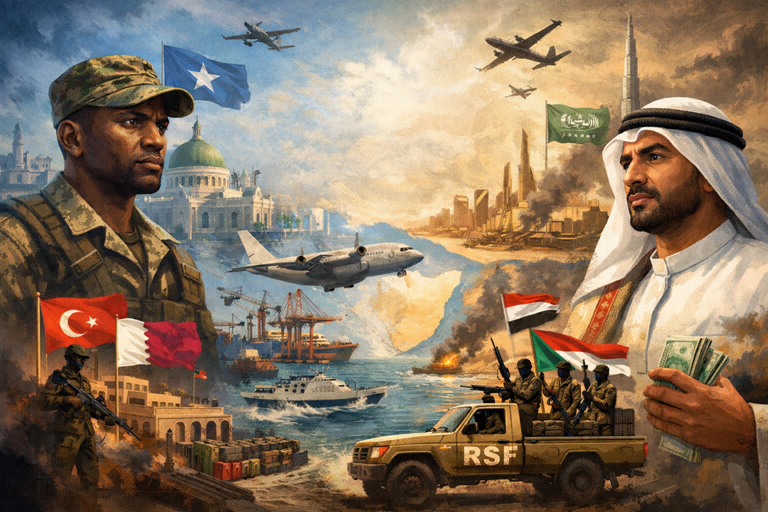
But behind the formal communiqués lies a far more complex geopolitical rupture — one shaped by Gulf rivalries, Red Sea militarization, the war in Sudan, Somaliland’s diplomatic maneuvers, and Somalia’s own fragile federal politics.
This is not merely a diplomatic dispute. It is a recalibration of power across the Horn of Africa.
“This was not just about contracts — it was about who controls Somalia’s sovereignty.”
The Official Case: Sovereignty and Airspace
Somalia’s government framed its decision as a matter of national dignity and constitutional authority. Officials accused the UAE of violating Somali sovereignty, particularly through its engagement with federal member states and through alleged unauthorized use of Somali airspace and infrastructure.
The immediate friction reportedly involved Emirati-linked flights and activities that Mogadishu claims bypassed federal approval. For a government already struggling to assert control over its federal regions, the issue became symbolic: no foreign power, officials insisted, could treat Somalia’s fragmented political structure as an invitation to circumvent the centre.
Yet the rupture cannot be understood without looking beyond the official explanation.
The Somaliland Factor
For years, the UAE has cultivated deep ties with Somaliland, the self-declared republic in northern Somalia. Through DP World, Abu Dhabi invested heavily in Berbera Port, turning it into a strategic commercial and logistics hub along the Red Sea corridor.
Tensions escalated dramatically after reports that Israel moved toward recognizing Somaliland — a development widely believed in Mogadishu to have been facilitated or encouraged by Emirati diplomacy.
For Somalia’s federal government, this crossed a strategic threshold.
Recognition of Somaliland would not simply be symbolic; it would reshape regional alignments, insert Israel formally into Red Sea geopolitics via a non-recognized entity, and weaken Somalia’s territorial claim at a moment when it is already politically fragmented.
“For Mogadishu, Somaliland recognition is not a local issue — it is a geopolitical earthquake.”
Sudan, the RSF, and the Air Corridor Question
Another layer of tension involves the war in Sudan. United Nations experts and investigative reports have documented allegations that the UAE provided support to Sudan’s Rapid Support Forces (RSF), claims Abu Dhabi has denied.
Within Somalia, concerns intensified over reports that Somali airspace and facilities — particularly in semi-autonomous regions — may have been used as transit points for logistics linked to the Sudan conflict.
Whether or not Mogadishu publicly detailed these concerns, the perception that Somalia risked becoming an unintended corridor for another nation’s war added fuel to the sovereignty argument.
“Somalia’s airspace cannot become a corridor for other people’s conflicts.”
Gulf Rivalries Spill into the Horn
The rupture also reflects shifting dynamics between Saudi Arabia and the UAE. Once closely aligned, the two Gulf powers increasingly compete for influence across the Red Sea basin.
Saudi Arabia has deepened its engagement with Horn of Africa states, while the UAE has expanded its network of ports and security partnerships stretching from Yemen to Eritrea, Somaliland, and Puntland.
Somalia’s move can be read as part of this broader recalibration. Aligning more closely with Riyadh — and maintaining strong ties with Turkey and Qatar — provides Mogadishu with counterweights to Emirati leverage.
Turkey, in particular, has become Somalia’s most visible security partner, training thousands of Somali soldiers and managing key infrastructure in Mogadishu. Qatar has also maintained political ties with Somalia’s current leadership.
In this context, distancing from Abu Dhabi may be less about isolation and more about repositioning.
The Shadow of 2018
This is not the first rupture.
In April 2018, under President Mohamed Abdullahi “Farmajo,” Somali authorities seized $9.6 million from a UAE aircraft at Mogadishu airport, triggering a diplomatic crisis. The UAE said the funds were intended to pay Somali troops; the Somali government questioned the legality and transparency of the transfer.
Relations deteriorated sharply, and security cooperation was suspended.
When President Hassan Sheikh Mohamud returned to office in 2022, ties were restored. The seized funds were returned, and engagement resumed. His election, viewed by some domestic critics as benefiting from Gulf backing, initially signaled renewed cooperation.
The current break therefore represents not a sudden shift, but the latest swing in a volatile relationship.
Domestic Politics: Reasserting the Centre
Somalia’s internal dynamics are critical to understanding the decision.
Federal member states such as Puntland and Jubaland maintain their own relationships with the UAE, particularly in security and port development. By cancelling federal agreements, Mogadishu is also sending a message to regional leaders: foreign policy authority rests with the centre.
In a country where federal cohesion remains fragile, sovereignty is not just external — it is internal.
The move allows President Hassan Sheikh to reclaim nationalist ground amid criticism and to demonstrate that Somalia is not beholden to any external patron.
The Economic Gamble
The costs, however, are real.
The UAE has been one of the most active investors in Somali port infrastructure. Cutting agreements risks deterring foreign direct investment and complicating trade flows, particularly in regions that depend on Emirati-linked projects.
For a country rebuilding after decades of conflict, walking away from Gulf capital is not a trivial decision.
Yet the calculation appears strategic: sovereignty and political cohesion may, in the government’s view, outweigh immediate economic gains.
A Signal Beyond Contracts
Ultimately, Somalia’s decision is less about terminating agreements and more about redefining boundaries.
It signals that the country’s current fragility will not be treated as a geopolitical opening for others to maneuver unchecked. Mogadishu is asserting that vulnerability does not equal permission — and that competition among Gulf powers, regional rivals, and global actors must unfold on terms set in the Somali capital, not negotiated around it.
“Somalia may be fragile — but it is not for sale.”
Whether this posture can be sustained amid economic pressures and regional rivalries remains to be seen. But the message is unmistakable: Somalia intends to play a more assertive role in shaping how external power struggles unfold on its own soil.
In the Horn of Africa’s new era of strategic competition, Somalia is no longer content to be an arena. It wants to be an actor.
