
How Mogadishu’s failure to reward merit drove a national icon into the arms of secession
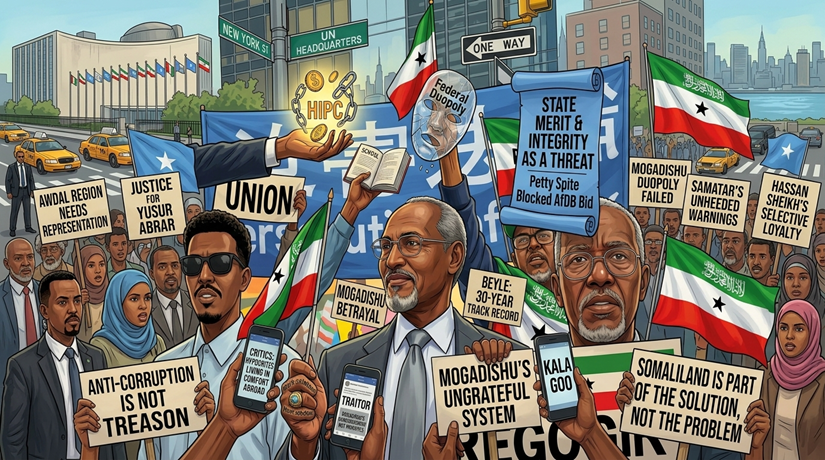
Recent footage from the streets and the United Nations headquarters in New York, featuring Dr. Abdurahman Duale Beyle/Beileh campaigning for Somaliland’s international recognition, has sparked shock and an unsettled debate across the Somali political landscape. The man who was once the “Face of Finance and Diplomacy” for Somalia, who penned the very songs and poems celebrating unity and the blue flag, is now declaring on an international stage that Somaliland has the right to be an independent state—even if Israel is the one to recognize it.
To the casual observer, this is a story of emotional betrayal. But to the keen analyst of Somali politics, Dr. Beyle’s unexpected political U-turn is not merely a personal shift; it is a stark mirror reflecting the pain, disillusionment, and systemic failure of Mogadishu’s state-building project. It is time to restore a truth that some would like to smother in the capital: the campaign of denigration waged against Dr. Beyle is deeply unjust, poorly founded, and revealing of a political system that has long ceased to reward merit, patriotism, and selfless service.
The Anatomy of Betrayal: Merit vs. The Duopoly
To understand the poet’s dilemma, one must first examine the toxic environment of Mogadishu’s factional politics that broke his faith in the center. During President Mohamed Abdullahi Farmajo’s mandate, Beyle was the tireless engine of the administration. Yet, when he sought a parliamentary seat, he was denied—because in Mogadishu, one is rarely elected; one is selected. As reported by Kormeeraha magazine, Farmajo never stepped out of the shadows to publicly support him while he was being lynched in Parliament.
When President Hassan Sheikh Mohamud took office, Beyle temporarily continued to serve to keep the crucial IMF debt relief project on track. Instead of being rewarded for stabilizing the economy when international budgetary aid had been cut, he was vilified as a “stooge” and subjected to a relentless smear campaign.
The final blow came when Beyle, possessing over 30 years of experience at the African Development Bank (AfDB), sought the federal government’s endorsement to lead the institution. Hassan Sheikh blocked him. The message was clear: the federal presidency and its highest rewards are the preserve of a Darod-Hawiye duopoly. Men from the Awdal region, despite their boundless love for a united Somalia and their undeniable competence, are kept at arm’s length. When the system operates on nepotism rather than meritocracy, the intellectual is forced to choose between irrelevance in the center and dignity in the periphery.
The Toll of Homecoming: Coercion and Political Realism
Critics accuse Beyle of treason, ignoring the complex reality of his homecoming. When Beyle lost any chance of remaining in Mogadishu to serve, Hargeisa actively courted him. However, there is a catch. One of the unwritten conditions imposed by the Somaliland secessionists on former federal officials wishing to return to their regions of origin is the public repudiation of the Somali union.
This is a form of political blackmail. Dr. Beyle, a man of immense intellect, surely harbors no illusions about the exclusive clan regime in Hargeisa; he knows the fate that awaits former unionists there. Yet, having been pushed out the door by the so-called guardians of the union in Mogadishu, he had no choice but to pay the toll to return home and serve his people. His shift is thus a complex amalgamation of genuine disillusionment with Mogadishu’s failures and the pragmatic coercion required to operate in Hargeisa.
The Grassroots Patriot vs. The Diaspora Hypocrisy
The irony of the current social media witch-hunt is that it is largely driven by the diaspora and politicians who enjoy comfort and safety abroad. They cry treason against a man whose patriotism was built in brick and mortar. Long before his federal tenure, in 2008, Beyle founded a secondary boarding school in Geb, a rural locality in the heart of Awdal. This highly demanding project, mobilized with the region’s diaspora, enabled rural children to continue their studies. Its first graduates are now doctors, nurses, and teachers.
You cannot measure a man’s love for his country solely by his federal portfolios; you must look at what he built when no one was watching. Watching formerly obscure diplomats and petty social media influencers try to attack a giant who has left an indelible mark on the federal financial system is not just ridiculous; it is obscene. They want to seize the moment to make a name for themselves, but they cannot measure up to his legacy.
The Precedent of the Intellectual’s Revolt
Dr. Beyle’s departure is not an isolated incident; it is part of a tragic pattern of marginalized technocrats. We must recall Dr. Yusur Abrar, the former Governor of the Central Bank, who fled Mogadishu for her life after being targeted for her anti-corruption work. We must remember Dr. Elmi Mohamed Nur, who replaced Beyle as Finance Minister and was promptly fired when he tried to continue Beyle’s anti-corruption reforms.
And we must look to Professor Ahmed Ismail Samatar. An ardent nationalist and fierce critic of secession, Samatar was told by former President Sharif Sheikh Ahmed that there was “no place in Mogadishu for someone of his clan.” Like Samatar, and like the late Prime Minister Ali Khalif Galaydh who also eventually repudiated the elusive union, Beyle represents the “Intellectual’s Revolt.” When the center of the country becomes a place where output, justice, and intellect are punished, the intellectual chooses to salvage their dignity by serving their homeland.
Conclusion: Patching the Cracking Boat
Those who complacently enjoy their lives abroad while dragging Dr. Beyle through the mud should know two things. First, in practical political and economic terms, Somaliland’s current status is no different from that of Puntland or Jubaland; the constitutional debate is secondary to the reality of the fractured state. Second, they should direct their time and energy toward patching the federal boat, whose hull is cracking more and more under the current administration.
Dr. Abdurahman Duale Beyle has gone down in Somalia’s history as the man who restored the country’s economic dignity with his own hands, yet that same history will record him as the man who convinced the world that the Somalia he served is fracturing. The poet who once sang of unity now navigates its ruins—not because he chose to, but because those who controlled the center left him no stage upon which to sing.
It is a historical tragedy, but it is the natural outcome of a failed political system that failed to honor its own heroes. Mogadishu pushed him out; Hargeisa demanded a toll. If we truly want to defend Somalia’s unity, we must stop attacking the patriots who were forced to leave, and start building a system that gives them a reason to stay.