

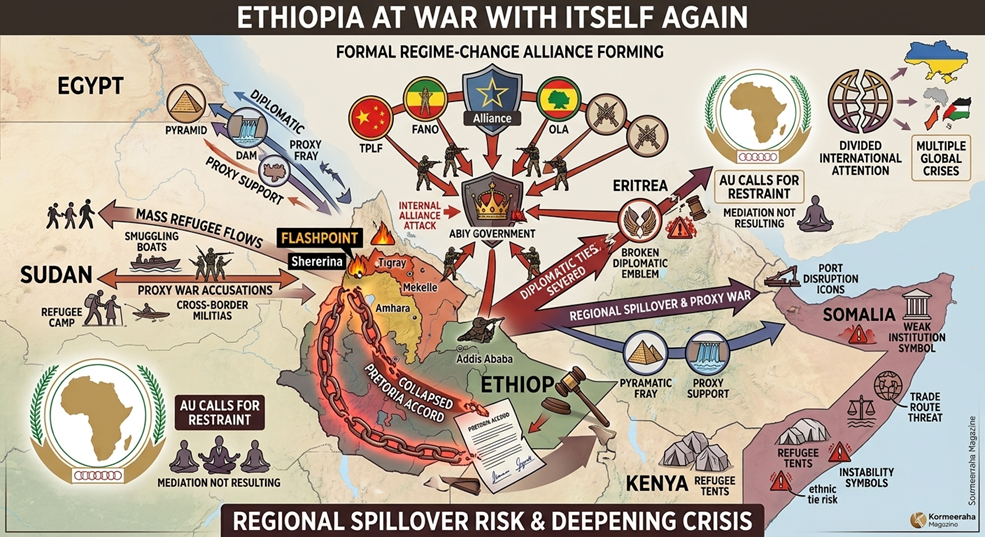
For years, Ethiopia’s federal government and regional militias existed in an uneasy truce. Violence flared and alliances shifted, but the country repeatedly avoided a return to the scale of the Tigray War of 2020–2022. That restraint has now collapsed. After forming a formal military alliance with six other armed groups, the Tigray People’s Liberation Front (TPLF) seized airports across Tigray and declared what it calls a defensive war against the federal government.
This escalation grew out of unresolved grievances from the Tigray War, an incomplete peace agreement, Prime Minister Abiy Ahmed’s centralization of power, and a realignment of forces that once fought one another. The immediate trigger was Shererina, a strategically vital town near the Sudanese border. Since then, Ethiopia and Eritrea have severed diplomatic ties, the federal government has accused Eritrea, Sudan, and Egypt of backing the rebels, and hundreds have been killed. This article examines how Ethiopia reached this point and what the widening conflict could mean for the Horn of Africa.
Background : TPLF Dominance And Abyi’s Rise
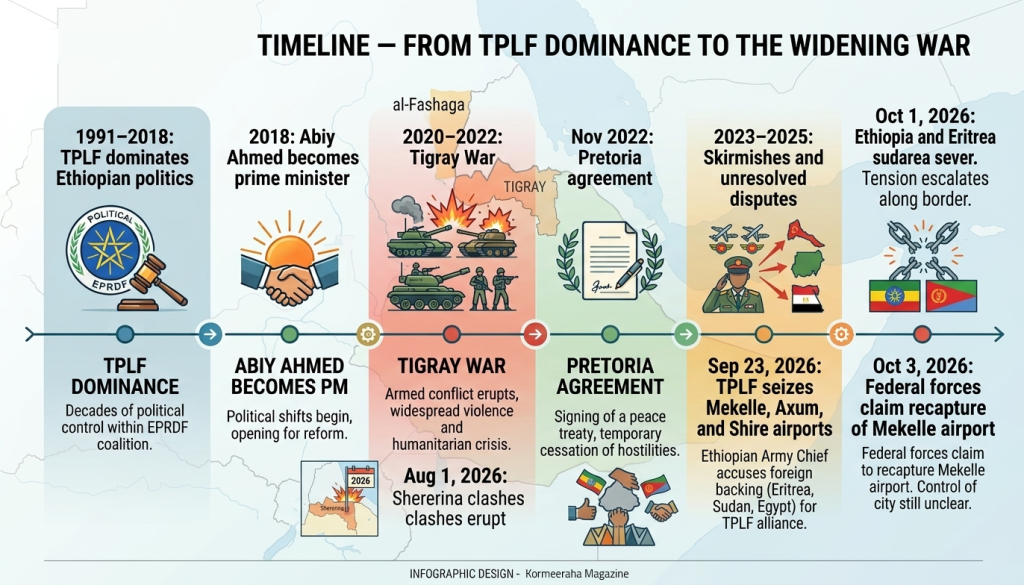
From the 1990s until 2018, Ethiopian politics was dominated by the TPLF, a militia from Tigray, one of Ethiopia’s twelve regional states. Though Tigrayans are only about 6% of the population, the TPLF helped overthrow the Derg dictatorship, which ruled from 1974 until around 1990, and then became the country’s most formidable military force. That power helped it dominate national politics.
The TPLF was preferable to the Derg, one of the most brutal regimes in modern history, but its rule was flawed. Economic growth was relatively solid, yet elections were not considered free or fair internationally. The TPLF also fought an expensive border war with Eritrea, led by Isaias Afwerki, from 1998 to 2000.
The TPLF was ousted in 2018 when two former allies in the legislature defected and backed Abiy Ahmed, a reformist critic of the TPLF. With their support, Abiy became prime minister. Tensions deepened over regional autonomy, including Tigray’s, which was still led by the TPLF.
The Tigray War, 2020–2022
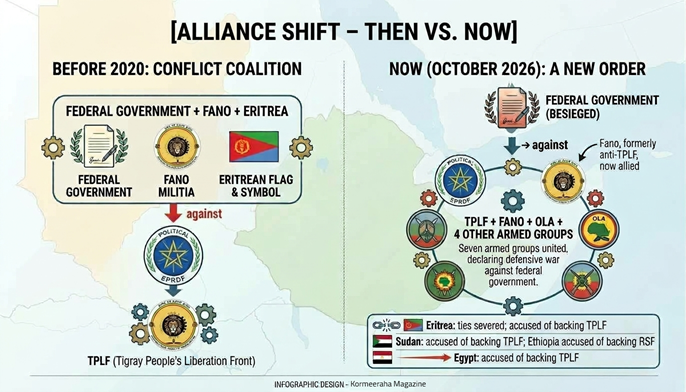
The standoff became full-scale war. Abiy’s federal forces were joined by regional militias—most notably the Fano from Amhara, who resented the TPLF’s earlier dominance—and by Eritrea.
The war lasted two years and was appallingly brutal. Ghent University researchers estimate that as many as 378,000 people were killed, most of them civilians. It ended with the Pretoria agreement in November 2022, which promised lasting peace but left key issues unresolved. The agreement excluded other regional militias and Eritrea, and it did not settle the dispute over western Tigray. Abiy’s government also refused to recognize or register the TPLF as a political party, and Tigray was excluded from the June election. Skirmishes continued, but they did not become all-out war.
That fragile calm was shattered on August 1, 2026, when heavy fighting erupted in Shererina, western Tigray. As we reported at the time, the clashes signaled the collapse of the Pretoria Accord. The Shererina spark set the stage for the TPLF’s next move: a formal military alliance and a declared defensive war.
The new TPLF Alliance And Shifting Regional Dynamics
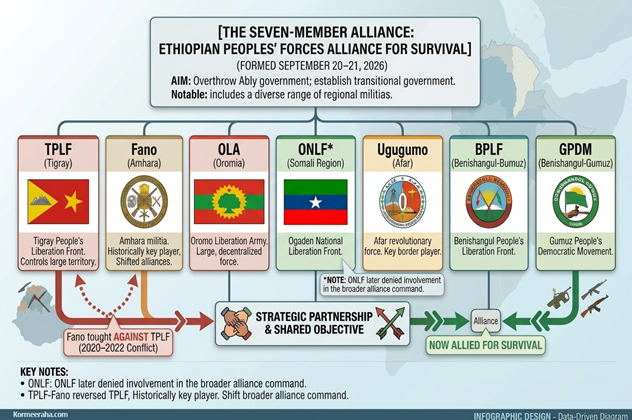
On September 20–21, 2026, seven armed groups announced the Ethiopian Peoples’ Forces Alliance for Survival, whose explicit aim is to overthrow Abiy’s government and establish a transitional government. The alliance brought together groups that were previously rivals—or even fought on opposite sides of the Tigray War.
The seven members are the TPLF, the Amhara Fano National Movement, the Oromo Liberation Army, the Ogaden National Liberation Front, the Afar Revolutionary Democratic Unity Front (Ugugumo), the Benishangul Peoples’ Liberation Front, and the Gumuz Peoples’ Democratic Movement. Fano leader Zemene Kassie chairs the alliance. The coalition spans Ethiopia geographically, from Tigray in the north to the Somali Region in the south.
This is a significant shift from 2020–2022, when the Fano fought alongside federal forces against the TPLF. The TPLF’s decision to ally with former enemies reflects the broader realignment: Abiy has replaced the TPLF as the perceived common enemy. The alliance’s objective is not defensive but explicitly regime change.
Military Escalation: Airports Seized, Multiple Fronts Opened
On September 23, 2026, Tigrayan forces seized control of airports in Mekelle, Axum, and Shire, marking a shift from months of mutual pressure to direct confrontation. Ethiopian Airlines suspended all flights to the three airports. By seizing the airports, Tigrayan forces cut federal access to the region’s civilian and military infrastructure.
The TPLF then announced what it called a “defensive war” against the federal government. The Ethiopian military claimed it had repelled attacks and killed 272 Tigrayan fighters in a counteroffensive in Amhara. Armed clashes broke out along multiple fronts, including the Kobo–Tumuga direction, the Zata, Dinqa, and Sekota lines along the Tigray–Amhara border, and the Tonsa line along the Tigray–Afar border.
By early October, the federal government and allied militias had launched a counteroffensive along three lines of advance toward Mekelle. On October 3, pro-government forces claimed to have recaptured the main airport in Mekelle, with reports of TPLF fighters abandoning posts and looting government facilities. The situation on the ground remains fluid.
Shifting Regional Dynamics And The Eritrea Break
The most dramatic regional development came on October 1, 2026, when Ethiopia announced it was closing its embassy in Asmara and ordered ten Eritrean diplomats to leave within 48 hours, accusing Eritrea of “direct and indirect acts of hostility and belligerence.” Eritrea responded the same day by severing all diplomatic ties.
This marks a stunning reversal from 2018, when Abiy restored relations with Eritrea after two decades of hostility—a rapprochement that helped earn him the Nobel Peace Prize in 2019. During the 2020–2022 Tigray War, Eritrean troops fought alongside Ethiopian federal forces against the TPLF.
The diplomatic break came hours after powerful explosions were heard overnight in Addis Ababa near Ethiopia’s military headquarters. TPLF rebels later claimed drone strikes on the capital. Relations had already deteriorated over Ethiopia’s push for direct access to the Red Sea, which it lost when Eritrea became independent in 1993. Abiy has repeatedly argued that sea access is essential to Ethiopia’s economic and security interests, while Eritrea has accused his government of harboring ambitions over its sovereign ports.
Proxy War Accusations: Eritrea, Sudan, Egypt
On September 28, 2026, Ethiopia’s army chief, Field Marshal Birhanu Jula, accused Eritrea, Sudan, and Egypt of supporting the TPLF-led rebels. Sudan dismissed the allegation as “baseless” and countered that Ethiopia was supporting the Rapid Support Forces, its foe in Sudan’s civil war. Egypt also denied involvement, though it expelled an Ethiopian embassy official in response.
The proxy dynamics are complex: both sides in Sudan’s civil war—the Sudanese Armed Forces and the RSF—are believed to have ties to partners now fighting on opposing sides in Ethiopia. Analysts warn that Ethiopia’s conflict could become a proxy for Sudan’s war. The African Union has called on Ethiopia, Eritrea, and Egypt to exercise “maximum restraint.”
What Happens Next?
The battlefield situation remains fluid. The TPLF and its allies initially made swift progress, seizing airports and capturing towns in the north. But the federal government has launched a counteroffensive, advancing on multiple axes toward Mekelle. Pro-government forces claim to have recaptured Alamata and the Mekelle airport, though TPLF forces have pulled back to new positions.
The federal government still probably holds the advantage because it is better funded and equipped, but if the last war is any guide, victory would not come quickly. With seven armed groups now involved—and external actors accused of backing both sides—the conflict is likely to be messy and drawn out.
The humanitarian situation is deteriorating rapidly. At least 52 civilians were killed in three days of fighting around Alamata in late September, and over 700 wounded were hospitalized. Tens of thousands have fled their homes in Afar, and the UN has warned of “large-scale displacement” across northern Ethiopia. Drone activity and airstrikes are increasingly endangering civilians and disrupting humanitarian operations, with the World Food Programme facing a severe funding shortfall.
Conclusion: A War With Regional Consequences
The renewed Ethiopian civil war is no longer merely a TPLF-versus-federal-government conflict. It is a widening struggle involving seven armed groups, a formal regime-change alliance, severed diplomatic ties with Eritrea, and proxy-war accusations spanning Sudan and Egypt. And it began, in a very concrete sense, in Shererina.
The most dangerous risk is spillover. Ethiopia and Eritrea have severed all diplomatic ties. Sudan and Ethiopia are trading proxy-war accusations. Egypt has been drawn into the diplomatic fray. Refugee flows, cross-border militia networks, arms trafficking, and ethnic and political ties could pull neighboring countries deeper into the conflict. Somalia remains fragile, and Djibouti and Kenya face risks of trade disruption, refugee pressure, and instability.
The African Union has called for restraint, but its mediation efforts have not yet produced results, and the international community’s attention remains divided across multiple global crises.
Shererina was not the cause of this war. The causes were deeper: the unfinished business of the Tigray War, the failure of the Pretoria Agreement to resolve western Tigray’s status, Abiy’s centralization drive, and the realignment of regional militias against him. But Shererina was the moment the powder caught. What followed—the alliance, the airport seizures, the diplomatic rupture—was not surprising. It was inevitable.
Unless it is stopped soon, the conflict could impose a truly disastrous cost—one the international community should be paying far more attention to.