

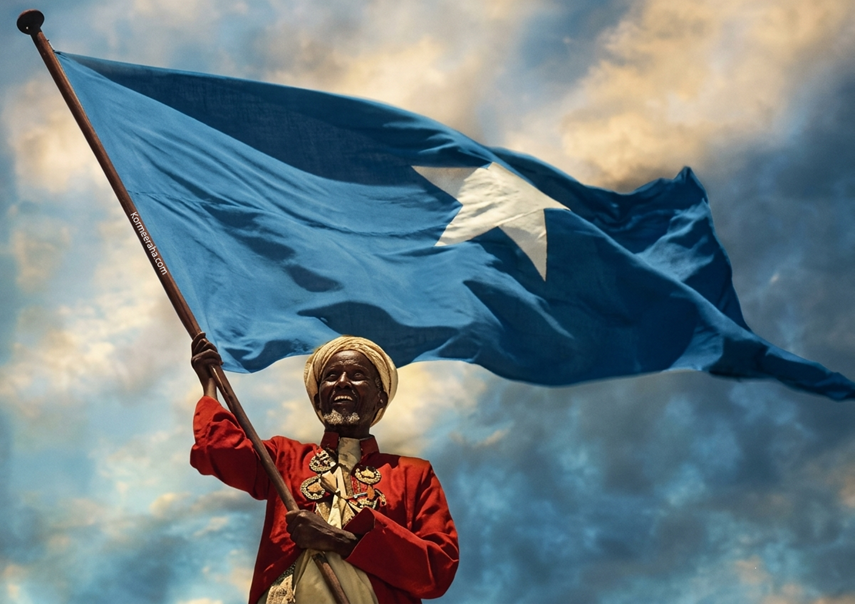
From its visionary design in 1952 to its controversial display at recent political gatherings, the story of the Somali flag is a mirror reflecting the nation’s highest aspirations and its current political fragility.
The history of the Somali national flag is a remarkable story of national identity, unity, and the enduring aspirations of the Somali people. Its adoption was not merely a procedural political decision; rather, it represented the crystallization of a collective dream: the unification of all five Somali-inhabited territories under a single, sovereign identity.
The Shangaani Gathering: Forging a National Identity
On October 12, 1952, a historic gathering convened in the Shangaani district of Mogadishu. Somalis from various regions, alongside representatives from the Northern Frontier District (NFD) and the Somali-inhabited territories under Ethiopian administration, assembled to deliberate on the design of a future national flag.
Thirty-seven different proposals were presented, the majority submitted by prominent political organizations, including the Somali Youth League (SYL), political coalitions (Xisbiyo), SANU, and others.
The Rejection of Literalism: Searching for a Unifying Symbol
Among the early proposals, the nineteenth design, submitted by the Xisbiyo, initially attracted considerable applause. It featured a green background adorned with three smaller stars and a larger central star. The three smaller stars represented Djibouti, the NFD, and the Somali territories under Ethiopian administration, while the larger star symbolized the eventual unity of all five Somali territories.
However, astute observers raised a critical logistical question: would the flag need to be redesigned once the reality of Greater Somalia was actually achieved? This uncertainty regarding the flag’s longevity ultimately weakened support for the proposal. The SYL subsequently presented its own design, but it too failed to secure the necessary consensus.
A Visionary Design: The Birth of the Blue Flag
Amid this ideological gridlock, Mohamed Awale Liban—an independent participant unaligned with any major political organization—stepped forward with a unifying alternative. Declaring that he possessed a design capable of serving all Somalis, he unveiled what would become the enduring banner of the nation: a light-blue field bearing a single, white, five-pointed star.
Prior to its public presentation, Liban had consulted with leading political figures of the era, including Abdullahi Issa Mohamud, Abdirashid Ali Sharmarke, and Mohamed Hirsi Nur “Sayidiin”, who are reported to have welcomed the design. The concept was then handed to Sharif Zeyn for physical production.
The reception was overwhelmingly positive. Representatives of SANU enthusiastically endorsed it, and the broader assembly quickly followed suit. Osman Geedi Raage, one of the thirteen founding members of the SYL, personally congratulated Liban, who was approximately 30 years old at the time.
In a subsequent interview, Liban elucidated the symbolism behind his creation. The light-blue background represented the vast Somali sky and the Indian Ocean, while the white star stood for peace. Though he was questioned about the design’s resemblance to another national flag, his explanation reflected a clear, indigenous vision: a national emblem representing peace, hope, and pan-Somali unity.
“The light-blue background represented the vast Somali sky and the Indian Ocean, while the white star stood for peace.”
From Trusteeship to Sovereign Independence
The proposed flag was subsequently submitted through the Italian Trust administration to the United Nations, where its official status was deliberated between 1952 and 1954. In 1954, following an address by Abdullahi Issa Mohamud at the UN, the design received approval.
Upon his return, the flag was hoisted at the Officio Governo in Mogadishu on October 12, 1954. In a poignant reflection of Somalia’s transitional status, it initially flew below the United Nations and Italian administrative flags, before being elevated to equal status in 1956.
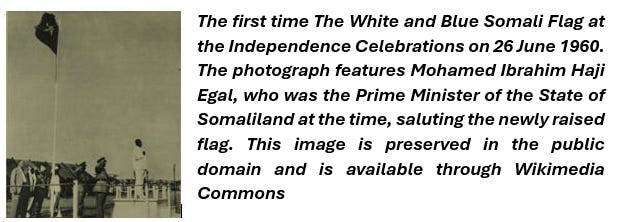
The flag’s ultimate triumph arrived during the historic days of independence. On June 26, 1960, it was raised in Hargeisa to mark the independence of British Somaliland. Five days later, on July 1, 1960, as the northern and southern territories united to form the Somali Republic, the light-blue banner became the national flag of a newly sovereign state.
A Troubling Precedent: The Silence of the Elite
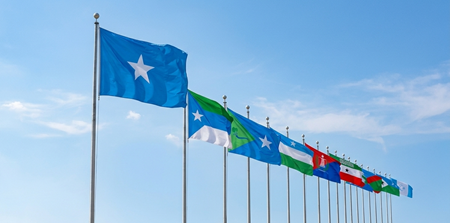
Given this lineage, it is deeply troubling that decades later, attempts were made to tamper with and replace this historic national symbol. Even more disturbing was the display of an altered, unauthorized flag at a high-level political gathering attended by senior figures of the modern Somali state.
Those present included President Hassan Sheikh Mohamud, alongside prominent regional and former leaders such as Abdiweli Mohamed Ali Gaas, Sharif Hassan Sheikh Aden, Ahmed Mohamed Islam (Ahmed Madobe), and Abdirahman Mohamed Farole.
Remarkably, as the altered flag was displayed, none of those present publicly challenged it. Their collective silence was deafening, raising legitimate and uncomfortable questions about the political elite’s commitment to defending the country’s foundational symbols.
“Their collective silence was deafening.”
It ultimately fell to General Mungaab to remove and tear down the altered flag, declaring unequivocally that it was not the Somali national flag. The then-Minister of Interior, Abdullahi Goodah Barre (Odawaa), supported this objection. President Hassan Sheikh Mohamud subsequently issued a clarification reaffirming the traditional blue flag as the legitimate emblem of the state.
A National Symbol That Must Never Be Compromised
The Somali flag is not the property of any president, political party, administration, or clan; it is the patrimony of the Somali people. It represents our shared history, our hard-won sovereignty, our independence, and our collective aspirations.
Anyone seeking the mantle of national leadership must first demonstrate an uncompromising respect for the country’s constitution, its territorial integrity, its national symbols, and its historical identity. The presidency of Somalia is a profound responsibility, not a personal entitlement.
Somalia cannot build a united, resilient future while its leaders compromise the very symbols that hold its people together. The blue flag must remain the symbol of our shared identity, and its protection must be treated as a national responsibility.
“The Somali flag is not the property of any president, political party, administration, or clan; it is the patrimony of the Somali people.”
Related
- The Star and the Struggle: How Somalia Found Its Soul (July 1, 2026)
- Reclaiming the Blue Sky: Reflections on June 26th and the Spirit of Somali Independence (June 25, 2021)