

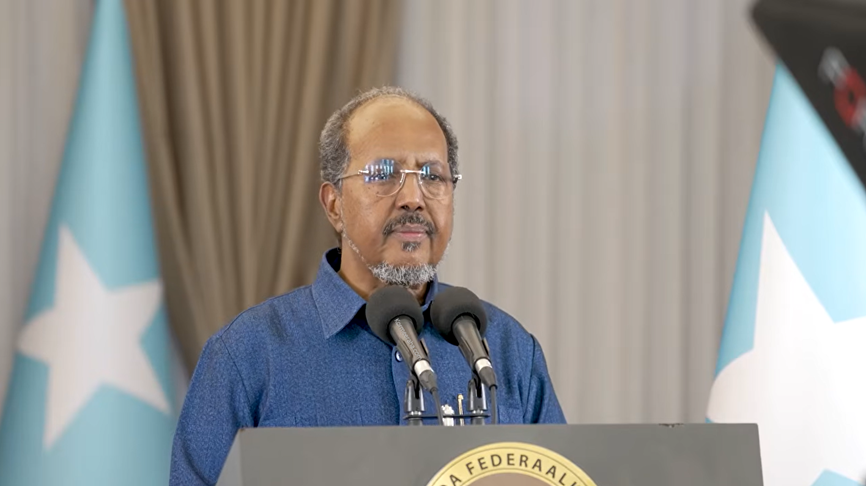
President Hassan Sheikh’s fiery indictment of Emirati interference is a legitimate grievance. But delivered by an expired president, it is less a defence of the nation than a desperate distraction from a state in free-fall.
When Somali President Hassan Sheikh Mohamud took to the podium on November 17, 2026, to deliver a blistering five-point indictment against the United Arab Emirates, he struck a chord that resonates deeply in Mogadishu. The UAE’s clandestine military bases, its parallel security forces, its brokering of Israel’s recognition of Somaliland, and its blatant bypassing of the Federal Government are genuine threats to the Horn of Africa’s most fragile state.
Hassan Sheikh’s concerns are undeniably legitimate. But in the theatre of geopolitics, timing and mandate are everything. By waiting until the twilight of his tenure to sound the alarm, the President has missed his window to act, compromised the very sovereignty he swore to protect, and exposed a fatal paradox.
“Somalia is facing an existential threat from foreign interference, but it is being led by a man who no longer possesses the constitutional legitimacy to defend it.”
President @HassanSMohamud reaffirmed Somalia’s unwavering commitment to defending its sovereignty, territorial integrity and national unity, while addressing the actions undermining the country’s statehood.
The President called on all Somalis to stand united, reject foreign interference and safeguard the national interests of the country.
— Villa Somalia (@TheVillaSomalia) November 17, 2026
The Sovereignty Paradox: A Door Left Open
To understand the depth of Somalia’s current vulnerability, one must look at the missed opportunities of the past four years. The tragedy of Hassan Sheikh’s foreign policy is not just that the UAE interfered, but that the doors to that interference were willingly thrown open by his own administration.
When Hassan Sheikh assumed office in May 2022, he inherited a tense but fiercely sovereign stance from his predecessor, Mohamed Abdullahi “Farmaajo.” For all of Farmaajo’s domestic controversies over delayed federal elections, his administration drew a hard, uncompromising line on national sovereignty. It was Farmaajo who, in 2018, severed military ties with the UAE following the infamous $10 million cash seizure at the Mogadishu airport, refusing to let foreign capital dictate Somali security. Farmaajo specifically sought to restore and centralize state authority against the fragmentation favoured by Gulf actors.
Hassan Sheikh dismantled this architecture. Operating under the populist slogan of “A Somalia at peace with itself, and at peace with the world,” he reversed Farmaajo’s policies, reopened the channels to Abu Dhabi, and welcomed Emirati military and economic influence back into the country in 2022 and 2023.
“He traded the hard-won boundaries of sovereignty for transactional counter-terrorism support. A sovereignty compromised by one’s own delayed reaction is a sovereignty lost.”
He had the mandate, the political capital, and the international backing to set strict boundaries on foreign military and economic engagements during his first three years. He chose not to. Now, with the UAE entrenched in Berbera, Bosaso, and Kismayo, and operating parallel security structures, Hassan Sheikh is crying foul.
The Clock Ran Out: Governing in the Shadows
The most glaring flaw in the President’s November 17 address was not its content, but the man delivering it. On May 15, 2026, Hassan Sheikh Mohamud’s constitutional term expired. His subsequent, highly contested attempt to extend his mandate until May 2027 was recently dealt a fatal blow when the Supreme Court rejected the manoeuvre.
In the eyes of the Somali people, the constitution, and increasingly the international community, Hassan Sheikh is a president without a portfolio.
“Stripped of democratic legitimacy by the Supreme Court, he is now governing in the shadows. A leader whose authority is contested at home cannot project power abroad.”
This illegitimacy is not merely a domestic political nuisance; it is the root cause of Somalia’s current multi-sector collapse. When the Federal Government attempts to annul Emirati port agreements or ban UAE military flights, the regional states of Puntland, Jubaland, and Somaliland simply ignore the decrees, viewing Mogadishu as an illegitimate occupant of Villa Somalia. The centre cannot hold because the centre has no legal mandate to command.
@HassanSMohamud went to visit #UAE for his first abroad trip after taking over the presidency.
The Emirates contributed millions for his successful takeover.
The #UAE was held at bay for its interference in #Somalia’s internal politics by the previous administration. https://t.co/Dnk6R52961
— Kormeeraha Magazine (@Kormeeraha) June 19, 2022
A Nation in the Cross-hairs
The fallout of this leadership vacuum is visible across every sector of the Somali state. The country is in a state of extreme vulnerability, and every recent setback is inextricably linked to the illegitimate position of its executive.
- Security: The most alarming development is the withdrawal of Ugandan troops from the AUSSOM mission. Whispers circulating through the region suggest the UAE has pledged upwards of $500 million to Kampala to facilitate this exit, deliberately creating a security vacuum to weaken the Federal Government and undercut Turkish influence. Because Hassan Sheikh lacks the political capital to unify the country, Al-Shabaab is already exploiting the retreating lines.
- Diplomatic: Somalia’s leverage on the global stage has been blunted. While Mogadishu attempts to use its non-permanent UN Security Council seat to block the UAE’s Lana Nusseibeh from becoming UN Secretary-General, its diplomatic weight is diminished. The international community is hesitant to fully back a fractured state led by an expired president.
- Political and Economic: The opposition and regional leaders, recognizing the power vacuum, have bypassed Mogadishu entirely, flying to Abu Dhabi and Dubai to forge their own alliances. The state is effectively paralyzed, unable to pass critical economic reforms or secure unified international development funds because there is no universally recognized authority to sign the checks.
The Backfire of Nationalism
Hassan Sheikh’s strategic calculation in launching this public war against the UAE was likely twofold: to force Abu Dhabi’s hand through public shaming, and to ignite a surge of Somali patriotism that would unite a fractured populace behind his flag.
It is a miscalculation of historic proportions.
The Somali public is not rallying behind him. Instead of viewing his November 17 speech as a courageous defence of the nation, citizens and political analysts see right through the manoeuvre. They recognize it for what it is: a desperate attempt by a lame-duck president to use the spectre of foreign interference to distract from his own failures and his expired mandate.
“Somalis have grown profoundly weary. Rather than generating a wave of patriotic support, the President’s outcry is amplifying deafening calls for his immediate resignation and long-overdue elections.”
The Ultimate Price
President Hassan Sheikh Mohamud is right about the UAE. The Emirati strategy in the Horn of Africa is predatory, designed to fracture sovereign states into manageable, profitable fiefdoms. But identifying the disease does not excuse the failure to prevent it.
By waiting until his legitimacy had evaporated to confront a threat he himself allowed to take root, Hassan Sheikh has left Somalia exposed. The nation is now caught in a devastating crossfire: battered by foreign interference on the outside, and hollowed out by an illegitimate, expired leadership on the inside.
In the end, you cannot defend a nation’s sovereignty when you no longer have the mandate to represent it. The UAE may have compromised Somalia’s borders, but it was Hassan Sheikh’s delay, and his subsequent refusal to step aside, that compromised its future.
Related
- The Dual Collapse: When Constitutional Crisis Meets Security Freefall in Somalia (November 10, 2026)
- Somalia Needs Partners, Not Protectors: Why HSM Must Tread Carefully with the UAE (October 14, 2026)
- Ambushed at Jamee’o: The Deadly Cost of Somalia’s Security Rift (October 29, 2026)
- Inside Somalia’s Rift with the UAE (January 18, 2026)