
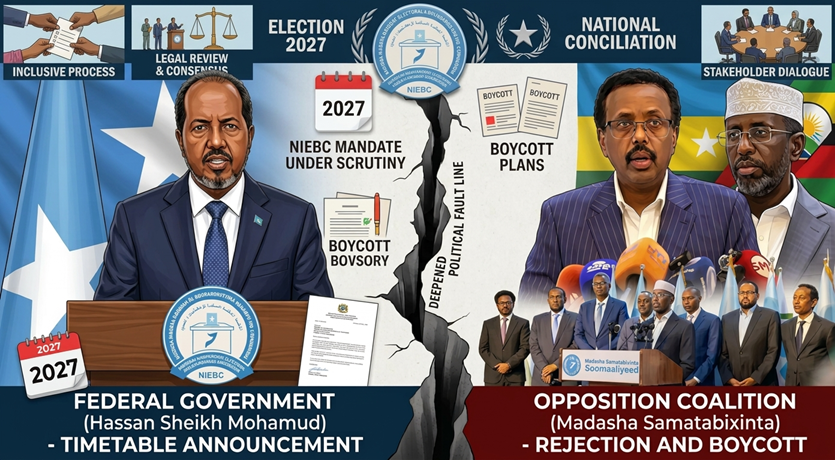
Somalia stands at a precarious crossroads. After nearly two decades of institutional rebuilding, the nation faces its most severe political crisis since 2012. The announcement of a new federal election timetable for 2027 has deepened fault lines, threatening to unravel years of progress and potentially drag Mogadishu back into civil conflict. The core polarization lies in the clash between the federal government’s push for a historic “one-person, one-vote” system and the opposition’s accusation that this transition is a unilateral power grab.
The Catalyst: A Contested Timetable
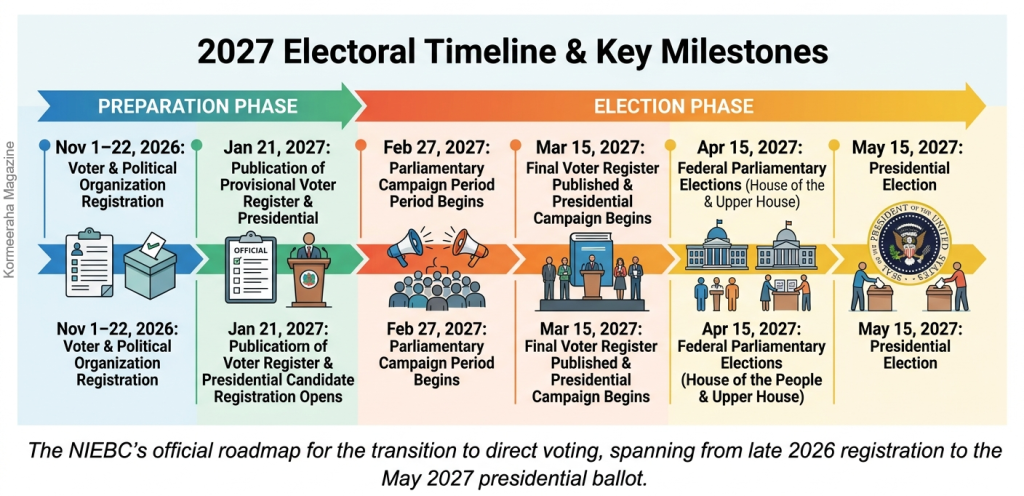
The National Independent Electoral and Boundaries Commission (NIEBC) announced that federal parliamentary elections will occur on April 15, 2027, followed by the presidential vote on May 15, 2027. While this marks a shift from clan-based indirect voting, the timeline rests on controversial March 2026 constitutional amendments extending mandates from four to five years. Since President Hassan Sheikh Mohamud’s term was set to expire in 2024, the new date grants him an extra year in office. Opposition leaders, including former Presidents Farmaajo and Sharif Sheikh Ahmed, have rejected the timetable as an illegal extension, labeling the NIEBC a tool of the incumbent rather than an independent arbiter.
The Breakdown of Consensus
Negotiations between the federal government and opposition factions have collapsed. Despite mediation efforts by Turkey, President Mohamud has refused compromise, stating he will not relinquish control of the electoral process. In response, opposition lawmakers accuse the government of sabotaging inclusive talks by unilaterally releasing the timetable. The opposition is now moving toward active resistance, with the Somali Future Council exploring alternative timetables and independent oversight committees.
“For the opposition, this is not a democratic milestone; it is an illegal term extension.”
Regional Rebellion: Puntland and Jubaland
Semi-autonomous states Puntland and Jubaland have severed ties with Mogadishu, viewing the 2027 framework as illegitimate. Puntland President Said Abdullahi Deni has rejected the revised 2026 constitution, insisting the 2012 Provisional Constitution remains the only legal framework, and has boycotted all federal mechanisms. Puntland refuses to recognize Mogadishu’s authority until an inclusive national dialogue occurs. Meanwhile, Jubaland President Ahmed Madobe argues Somalia is unprepared for direct suffrage by 2027 and has rejected the federal electoral commission’s jurisdiction within his territory. Both regions threaten parallel electoral processes or total boycotts, which would fundamentally compromise the legitimacy of any resulting federal government.
The Southwest State Crisis: From Federal Model to Rebel Stronghold
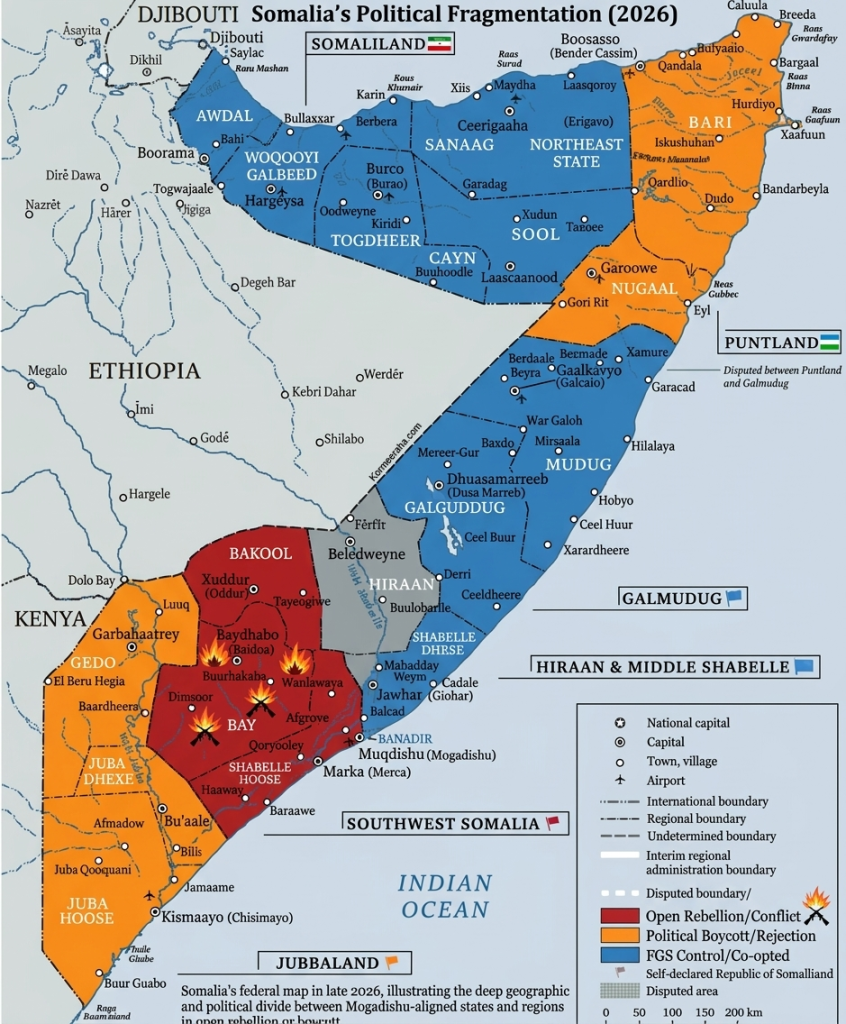
Southwest State, initially touted as the model for direct voting, has descended into armed rebellion. After the ruling Justice and Solidarity Party (JSP) secured local loyalty in June 2026, stability collapsed following the ouster of former President Abdiaziz Laftagareen. Laftagareen, now aligned with the opposition, has launched a coordinated offensive, capturing the strategic district of Buurhakaba near Baidoa. This resurgence threatens to flip Southwest from a federal ally to an opposition stronghold. If Laftagareen unseats the Mogadishu-backed administration, the federal electoral roadmap faces ruin, leaving Villa Somalia isolated and rendering the Bay region unsafe for voter registration.
Allegations of Co-optation: Galmudug and Hirshabelle
The federal government is accused of securing loyal administrations in Galmudug and Hirshabelle through controversial maneuvers. In Galmudug, a September 30 parliamentary rerun saw the JSP win 67 of 89 seats after banning the opposition Towfiiq party. With the legislature under JSP control, loyalist Hussein Mohamed Nur was elected Speaker on October 18, and Liban Ahmed Hassan was nominated as the sole presidential candidate for the October 22 vote. Critics dismiss this as a top-down appointment. Similarly, in Hirshabelle, the JSP backed the re-election of incumbent Ali Guudlaawe, bypassing clan power-sharing agreements and sparking protests in Beledweyne. These interventions aim to ensure local apparatuses remain under federal control during the November voter registration window.
The Risk of Civil War and Geopolitical Proxy Conflict
Analysts warn of a high risk of urban warfare, driven by three factors. First, the Somali National Army retains strong clan loyalties, with political disputes already sparking skirmishes in Mogadishu in June 2026. Second, internal fragmentation allows Al-Shabaab to reclaim territory in central Somalia. Third, geopolitical rivalries are amplifying the crisis; the federal government’s pivot toward Qatar, Turkey, and Egypt has created a volatile proxy dynamic. This tension is acute in Southwest State, where Mogadishu’s attempt to deploy Egyptian troops has been fiercely rejected by Laftagareen’s forces as reckless provocation against Ethiopia, further militarizing the rebellion with alleged cross-border support. The UAE’s continued ties with dissident regional states raise fears that these local disputes could evolve into a funded, protracted conflict similar to Sudan.
“If major geographic zones are excluded from the national vote, the legitimacy of any resulting federal government would be fundamentally compromised.”
International Divisions
International partners are divided. Western nations, including the UN, US, and EU, urge restraint and consensus, fearing civil war, with some contingency plans for forced mediation. Conversely, Turkey’s neutrality is questioned due to its deep military and economic integration with the federal government. Opposition groups reject Turkish mediation, citing the deployment of Turkish-trained forces in domestic political altercations, viewing Ankara as a patron of the incumbent rather than a neutral broker.
A Nation at Risk
Somalia’s path to stable democracy is hanging by a thread. The 2027 election timetable has become a flashpoint for constitutional crisis, with key regions in open rebellion and security forces fragmented. If gridlock sparks sustained fighting, the consequences could be catastrophic: collapsed debt relief, withdrawal of African Union missions, and humanitarian disaster. With trust eroded and positions hardened, Somalia’s federal system is not just polarized; it is fracturing.
Related
- Fractured Southwest: The Geopolitical Battle for Mogadishu (September 3, 2026)
- The Shub Assassination Plot: Sovereignty, Suspicion, and Spoiled Evidence (September 30, 2026)
- Why Turkish Mediation Won’t Save Somalia (July 13, 2026)
- Puntland’s Precipice: When Federalism Meets Gunfire (July 25, 2026)
- The Mogadishu Deadlock: Where Compromise Goes to Die (May 28, 2026)