
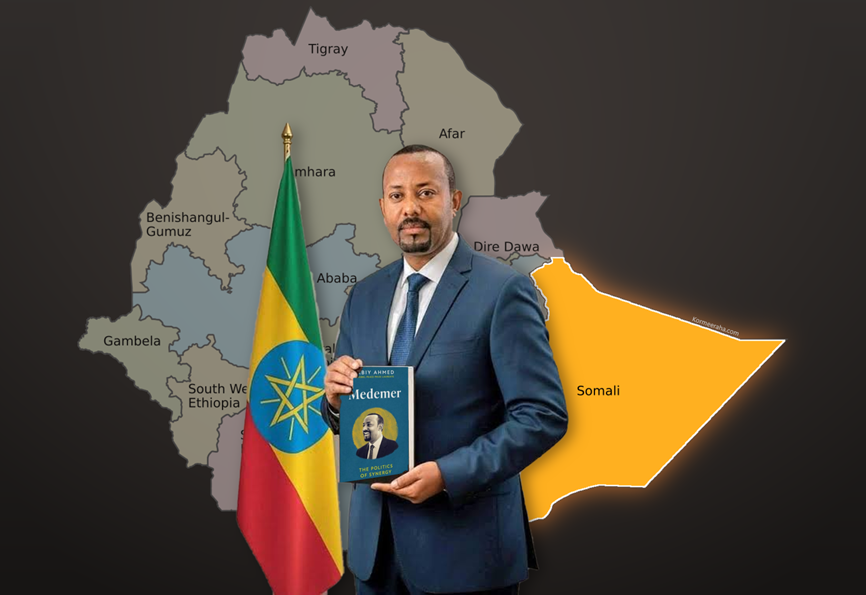
The question of whether Prime Minister Abiy Ahmed’s Medemer philosophy serves or subverts the interests of the Somali Region is not merely an academic exercise; it is an existential inquiry into the political future of Ethiopia’s eastern periphery. Before dissecting the implications of Medemer, one must look beyond the surface-level rhetoric of “synergy” and examine the underlying constitutional architecture of the Ethiopian state. The friction between ethnic-based and geographical federalism is not just a matter of administrative design—it is the battleground upon which the survival of minority identities is fought.
“For the Somali Region, this framework was not a gift from the center; it was a hard-won political safeguard born from decades of marginalization and the historical trauma of the Ogaden.”
Ethnic Federalism: A Fragile Shield
Ethiopia’s current constitutional order, established in 1995, is predicated on ethnic-based federalism. This model recognizes the state not as a monolith, but as a mosaic of “nations, nationalities, and peoples.” For the Somali Region, this framework was not a gift from the center; it was a hard-won political safeguard born from decades of marginalization and the historical trauma of the Ogaden.
Ethnic federalism provides the Somali people with a vital institutional shield. It guarantees their collective right to self-determination, protects their linguistic and cultural heritage, and ensures that their political destiny is not entirely subsumed by the demographic weight of the highland majority. It allows the region to govern its internal affairs, manage its local security, and assert its territorial boundaries.
Yet, we must confront the hard truths of this system. Ethnic federalism is not a panacea. In practice, it has sometimes been weaponized by regional elites to consolidate local power, leading to internal fragmentation and the marginalization of minority clans within the region itself. Furthermore, the autonomy it promises is frequently compromised by the financial and political leverage of the federal center. Nevertheless, for all its flaws, ethnic federalism remains the only constitutional mechanism that formally recognizes the Somali people as a distinct political entity with inherent rights.
The Mirage of Civic Federalism
The alternative model—geographical or civic federalism, exemplified by the United States—organizes states along territorial or administrative lines rather than ethnic identity. In theory, this model promotes a unified national citizenship where political participation is blind to ethnic background.
However, applying this model to Ethiopia’s complex demographic reality requires extreme caution.
“In a country where historical power dynamics are deeply asymmetrical, a purely geographical or ‘civic’ federation often serves as a Trojan horse for demographic domination.”
In a country where historical power dynamics are deeply asymmetrical, a purely geographical or “civic” federation often serves as a Trojan horse for demographic domination. If political representation and resource allocation are determined strictly by population numbers and administrative “efficiency,” historically marginalized communities face severe vulnerabilities.
For the Somali Region, which is vast, strategically located, and rich in resources but relatively sparse in population, the shift toward geographical federalism is deeply alarming. If the constitutional recognition of the Somali as a distinct “nation” is replaced by mere administrative zoning, the region risks losing its leverage over its own political, economic, and cultural institutions. The fear is not unfounded: without the protective umbrella of ethnic recognition, the Somali Region could be gradually diluted, its borders redrawn, and its political voice drowned out by the demographic majorities of the centre.
Medemer: Synergy or State Consolidation?
Abiy Ahmed’s Medemer—translated variously as synergy, additivity, or collective contribution—is pitched as a philosophy of national reconciliation, economic integration, and unified development. The aesthetics of the philosophy are undeniably appealing. Who, after all, would argue against unity, synergy, and shared prosperity?
But the critical question for the Somali Region is not whether unity is desirable; it is what kind of unity is being proposed, and at whose expense.
The hard truth of Medemer is that it is fundamentally a project of state consolidation. It seeks to smooth out the “frictions” of ethnic federalism by centralizing authority and promoting a singular, overarching Ethiopian identity. If Medemer succeeds in eroding the constitutional pillars of ethnic federalism without replacing them with equally robust, enforceable guarantees for minority communities, the Somali Region will face severe political disenfranchisement.
“Under the guise of ‘synergy,’ the periphery is often asked to surrender its distinct political voice to the center.”
Under the guise of “synergy,” the periphery is often asked to surrender its distinct political voice to the center. The Somali Region risks being transformed from a constituent nation with constitutional veto power into a mere administrative zone, vulnerable to the extraction of its resources and the imposition of policies drafted in Addis Ababa without its meaningful consent.
The Price of False Unity
The Somali people—both the political leadership in Jigjiga and the vibrant intellectual class in the diaspora—must approach the Medemer debate with unflinching political awareness. National unity should never be conflated with the surrender of regional autonomy, historical identity, or collective constitutional rights.
The Somali Region must undoubtedly champion peaceful coexistence, economic integration, and cross-regional cooperation. But it must do so from a position of constitutional strength, not subservience. It must fiercely defend its territorial integrity, its political representation, and its legitimate right to self-governance.
“Unity without equity is subjugation by another name. Development without political sovereignty is merely exploitation.”
Unity without equity is subjugation by another name. Development without political sovereignty is merely exploitation. And national integration must never be weaponized to dismantle the rights of historically recognized communities.
The fundamental question facing the Horn of Africa is this: Can Ethiopia forge a united, prosperous state without dismantling the constitutional identity and political rights of its constituent peoples?
It is not enough for the Somali people to ask this question. They must organize, articulate, and demand the answer.
Related
- Ethiopia at War Again (October 4, 2026)
- Ethiopia on the Brink: Shererina Clashes Signal Collapse of Pretoria Accord (August 3, 2026)
- Abiy’s Ethiopia: Ballots in the Capital, Bullets in the Regions (June 2, 2026)