
As Sudan’s war enters its fourth year, what began as a hopeful popular uprising has become the world’s largest humanitarian crisis. The 2019 revolution that ousted longtime ruler Omar al-Bashir promised democratic transformation. Instead, it gave way to a fragile power-sharing arrangement that collapsed into a military coup in 2021, orchestrated by two key figures: Abdel Fattah al-Burhan, head of the Sudanese Armed Forces (SAF), and Mohamed Hamdan Dagalo—known as Hemeti—leader of the Rapid Support Forces (RSF).
By April 2023, the alliance between these two men had fractured into open war. Today, millions are displaced, cities lie in ruins, and more than nine million people have fled their homes. Yet beyond the visible devastation lies a deeper truth: Sudan’s war is no longer just a domestic struggle. It has become an internationalized conflict shaped by covert foreign involvement, illicit economies—weapons, gold, and people—and geopolitical ambition.
Ethiopia’s Quiet Role Comes Into Focus
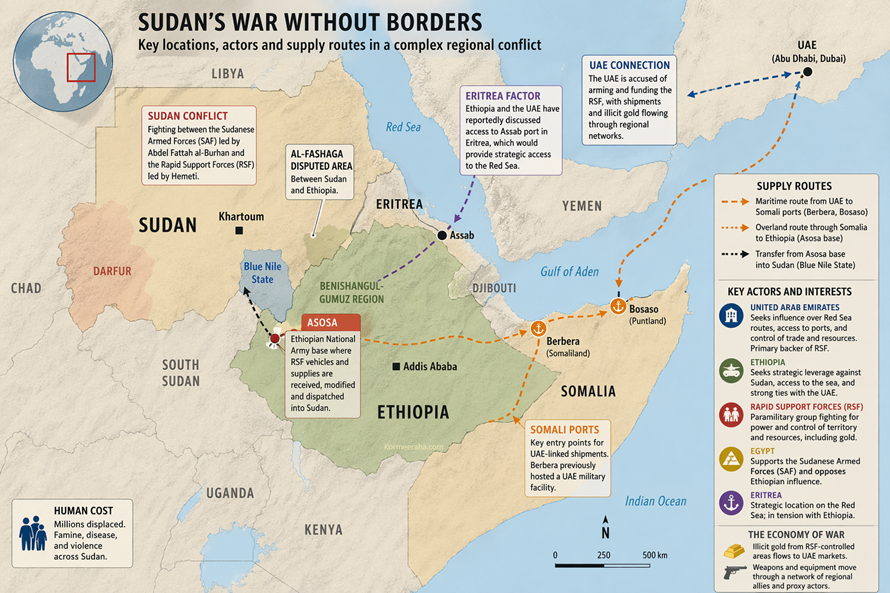
Recent investigative findings have cast a spotlight on Ethiopia’s alleged involvement—despite its official claims of neutrality. Satellite analysis conducted by Yale University’s Humanitarian Research Lab, alongside reporting by Middle East Eye, points to suspicious activity at an Ethiopian National Army base near the western city of Asosa, close to the Sudanese border.
The evidence suggests this base has been used to support RSF operations. Large numbers of vehicles—matching RSF equipment, not Ethiopian military stock—have been transported into the facility. Satellite imagery shows them being retrofitted with mounted weapons, turned into “technicals.” Then they appear in fighting in Sudan’s Blue Nile state, where RSF forces have recently advanced. ConX containers, new tents, and supply distribution patterns all point to a persistent logistical hub.
Neither the RSF, nor the UAE, nor the Ethiopian army have denied the evidence.
Motives Behind the Mask of Neutrality
Why would Ethiopia risk its reputation? The first answer is retaliation. Addis Ababa has long accused Sudan’s military of supporting rebel groups in Ethiopia’s Tigray region—a charge widely believed to be true. Backing the RSF serves as strategic payback.
Second is a bitter territorial dispute over the fertile al-Fashaga borderlands, a quiet but longstanding feud between Khartoum and Addis Ababa.
But the most significant driver lies elsewhere: the United Arab Emirates. Ethiopian sources—including former advisors to the foreign ministry and army generals—describe Prime Minister Abiy Ahmed’s foreign policy as deeply tied to Abu Dhabi. And that relationship has an explosive edge. Last year, a source who advised the Ethiopian government revealed that the UAE and Ethiopia planned to invade the Eritrean port of Assab, giving landlocked Ethiopia sea access while expanding Emirati control over Red Sea shipping lanes. The plan was later shelved, but it underscores how far the alliance can go.
The UAE and the Economics of War
The UAE has repeatedly denied direct involvement in Sudan’s conflict, yet mounting evidence—including tacit admissions from US officials—suggests otherwise. At the end of the Biden administration, American officials said the UAE would “stop its support for the RSF,” an implicit acknowledgment that such support existed.
The relationship between Hemeti and the Emirates is long and lucrative. When Sudan sent 30,000–40,000 fighters to support the Saudi-Emirati coalition in Yemen, most came from the RSF. Gold from RSF-controlled areas of Darfur flows to refineries in Dubai and Abu Dhabi. Entities connected to Hemeti own property in Dubai. Before the war, Hemeti spent ten days in the UAE.
Supply Lines Across the Horn of Africa
The international dimension extends far beyond financial ties. A network of supply routes connects the UAE to Sudan through the Horn of Africa. Key ports in breakaway regions—Berbera in Somaliland (which hosts an Emirati military base) and Bosaso in Puntland—have served as logistical hubs for moving equipment inland. Car carriers transport vehicles from Berbera into Ethiopia.
These routes became more complicated after Somalia’s federal government, angered by foreign influence, cancelled its contracts with the UAE. In response, supply chains have shifted, with Ethiopia emerging as a crucial transit corridor. From there, weapons and equipment move across porous borders into Sudan, sustaining RSF offensives. Additional support is believed to come from other regional actors, including Khalifa Haftar’s forces in eastern Libya and transit networks through Chad.
A Regional Proxy War
Sudan’s conflict increasingly resembles a proxy war. Egypt supports the SAF, motivated by concerns over Nile waters and its rivalry with Ethiopia; Egyptian military personnel are reportedly present in Sudan, including in the Blue Nile region. Meanwhile, other states and non-state actors exploit the war’s instability for political and economic gain. Human smuggling networks have flourished alongside weapons and gold trafficking.
What emerges is a layered conflict in which local grievances intersect with global ambitions. Ethnic tensions, historical rivalries, and competition over resources are amplified by foreign involvement, creating a cycle of violence that is difficult to break.
The Human Cost of Hidden Agendas
Amid this complex web of alliances and interests, Sudan’s civilian population continues to pay the highest price. Entire communities have been uprooted, basic services have collapsed, and humanitarian access remains severely restricted.
The war’s persistence is not simply the result of internal divisions but of a system that rewards instability. Illicit trade, geopolitical maneuvering, and covert support have transformed Sudan into a battleground for competing powers, where peace is secondary to profit and power.
A Conflict Without Easy End
Sudan’s war stands as a stark example of how modern conflicts evolve beyond national borders. Official declarations of neutrality ring hollow against satellite evidence, supply chains, and financial networks that tell a different story.
As long as external actors continue to fuel the conflict—whether through direct support, economic incentives, or strategic positioning—the prospects for resolution remain dim. What began as a revolution for dignity and justice has been overtaken by forces far larger than Sudan itself. And from the base at Asosa, the supply line continues to run.