

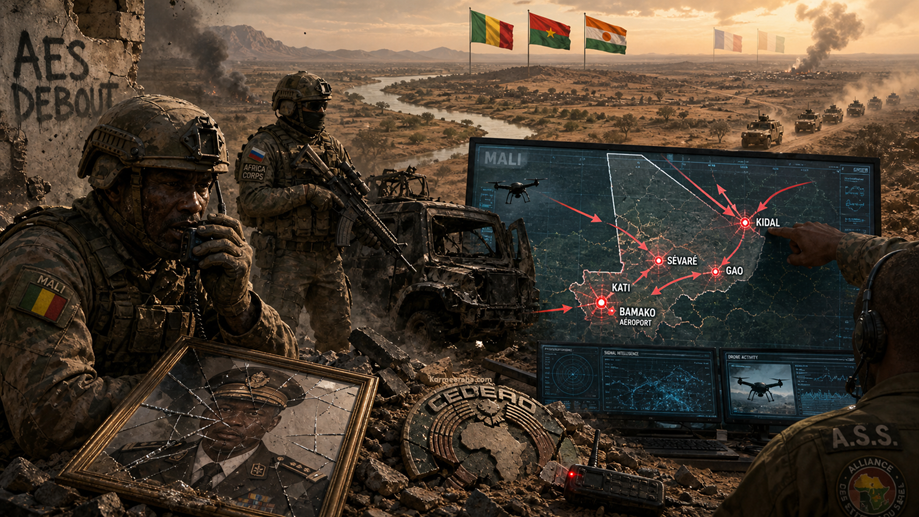
On April 25, 2026, Mali faced its most complex security challenge in over a decade. Before dawn, explosions and heavy gunfire rippled across more than 1,000 kilometres of territory, striking simultaneously in Bamako, Kati, Sévaré, Gao, and Kidal. The scale was unprecedented. But the true shock lay not in the geography of the assault, but in its architects: for the first time in Mali’s modern conflict, Al-Qaeda’s regional affiliate JNIM and Tuareg separatist fighters executed a coordinated, synchronized offensive. What began as a multi-pronged strike quickly became a stress test for Mali’s security apparatus—and for the Alliance of Sahel States (AES) itself.
What We Know About the Attack
The April 25 operation was meticulously planned. Targets were selected to cripple command structures, disrupt logistics, and project psychological dominance. Car bombs struck high-value installations in Kati, including the residence of Defense Minister General Sadio Camara, who was killed in the blast.
Simultaneous assaults hit the main military base near Bamako’s international airport, where Russian Africa Corps personnel are stationed, and key garrisons in central and northern Mali. Communication intercepts and battlefield forensics suggest the attackers relied on encrypted networks, pre-positioned supplies, and precise timing windows. The synchronized nature of the strikes points to months of joint planning, advanced reconnaissance, and a departure from the decentralized, hit-and-run tactics that have long defined Sahelian insurgency.
An Unlikely Alliance
JNIM and the Tuareg separatists have historically been bitter adversaries. Where separatists seek political autonomy and control over northern territories, JNIM pursues a transnational extremist agenda that has repeatedly clashed with secular nationalist movements. In 2012, the radical group turned on the separatists shortly after their initial northern offensive, fracturing the rebellion and triggering a cycle of internecine violence.
Yet the April 25 coordination reveals a tactical convergence: both groups now view the Malian junta and its AES partners as an existential threat. Intelligence sharing, joint logistics, and synchronized strike windows suggest a pragmatic, enemy-of-my-enemy calculus. The alliance remains fragile—ideological fault lines haven’t vanished—but its operational debut proves that insurgent networks can rapidly adapt when strategic pressure mounts.
Foreign Hands: Suspected Backers
Malian and Russian officials have publicly accused several external actors of enabling the attack. Ukraine is alleged to have supplied intelligence and “kamikaze” drones, prompting Mali to sever diplomatic ties with Kyiv. France and the EU are accused by Russian intelligence of having “European instructors” train rebel fighters, a charge Mali’s junta embraces given its post-2022 rupture with Paris. Neighbouring Mauritania launched an investigation after claims that its territory hosted training camps. Algeria, while a nominal mediator, faces suspicion over porous border zones like Tinzaouaten where rebels regroup. Most sharply, Mali accuses Ivory Coast of harbouring exiled politicians (notably Karim Keïta), pushing ECOWAS sanctions, and serving as a proxy for French interests—a charge that has pushed bilateral relations to a “breaking point.”
The Response: Holding the Line
What followed the initial strikes was not collapse, but a coordinated counteroffensive. Malian security forces, backed by Russian Africa Corps air and ground support, rapidly sealed off critical infrastructure in Bamako and Kati. Within hours, AES joint command structures activated cross-border intelligence sharing, enabling rapid troop redeployment to contested zones. Curfews, fortified checkpoints, and drone reconnaissance disrupted rebel supply lines, while AES rapid-reaction units prevented the consolidation of insurgent gains.
Despite the loss of General Camara—a devastating blow—the chain of command held. Military leadership quickly transitioned operations, ensuring continuity in both domestic security and international coordination. Crucially, the defence of Bamako and the central command hubs remained intact, denying insurgents the symbolic victory they sought.
Containing the Gains, Exposing the Limits
Insurgent narratives following the attacks painted a picture of sweeping territorial control, but ground realities tell a different story. While Malian and Russian forces executed a tactical withdrawal from Kidal—a decision framed by military sources as a consolidation to fortified positions rather than a rout—control of the city remains heavily contested and vulnerable to AES counterstrokes.
In Gao and Sévaré, AES forces launched immediate pushing operations, reclaiming key intersections and cutting off insurgent reinforcement routes. JNIM’s subsequent announcement of a “blockade” around Bamako has proven largely symbolic; supply convoys continue to move under heavy escort, and civilian markets remain operational. The rebels’ over-extension has left them exposed to targeted AES airstrikes and special operations raids. Far from a decisive breakthrough, the April 25 offensive highlighted the logistical fragility of coordinating disparate militant factions across vast desert terrain.
The AES at a Crossroads
The attack underscored both the vulnerabilities and the latent strength of the Alliance of Sahel States. Formed by Mali, Burkina Faso, and Niger after their respective political transitions, the AES was designed to replace foreign security dependencies with African-led coordination. The April 25 assault tested that premise—and revealed where it must evolve.
To prevent future coordinated strikes, the AES must accelerate three critical pillars: first, a fully integrated, real-time intelligence fusion centre capable of tracking cross-border militant movements, drone trafficking, and external training networks. Second, the permanent deployment of the AES’s 15,000-strong joint force along volatile frontiers, transforming it from a symbolic commitment into a rapidly mobilizable deterrent. Third, a unified diplomatic strategy to expose and isolate state actors accused of arming or training rebel factions, while securing cooperation with neighbouring states on border monitoring.
The AES does not need to become a supranational government to succeed, but it must operate as a single security ecosystem. That means standardized communications, joint command protocols, and pre-authorized cross-border pursuit agreements. The April 25 attacks were not a failure of African defence; they were a catalyst for its next phase. By transforming reactive cooperation into proactive integration, the AES can neutralize the threat of synchronized insurgent operations before they materialize. In a region where militant adaptability has long outpaced state coordination, the alliance’s survival—and the Sahel’s stability—now depends on turning shared sovereignty into shared security. The shield was tested. It held. Now, it must be forged stronger.