

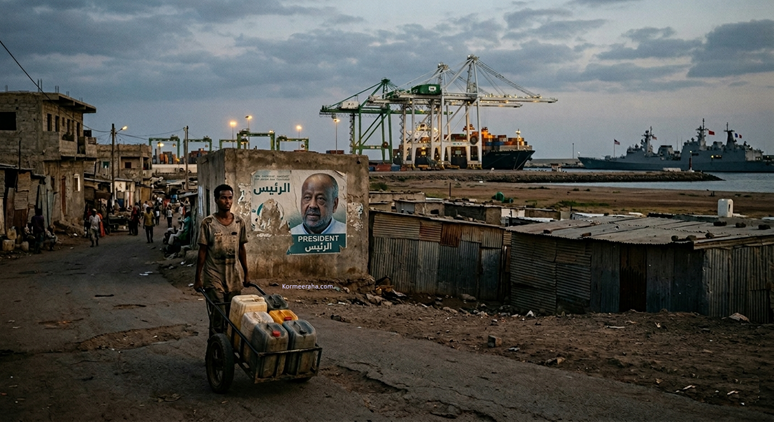
In the stifling heat of the Gulf of Tadjoura, a strange architecture takes shape. On one side of the horizon, the gray hull of a U.S. Navy vessel glides past Camp Lemonnier; on the other, the gleaming, high-walled fortifications of China’s first overseas military base stand as a silent sentinel. To the casual observer, Djibouti is the ultimate success story of the post-Cold War era—a tiny, resource-poor nation that transformed its geography into a multi-billion-dollar rental empire.
But as President Ismail Omar Guelleh (IOG) prepares to secure his sixth term on April 10th, the “Landlord of the Horn” is finding that his tightrope is fraying. Behind the high-tech port terminals and the polished rhetoric of “Vision 2035” lies a brittle state, hollowed out by debt, drained by corruption, and increasingly held hostage by the very foreign powers it sought to exploit.
The Architecture of Dependency
Djibouti’s stability has long been a mirage. For twenty-seven years, the Guelleh administration has operated on a simple, cynical premise: if you host everyone’s military, no one will allow you to fail. By leasing soil to the Americans, the Chinese, the French, the Japanese, and the Saudis, IOG created a sovereign safety net.
However, in 2026, this “neutrality” has morphed into a staggering economic dependency. With an external debt-to-GDP ratio that remains one of the highest in the region—much of it owed to Beijing—Djibouti is no longer a neutral arbiter. It is a debtor state. When a nation’s primary export is its own sovereignty, it loses the ability to say “no.” We see this in the increasing friction between the U.S. and Chinese footprints on the ground, where IOG is forced to perform a diplomatic kabuki dance to appease his creditors while keeping his security guarantors close.
The Hollow Core
The most tragic casualty of this “rental state” model is the Djiboutian people. While the government boasts of double-digit growth in port throughput, the reality in the streets of Balbala is one of terminal stagnation. The wealth generated by the Bab-el-Mandeb trade does not trickle down; it offshores.
Endemic corruption and a “Emirati-style” of governance—where the presidency functions more like a family-run corporation than a public office—have led to massive capital flight. While the ruling elite invests in Parisian real estate and private jets, the Djiboutian working class is quite literally vanishing. With youth unemployment estimated at a staggering 76%, the country’s most valuable resource—its people—is being wasted.
This is not merely an economic failure; it is a security threat. A leader who does not have the backing of his own people is a leader who is perpetually vulnerable. Without domestic accountability, IOG has no recourse but to subject himself to foreign powers who play with his internal vulnerabilities. He has traded the faith of his citizens for the temporary protection of foreign bayonets.
Playing with Regional Fire
The domestic decay is mirrored by an increasingly reckless foreign policy. In an attempt to maintain his relevance, IOG has waded into the murky waters of Somali politics and the Ethiopia-Somaliland dispute. By allegedly backing regional proxies to counter Ethiopia’s naval ambitions, Djibouti is playing a high-stakes game of “divide and rule” that could easily blow back.
The Ethiopia-Somaliland MoU has fundamentally changed the math. As Addis Ababa seeks to bypass Djibouti’s exorbitant port fees, the financial foundation of the Guelleh regime is crumbling. If the port revenue dries up, the patronage system that keeps the elite loyal will collapse. In this vacuum, the “stability” that IOG has sold to the West for decades will be revealed for what it truly is: a one-man monopoly that neglected to build a nation.
The Sixth Term: A Final Act?
The 2026 election, scrubbed of any meaningful opposition and staged after the convenient removal of constitutional age limits, is intended to project strength. In reality, it signals a regime in retreat. At 78, Guelleh is presiding over a country where the stadium rallies are orchestrated but the markets are quiet.
True stability requires a social contract, not just a lease agreement. By hollowing out the working class and mortgaging the future to foreign superpowers, the administration has created a state that is too big to fail but too weak to function.
As the world watches the ships pass through the Bab-el-Mandeb, they should look closer at the shore. The landlord is still collecting rent, but the house is on fire. If Djibouti is to survive the decade, it needs more than a sixth term of the status quo; it needs an atoning return to its people. Without it, the “indispensable” nation may find itself becoming the region’s next great casualty.
