

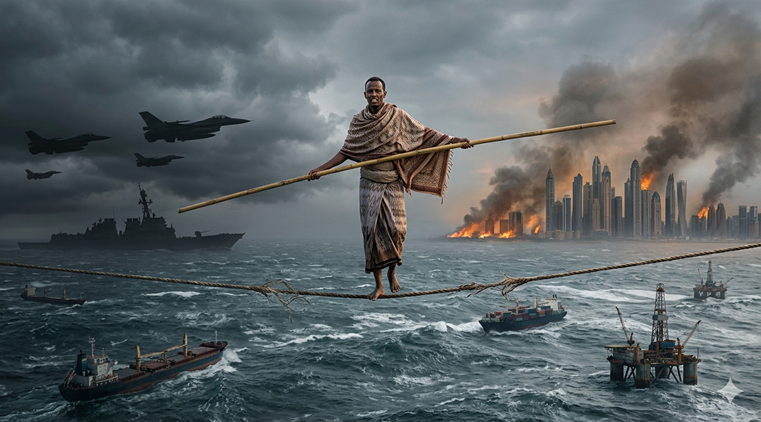
For many countries, conflict in the Gulf is a geopolitical headline. For Somalia, it is something far more immediate. Deep economic ties, a vast diaspora, and religious connections mean that any escalation in the region reverberates quickly across Somali society.
The recent war involving Iran—sparked by a joint U.S.-Israeli military operation—has once again placed Somalia in a precarious position, forcing it to navigate competing pressures while safeguarding its own fragile stability.
Public Sentiment: Fear, Frustration, and Solidarity
Among the Somali public, reactions to the Iran war have been shaped by a mix of concern and political interpretation. Many view the conflict as part of a broader pattern of external pressure on Muslim-majority countries.
Somalis have witnessed sustained Western engagement—not only in supporting what the Israeli genocide in Palestine, but also in undermining Somalia, as well as Afghanistan, Iraq, Libya, Syria, Yemen, Sudan, and now Iran.
At the same time, Iran’s retaliatory actions against Gulf Arab countries hosting U.S. assets have heightened anxiety. Social media discourse has reflects anxiety over maritime security in key waterways such as the Gulf of Aden, as well as the safety of Somali communities in the Gulf. There is also growing unease about Somalia being used—willingly or unwillingly—as a geopolitical staging ground.
The Iran War: A New Layer of Risk
The latest escalation involving Iran has introduced new and more direct security concerns for Somalia.
Reports of Israel’s recognition of Somaliland have heightened tensions, particularly amid claims that aerial activity has been observed around the UAE-built Berbera military base. While details remain contested, such developments have fuelled fears that Somali territory—directly or indirectly—could be drawn into the conflict.
If the war expands further, especially with deeper involvement from Houthi forces in Yemen, the risks grow significantly. Given Somalia’s proximity across the Gulf of Aden, the possibility of missile or drone spillover into Somali territory is no longer unthinkable. What was once a distant conflict could become a direct security threat.
Not the First Time: Somalia in the Middle of Gulf Rivalries
This is not the first time Somalia has found itself caught between competing Gulf powers. Recent history offers multiple examples of the country being pressured to take sides.
1. The 2017 Qatar Blockade Crisis
When Saudi Arabia, the UAE, Bahrain, and Egypt imposed a blockade on Qatar, Somalia was asked to align with the coalition. Then-President Mohamed Abdullahi Farmaajo refused the request, choosing neutrality despite reported financial incentives. In retaliation, these countries’ meddling in Somali politics generated instability that contributed to his electoral defeat.
2. Renewed Pressure Under Hassan Sheikh Mohamud
More recently, Somalia again faced pressure to take sides—this time in relation to the Yemen conflict. Under President Hassan Sheikh Mohamud, tensions with the UAE escalated, ultimately leading to a breakdown in relations and the termination of key agreements.
3. The Current Crisis and Diplomatic Pressure
In the wake of the Iran conflict, Gulf Cooperation Council (GCC) countries affected by alleged Iranian missile and drone strikes have pushed Somalia to condemn Iran. At the same time, there is pressure not to criticize the United States and Israel, who are widely seen as having initiated the current escalation—despite Somalia having previously condemned Israel for attacking Iran. This places Somalia in a familiar yet increasingly untenable position: caught between powerful allies with conflicting expectations.
A Nation Economically Tied to the Gulf
Beyond geopolitics, there is a human dimension. Hundreds of thousands of Somalis live and work in Gulf countries, and their remittances sustain millions of households back home. Any escalation threatens not only their safety but also their livelihoods—and the lives of their loved ones are on the line. A downturn in Gulf economies—or a widening war—would likely reduce remittances, deepen poverty in Somalia, and strain already fragile social systems.
In fact, Somalia’s economic lifelines run directly through the Gulf. Essential imports such as food and fuel depend heavily on Gulf markets and transit routes. Dubai, in particular, functions as a financial hub for Somali remittance companies. Instability there risks paralyzing the very system that keeps much of Somalia’s economy afloat.
Any disruption—whether through war, sanctions, or instability—can trigger immediate consequences: rising prices, reduced remittance flows, and increased hardship for ordinary citizens.
Walking the Tightrope
Somalia today faces a convergence of risks: economic vulnerability, political pressure, and growing security concerns tied to regional conflict. The Iran war has underscored a hard truth: Somalia cannot fully insulate itself from Gulf rivalries. Its geography, dependencies, and diaspora ties make disengagement nearly impossible.
Somalia is walking a diplomatic tightrope—seeking to maintain neutrality while under pressure to choose sides. The stakes, however, are higher than ever. With the added risk of military spillover, potential involvement of regional actors like the Houthis, and increasing external pressure, Somalia’s margin for maneuver is shrinking. The challenge ahead is not just to avoid entanglement, but to build resilience—economic, political, and strategic—in a world where distant wars are no longer truly distant.
