
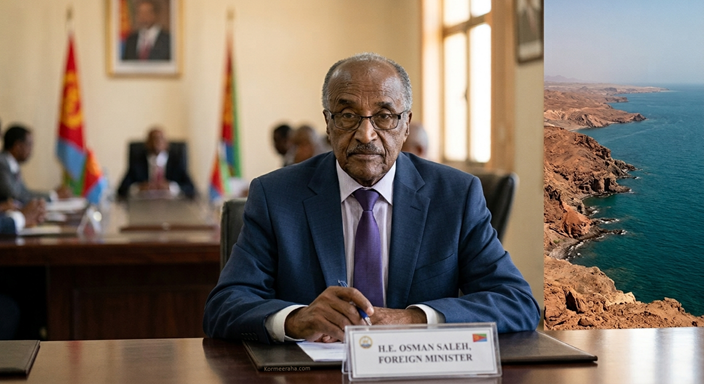
Eritrea’s foreign minister, Osman Saleh, has accused the United Arab Emirates of “port imperialism” in Africa. The allegation arrives amid growing scrutiny of UAE port concessions, military ties, and the blurry boundary between commercial investment and geopolitical control.
Recently, several African governments have challenged the UAE’s expanding role. Algeria cut diplomatic ties on September 10, giving ambassadors 48 hours to leave. Sudan severed relations in May 2025, and Somalia cancelled all UAE agreements in January, including port, defense, and security deals. While unconfirmed reports suggest Eritrea may also sever ties, Asmara has made no authenticated announcement to that effect.
However, whether formal ties are cut or not, Eritrea’s underlying message is clear: an African government that once hosted a UAE military base is now urging the rest of the continent to question why the Emirates wants so many ports.
The UAE’s Strategy: Investment or Leverage?
The UAE frames its Africa strategy purely as investment. It has poured billions into strategic ports, recognizing that most African governments lack the capital to build and maintain world-class maritime infrastructure. Consequently, many of Africa’s largest terminals are financed or operated by foreign entities, primarily UAE firms, Chinese state companies, and European shipping lines.
The debate is whether these deals are strictly commercial or serve as geopolitical leverage. This concern is heightened by the convergence of UAE and Israeli interests in the Horn of Africa. In Somaliland, Somalia’s breakaway region, for example, was recognized by Israel in December, while its Berbera port is financed and operated by the UAE’s DP World.
Eritrea’s Warning from Asmara
In a September 12 interview with Middle East Eye in Asmara, Foreign Minister Osman Saleh pushed back against the UAE’s narrative. He noted that the UAE has port facilities scattered across the region and urged African countries to ask why. Rejecting the idea that these are purely commercial ventures, Saleh stated that Eritrea explicitly rejected a DP World deal and refuses to allow any foreign power to hold a monopoly on its ports.
Saleh also questioned Israel’s motives in the Horn of Africa, asking why it needs a base in Somaliland, and noted that Eritrea has refused an Israeli embassy in Asmara—not out of antagonism, but to avoid entangling relations altogether.
Furthermore, a senior Eritrean official claimed to Middle East Eye that around 2016—four years before the Abraham Accords—the UAE requested a shared military base with Israel on an island in Eritrea’s Dahlak archipelago. Eritrea reportedly rejected the request. While this account comes from an unnamed official and remains unverified, it underscores Asmara’s deep-seated suspicions of Emirati intentions.
The Ghost of Assab: Why Eritrea is Watching
Eritrea’s skepticism is rooted in direct experience. From 2015 onward, Eritrea hosted the UAE military, which built a base in Assab, Eritrea’s southern port, to prosecute the war in Yemen. Troops and heavy equipment moved through an African port to fight a war across the Red Sea.
Though the Associated Press reported via satellite imagery in 2021 that the UAE was dismantling parts of the base after pulling back from Yemen, the precedent was set.
“When Saleh warns that UAE ports are not just about investment, he is speaking from the perspective of a nation that watched its commercial infrastructure become a launchpad for a foreign war.”
Why Ports Matter
According to the UN, about 80% of global trade by volume travels by sea. Fuel, fertilizer, rice, and medicine all pass through ports. Whoever controls the port influences the price of goods. Delays raise storage costs, driver waiting times, and ultimately, retail prices.
Under colonialism, African railways and roads were built to extract resources—moving them from mines and plantations to ports, rather than connecting African cities. That legacy explains why many African traders still find it easier to ship to Europe than to a neighboring country. When a foreign power builds a port, runs the terminal, owns the trucks, warehouses, and cargo-clearing software, the critical question arises:
“Are they building Africa’s future, or accelerating its old extractive economy?”
The UAE’s African Footprint
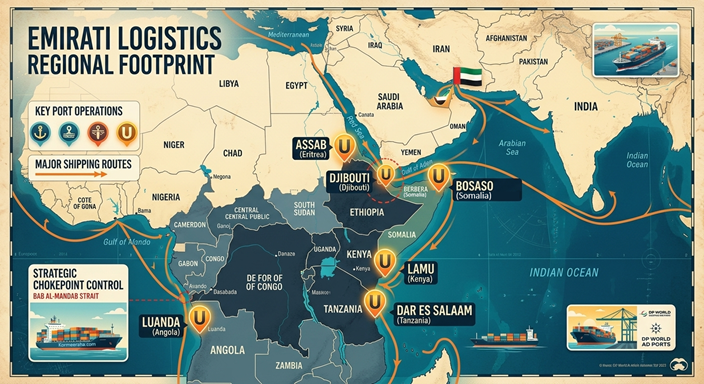
Two Emirati companies dominate this landscape: Dubai’s DP World and Abu Dhabi’s AD Ports Group.
DP World operates Berbera in Somaliland (where a new terminal opened in 2021 with a 500,000 TEU capacity, alongside a Dubai-modeled free zone) and holds a 30-year concession for Bosaso in Puntland. In Tanzania, it runs Dar es Salaam’s Terminal One under a 30-year build-operate-transfer agreement. In Senegal, it runs the Dakar container terminal and is building a $1 billion deep-water port. It is also building the DRC’s first deep-water port at Banana.
AD Ports Group signed a 20-year concession for Angola’s Luanda terminal and took majority control of a new terminal in Congo-Brazzaville. In early 2026, it joined a 30-year concession for a new terminal in Douala, Cameroon.
These contracts span from the Red Sea to the Atlantic. The pattern is defined by long concessions—20 or 30 years, often outlasting multiple presidential terms. The deals frequently bundle ports, inland logistics, warehousing, and technology. When one company controls the terminal, the trucks, the depot, and the customs software, replacement becomes nearly impossible.
A long contract is not inherently colonial; a company spending $800 million needs time to recoup its investment. But when a foreign entity holds a 30-year lock on a country’s largest port, plus its internal logistics and customs software, where is the line between investment and control?
Three African Case Studies
When African governments realize they have signed unfavorable port deals, they face a dilemma: cancel and pay the price, or renegotiate and live with it. The continent has seen three distinct outcomes:
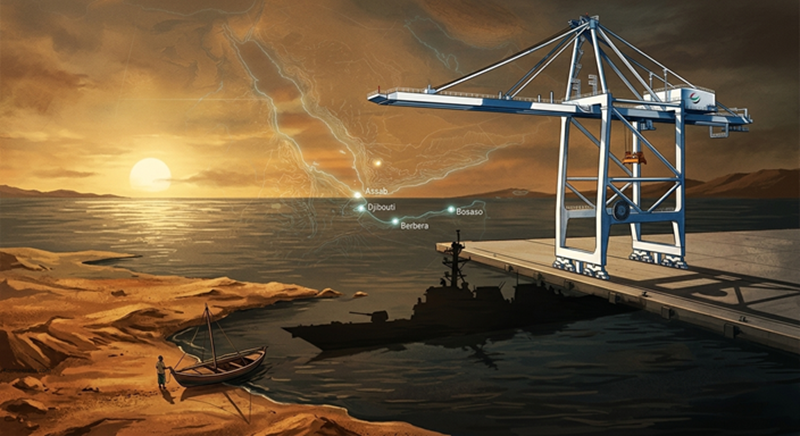
- Somalia and Somaliland (The Fractured Sovereignty): In January, Somalia’s federal government cancelled all UAE agreements, citing threats to its sovereignty. Somaliland, Puntland, and Jubaland rejected Mogadishu’s authority, and DP World continued operating Berbera. A national government cancelled a contract; the contract kept running. The stakes escalated after Israel recognized Somaliland in December, with reports of military construction at Berbera potentially for UAE, Israeli, and US use. The parties denied a formal defense agreement, but the pattern echoes Assab—a commercial port quietly becoming a military asset.
- Djibouti (The Cost of Cancellation): In 2018, Djibouti cancelled DP World’s concession at the Doraleh terminal and seized the port. DP World pursued international arbitration, and Djibouti has consistently lost rulings. The port is in Djibouti’s hands, but the financial liability remains. Sovereignty is determined not just when a contract is cancelled, but when it is signed—through exit and penalty clauses.
- Sudan (The Proxy War Realization): Sudan signed a $6 billion deal with AD Ports in 2022, but cancelled it in 2024. By May 2025, the army-led government cut diplomatic ties, accusing the UAE of arming the RSF. Amnesty International traced guided bombs in RSF hands back to the UAE. Sudan concluded that the country offering to build its port was simultaneously arming the force destroying it.
The UAE’s Response
When the Financial Times labeled the UAE’s African strategy “imperialism” in August, the UAE foreign ministry pushed back. Its communication director argued that treating African governments as passive victims ignores their sovereignty and agency, noting that no one forced Angola or Senegal to sign deals.
This is a valid point: consent, however, does not prove a deal is sound. A government can sign willingly and still accept a bad contract, fail to protect its traders, or hand over a strategic asset for decades.
“Respecting African sovereignty means holding African leaders accountable for the ink they put to paper.”
What Africa Should Do
Africa should not reject foreign investment outright. Berbera is a functioning port, and Dar es Salaam is clearing ships faster, proving that the UAE brings valuable capital and logistics expertise to the continent. However, the terms of engagement must fundamentally change. Contracts must be fully transparent and public, allowing citizens to read exactly what was signed in their name. This transparency must be backed by regulatory independence, ensuring that national authorities can audit operator data, maintain port operations if a foreign company departs, and keep tariffs reviewable rather than locked in for decades.
Crucially, there must be a strict separation between commerce and military assets. The precedent of Assab proves that commercial infrastructure can quietly become a launchpad for foreign conflicts. Therefore, military assets must require separate, distinct agreements that are debated and approved on their own merits, never assumed to be bundled with a commercial port deal. Furthermore, these contracts must include clear exit clauses that allow host nations to renegotiate terms if the geopolitical landscape shifts.
Finally, African governments must stop competing against one another for the same foreign investor. When countries like Senegal, Cameroon, and Angola negotiate separately, the investor simply compares their offers, and the weakest terms win. By shifting to collective negotiation, the continent could leverage its vast maritime geography to strengthen its bargaining position, ensuring that foreign capital builds Africa’s future rather than accelerating its old extractive economy.
A Continental Reckoning
Eritrea’s warning matters beyond its own borders. Asmara has its own disputes with Ethiopia over Red Sea access and its own reasons to oppose Emirati influence. The goal is not to adopt Eritrea’s specific politics, but to recognize a broader trend: in a span of 16 months, Sudan, Somalia, Algeria, and Eritrea have all taken public stands against the UAE for vastly different reasons.
When four countries say the same thing about the same investor, the rest of Africa should at least read its own port contracts. The question remains: Should every African country with a UAE port contract review it publicly? Or is the UAE simply the investor with the money, and Africa cannot afford to say no?