
In contemporary political discourse, the rhetoric of division has found a dangerous, recurring focal point. Across the Atlantic and throughout Europe, populist right-wing factions increasingly isolate specific ethnic and national groups as political scapegoats. Among these, the Somali diaspora has faced a persistent, disproportionate, and unwarranted campaign of stigmatization. Drawing from the same “othering” playbook once deployed against minority leaders and marginalized communities, this rhetoric seeks to marginalize a vibrant, deeply integrated demographic.
To understand this fixation is to confront a glaring paradox: why are a people who exemplify the core tenets of civic integration persistently targeted by political demagogues?
The Reality of Integration vs. The Myth of the Outsider
For decades, the primary demand placed on migrants by Western societies has been clear: integrate, contribute economically, respect democratic institutions, and become active members of the civic fabric. By every measurable standard, the global Somali diaspora has met and exceeded these expectations.
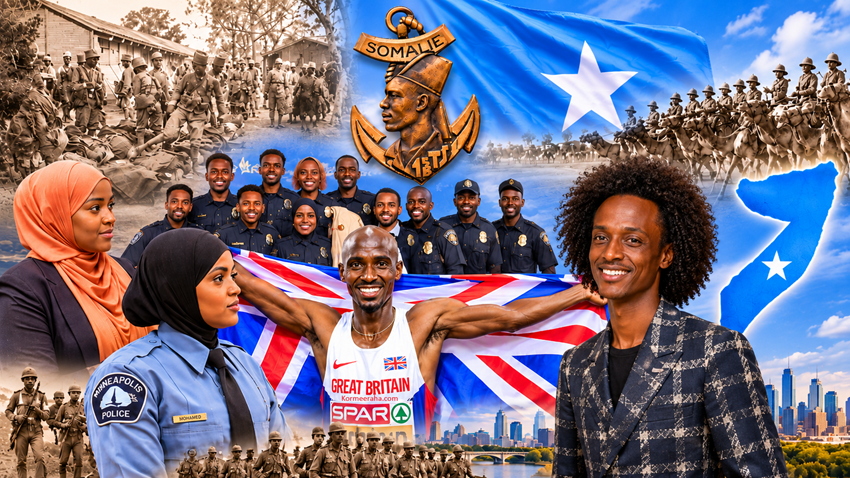
Arriving largely over the past three decades after fleeing a devastating civil conflict, Somalis have woven themselves into the socioeconomic tapestry of Western nations. In the realm of civic and political leadership, Somali-Americans, Somali-Canadians, and individuals of Somali descent across the United Kingdom, Sweden, Norway, and the Netherlands now hold prominent legislative and parliamentary seats. They are no longer just participants in democracy. They are actively shaping policy from within the halls of power and forging a formidable political shield in recent election cycles.
Beyond the political sphere, Somali immigrants form the backbone of essential Western public services, serving as physicians, nurses, and support staff within the United Kingdom’s National Health Service (NHS), alongside professionals running vital public transport and municipal networks. This integration is further cemented by robust economic enterprise. Across metropolitan hubs—from Minneapolis to London, and Oslo to Amsterdam—thriving Somali-owned businesses and entrepreneurial networks generate jobs, revitalize neighborhoods, and contribute substantially to national tax bases.
“Populist playbooks rely on a recognizable ‘boogeyman’ to galvanize base politics, substituting complex socio-economic anxieties with a visible, racialized target.”
Given this reality, the political targeting of Somalis defies logical metrics of social cohesion. It begs the question: What have Somalis done to provoke the ire of these political elements? The answer lies not in community behavior, but in the tactical utility of xenophobia.
Historical Debt and Forgotten Alliances
This modern hostility also reveals a profound historical amnesia. When European democracies faced existential threats during the twentieth century, soldiers from the Horn of Africa did not hesitate to stand alongside them.
During the First World War, the Tirailleurs Somalis, recruited primarily from the French Somali Coast (modern-day Djibouti), fought valiantly on the Western Front. They were instrumental in harrowing engagements, notably participating in the pivotal assault on Fort Douaumont near Verdun in October 1916, spilling their blood on European soil in defense of liberty. This legacy of sacrifice continued into the Second World War, where units like the Somaliland Camel Corps and various regional contingents operated alongside Allied forces in the East African campaign. Enduring severe conditions, they played a crucial role in breaking Axis blockades, resisting occupation, and securing strategic territories across the Horn of Africa.
“To turn around decades later and treat this community, or their descendants, as permanent internal threats is a historical betrayal.”
It strips away the shared sacrifices that bound Europe and the Horn of Africa during their darkest hours.
Human Imperfection vs. Manufactured Collective Guilt
To be intellectually honest, no sociologist or community leader denies a fundamental truth of the human condition. Every community on Earth possesses its share of fraudsters and unsavory characters. Human nature is remarkably consistent across all races, borders, and creeds.
However, populist rhetoric relies on a dishonest double standard. When an individual from a dominant majority commits a crime, it is treated as an isolated human failure. When an individual from a marginalized group like the Somali community stumbles, it is weaponized as an indictment of an entire ethnicity.
Recent years have seen this dynamic dangerously escalate. Political figures in the United States and their European emulators have launched relentless rhetorical and policy attacks targeting Somali communities, fueling widespread harassment and fear. By reducing a rich, resilient culture to crude caricatures, this rhetoric normalizes racism and provides a template that right-wing extremists eagerly copy to energize their own political fortunes.
Conclusion
The relentless focus on Somalis by political demagogues is not driven by facts, statistics, or genuine civic concerns. It is a calculated distraction, a political tool that feeds on prejudice when rational arguments fail.
The Somali diaspora stands as a testament to resilience, successful integration, and historical loyalty. Recognizing this requires looking past the cynical noise of modern politics and acknowledging a simple truth:
“Targeting a community that has given so much, integrated so deeply, and achieved so widely exposes the moral bankruptcy of the attackers, not the character of the attacked.”
For publications like Kormeeraha Magazine and the communities they serve, the mandate is clear: document the truth, reject manufactured guilt, and continue to build the future.
Related
- From Target to Table: How Somali-Americans Forged a Political Shield in 2026 (November 9, 2026)
- The Confidence to Win: How Somalis Became a Political Force in the West (October 13, 2026)
- How a Digital Lie Ignited Real-World Terror for Belfast’s Somali Diaspora (June 12, 2026)