
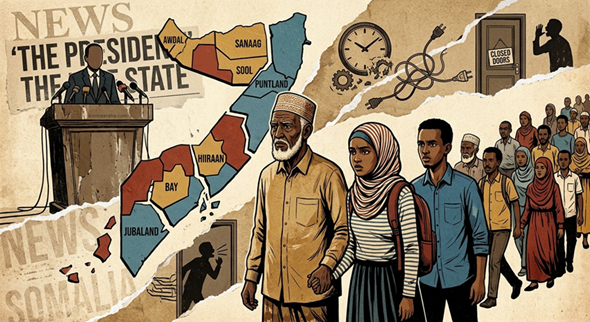
Let us dispense with the diplomatic euphemisms. The widespread discontent with President Hassan Sheikh Mohamud is neither a passing mood nor a tragic misunderstanding. It is a cold, calculated judgment. Forged over years and echoed across generations, this verdict is universal because the diagnosis is undeniable: Somalia is being governed poorly, and the decay is visible to all.
This is an administration that invokes sovereignty while failing to secure its own provincial towns. It preaches democracy while orchestrating elections devoid of consensus. It champions unity while governing by exclusion, weaponizing state resources to reward sycophancy and punish dissent.
“This is not a government finding its footing; it is a presidency that has learned to survive by shrinking the political space of the very country it claims to lead.”
The elders are not merely nostalgic; they are profoundly exhausted. They have watched promise after promise dissolve into the same tired choreography: power hoarded in Mogadishu, decisions brokered in closed-door cliques, and a public expected to applaud a social contract it never signed. The youth are not simply impatient; they are suffocating. They are fed platitudes about a future that perpetually recedes, while jobs, security, and honest political participation are rationed exclusively to the inner circle of the powerful.
The Arithmetic of Stalled Transitions
Consider the arithmetic of power, for the numbers strip away the mythology. Sharif Sheikh Ahmed governed for roughly 3.6 years under the suffocating weight of transitional arrangements. Hassan Sheikh Mohamud’s first term (2012–2017) lasted 4.4 years. Mohamed Abdullahi Farmajo stretched his tenure to 5.3 years, pushing the country to the brink of civil war in Mogadishu’s streets during the 2021–2022 extension crisis. Now, Mohamud’s second term is mired in its own constitutional twilight: the opposition insists his mandate expired on 15 May 2026, while the government clings to a disputed extension to 15 May 2027.
Tally it up, and you arrive at nearly 18 years of rule across these three men. The true scandal is not the tenure itself, but the method. It has been a continuous, messy stretch where rules are bent, mandates are stretched, and transitions are perpetually postponed, disputed, or staged without agreement.
“In nearly two decades, Somalia has not witnessed a single presidential transition that was both on schedule and universally accepted.”
The Geography of Alienation
And the regions have stopped pretending the centre holds.
From Awdal, the indictment is blunt: the northwest is debated, bargained over, and spoken for, but never genuinely consulted. A state that cannot hear Awdal forfeits its right to speak for Somalia. The same holds true for the contested soils of Sool and Sanaag.
From Bay, the charge is devastating. Baidoa has paid for Mogadishu’s political survival in blood, displacement, and terror, while the federal centre treats a regional power struggle as a mere subplot.
“In practice, Somali federalism has devolved into domination by another name.”
From Hiiraan, the reality is stark. A re-election celebrated in Jowhar but violently rejected in Beledweyne is not a political settlement; it is a fracture. A president who blesses contested results and ignores the communities that repudiate them is not healing Hirshabelle. He is shattering it.
Puntland sees a federal timetable imposed upon it, not negotiated with it. Jubaland navigates a centre it fundamentally cannot trust. Galmudug and Hirshabelle watch their electoral processes reduced to political theatre, where the curtain rises on a predetermined outcome. And Banadir witnesses the ultimate contradiction daily: a capital city governed not as a shared national hearth, but as a partisan stronghold.
The Moral Deficit of the Centre
This is the unvarnished truth of contemporary Somalia: the institutions are hollowed out, elections are contested before the ink dries, the security fight is weaponized as an excuse to avoid hard politics, and the presidency answers every crisis with the same blunt instrument—more control, less consensus.
This is why the discontent is generational. Fathers and sons, mothers and daughters, elders and students may disagree on the remedy, but they are united in their diagnosis: a leader who refuses to share power, who will not negotiate in good faith, and who cannot accept a process he cannot control, has forfeited the moral authority to ask for patience.
“Somalia does not lack for people, resources, or courage. It lacks a presidency willing to subordinate itself to the republic.”
Until power is negotiated rather than seized, until elections are agreed upon rather than imposed, and until the regions are treated as partners rather than subjects, this verdict will only sharpen. And it will be passed down, a bitter inheritance, from one generation to the next.
Related
- HSM’s Presidency: Experience Matters and Legacy Must Be Earned (October 22,. 2026)
- Fractured Federation: Somalia’s Political Polarization and the 2027 Electoral Crisis (October 19, 2026)
- The Hawadle Clan is Trapped Between Al-Shabaab and Villa Somalia (October 5, 2026)
- Fractured Southwest: The Geopolitical Battle for Mogadishu (September 3, 2026)
- Why Puntland Is Walking Away from Mogadishu (June 21, 2026)