

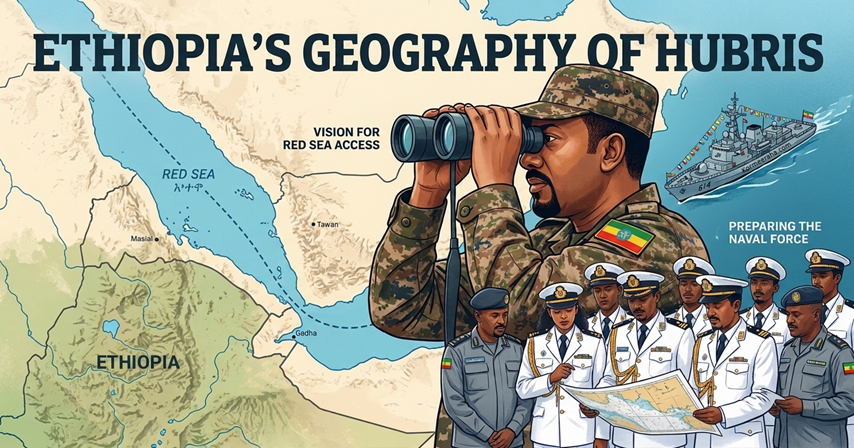
The Red Sea Paradox: A Landlocked Navy
Vice Admiral Kindu Gezu’s recent proclamation that Ethiopia’s naval capabilities are expanding to make the country a “capable partner in regional maritime affairs” reads less like a strategic milestone and more like a geopolitical paradox. Ethiopia is, and remains, a landlocked republic. One does not require a navy to participate in maritime consultations, nor does landlocked status constitute a historical injustice demanding territorial correction.
The Red Sea and the Bab el-Mandeb Strait are undeniably among the world’s most critical maritime chokepoints. The littoral states—Egypt, Saudi Arabia, Sudan, Eritrea, Yemen, Djibouti, and Somalia—bear the burden of regional maritime security. Here, a hard truth must be confronted: Somalia, despite possessing the longest coastline on the African mainland and occupying a pivotal geographic position, has historically failed to project the regional stewardship its geography demands. However, Somalia’s institutional deficits do not constitute a vacuum for Ethiopian expansionism.
“Somalia’s institutional deficits do not constitute a vacuum for Ethiopian expansionism.”
The Zeila Red Line: When Commerce Becomes Conquest
Prime Minister Abiy Ahmed’s strategic fixation on sea access has increasingly blurred the line between legitimate commercial logistics and imperial ambition. Ethiopia is neither the first nor the last landlocked nation to navigate global trade without a coastline. Geography is destiny, not a grievance. There is no inherent flaw in Ethiopia seeking commercial port access; memoranda of understanding to facilitate trade, investment, and logistics are standard diplomatic practice. Somalia, Djibouti, and Eritrea can, and should, offer Addis Ababa robust commercial arrangements.
The rupture occurred with the January 1, 2024, Memorandum of Understanding between Abiy Ahmed and Somaliland’s Muse Bihi Abdi. By proposing to exchange Ethiopian recognition of Somaliland’s secession for territorial and maritime concessions around Lughaye and Zeila in the Awdal region, Addis Ababa crossed a red line. This is not mere port access; it is a blatant violation of Somalia’s territorial integrity.
Zeila is not an expendable real estate asset. It is a historic cradle of Islamic civilisation in the Horn of Africa, holding a profound place in the continent’s religious and cultural heritage. Its sovereignty cannot be bartered away by political actors without the consent of its people and the legitimate federal authorities of the Somali state.
“Zeila is not an expendable real estate asset. It is a historic cradle of Islamic civilisation in the Horn of Africa.”
Sovereignty, Subversion, and International Enablers
Furthermore, Ethiopia’s parallel security engagements with regional administrations within Somalia reveal a deliberate strategy to bypass Mogadishu. While regional cooperation is valid, defense and maritime agreements that circumvent the federal constitutional order actively undermine Somalia’s national sovereignty. Addis Ababa must also recognize the bounds of international maritime law. Somalia’s Exclusive Economic Zone (EEZ) extends 200 nautical miles from its baselines. Commercial port access does not, and legally cannot, confer sovereign rights over another nation’s territorial waters or EEZ.
This expansionist posture is further complicated by the growing defense engagement between Ethiopia and European powers, notably France. European partners must recognize that arming Addis Ababa’s maritime ambitions risks destabilizing the very region they claim to want to secure. History offers a stark warning: Ethiopia’s previous imperial expansionism under the Menelik dynasty sowed seeds of regional friction that continue to haunt the Horn. Reviving nineteenth-century imperial thinking in the twenty-first century is a strategic miscalculation. Commercial access is a matter of economics; territorial acquisition is an act of aggression.
“Commercial access is a matter of economics; territorial acquisition is an act of aggression.”
An Unlikely Catalyst: Forging Somali Unity and Capability
Ironically, Ethiopia’s provocations have achieved what decades of internal Somali politics could not: they have served as a catalyst for national cohesion. The existential threat to Somalia’s sovereignty has forged a renewed, unified consensus across the political and social spectrum, reminding Somalis of the vital importance of national unity.
But unity must be matched by capability. Somalia must urgently reclaim its rightful role in the Red Sea and Bab el-Mandeb maritime architecture. This requires building capable national institutions, a professional coast guard and navy, ensuring effective maritime security, and executing a sophisticated, proactive regional diplomacy.
Ethiopia is entitled to peaceful, commercial access to the sea. It is not entitled to another nation’s territory, coastline, or sovereignty. The twenty-first century demands cooperation, adherence to international law, and mutually beneficial integration—not the resurrection of imperial conquests.
A landlocked country can undoubtedly prosper without owning a sea. Geography is a reality to be navigated, not a license for expansionism.
Related
- The Al-Alamein Summit: Forging a United Front Against Ethiopia’s Regional Ambitions (October 8, 2026)
- Trade Yes, Troops No: Somalia’s Nuanced Response to Ethiopia’s Maritime Ambitions (October 7, 2026)
- Somali Nation in Unison to Reject Ethiopia’ Encroachment (January 12, 2024)
- How Abiy’s Red Sea Speech Aims to Reshape the Horn of Africa (November 3, 2023)