
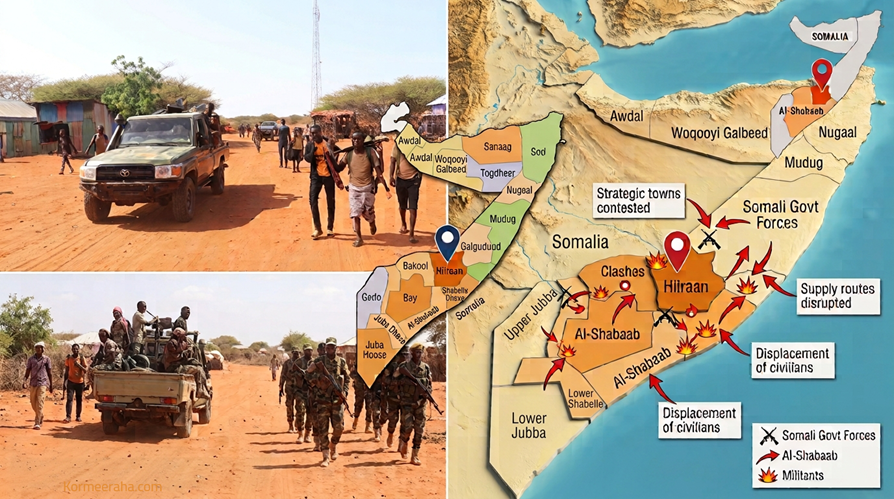
The Hawadle clan is caught in a devastating crossfire. They now face three distinct adversaries: the anti-Hawadle political establishment, the Al-Shabaab Islamist group, and President Hassan Sheikh Mohamud.
To understand how a major Somali clan reached this breaking point, one must look at the recent history of the Ma’awisley. For the past four years, this local clan militia bore the brunt of the struggle against Al-Shabaab in Hiiraan. These fighters were predominantly Hawadle. They sacrificed blood and treasure to push the extremist group out of their towns. Ultimately, they acted as the de facto defense force for the area.
Yet, the Federal Government did not support them. Instead, the Ma’awisley found themselves politically marginalized and targeted by Villa Somalia. The government tried to sideline these grassroots fighters to consolidate its own power. Consequently, the Hawadle realized they were fighting a war on two fronts. on one hand, they were battling terrorists. On the other, they were fighting a political establishment that viewed them as a threat.
Following this betrayal, and after a recent, highly controversial local peace deal between the Hawadle and Al-Shabaab, the clan has made a drastic calculation. The Hawadle have decided that they can no longer act as Somalia’s Ministry of Defense. They can no longer defend indefensible enemies alone. Doing so has become self-defeating, and every Somali understands the exact suffering of the Hawadle people.
Additionally, the primary catalyst for this shift—and the subsequent strategic agreement with Al-Shabaab—appears to be the recent election organized by President Hassan Sheikh. Under the new framework, the Hiiraan region has been divided into only four constituencies: Beledweyne, Jalalaqsi, Mataban, and Geeljiir.
This division is highly significant. It means two of those seats are reserved exclusively for the Habargidir clan. The other two are for all other clans, including the Hawadle. Given this blatant political sidelining, the Hawadle’s pivot toward a pragmatic, albeit controversial, truce with Al-Shabaab comes as no surprise.
Historically, Hiiraan has never had an airport, a seaport, a single factory, or a water dam. What it did have, however, was a network of roads and highways connecting most of its cities, districts, and villages. Today, even those roads are gone.
If the President wants the region to forgo big development projects in favor of the Abgaal, then why are the Hawadle the only ones expressing concern? Because of this, Hiiraan condemns President Hassan Sheikh Mohamud for his divisive policies against Somali unity and against the Hawadle.
Furthermore, if the President has decided that every major development project should go to Abgaal territory, why should the Hawadle be the only ones to object? Right now, President Hassan Sheikh is building massive infrastructure between Warsheekh and Mareeg. This includes highways, airports, seaports, satellite stations, and free-trade zones. Shockingly, he is even constructing launch platforms for intercontinental missiles. Therefore, one must ask: why should this concern Hiiraan alone?
Then, let the Somali people judge whether:
- A new, Abgaal-dominated Mogadishu city can be built between Warsheekh and Mogadishu;
- New Wargaandhi facilities can replace Balli-Doogle as the country’s main military base;
- Five thousand Abgaal elite officers can run the Government of Somalia and establish a new dynasty;
- Sheikh Sharif Sheikh Ahmed will be the next President of Somalia to further maintain the Abgaal dynasty;
- Scholars like Colonel Baadiyow, inciter Hassan Sheikh Ali, and influencer Yaxya Aamir can lead a new intellectual renaissance;
- Saabey and Wardheere can become the wealthiest and richest Somalis, as was once the case with Uunlay and Jirde.
A state that belongs to one clan is not a state. It is an estate.