
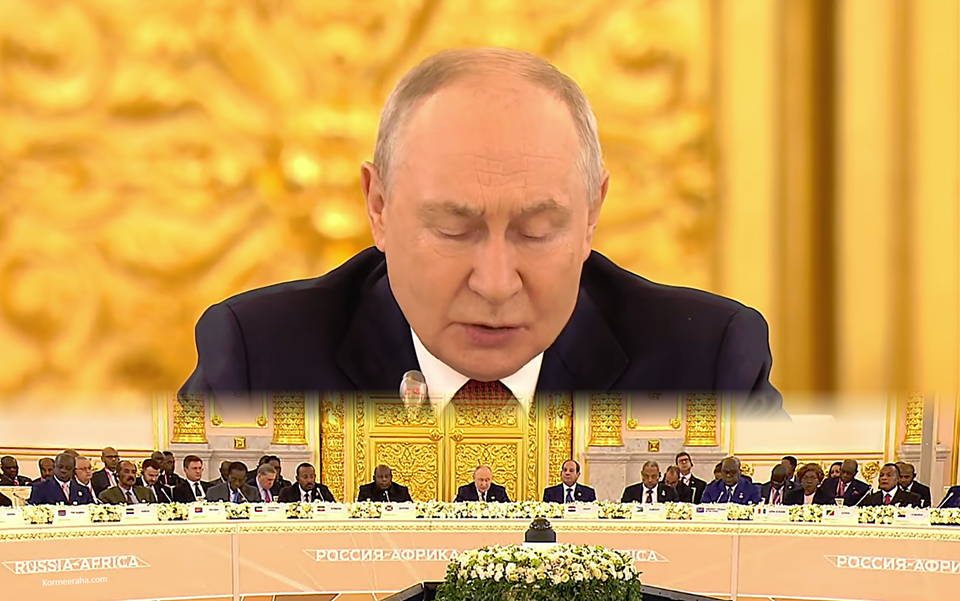
The third Russia-Africa Summit, held in Moscow on 28–29 October 2026, brought together representatives from 48 African countries, including 22 heads of state. For the Kremlin, the spectacle was intended to send a clear message: Western efforts to isolate Russia have failed. For African governments, the calculation was more practical. In a fractured world, Moscow offers another door to knock on — for trade, energy, security, diplomatic recognition, and room to manoeuvre.
But the question is not whether Africa should engage Russia. It should. The harder question is whether that engagement produces sovereignty, or simply rearranges dependency.
“The question is not whether Russia offers an alternative to the West, but whether that alternative offers Africa real agency.”
The Illusion of Balance
Moscow’s language is seductive: equal partnership, multipolarity, sovereign development. Foreign Minister Sergey Lavrov framed Africa as a rising pillar of a new world order, promising support for industrialisation rather than the old extractive model.
The numbers tell a less elegant story. Russia-Africa trade reached roughly $27 billion in 2025, up sharply from 2019. Yet the balance remains heavily tilted: Russia exported $22.7 billion to Africa while importing only $4.4 billion. Russia also accounts for less than 1% of foreign direct investment on the continent.
“In the language of commerce, this is not yet partnership; it is imbalance dressed in the vocabulary of sovereignty.”
There are real opportunities. Russia’s Rosatom is building Egypt’s El Dabaa nuclear power plant, a project that could provide electricity to millions. Moscow has also delivered 200,000 tons of free grain to six African countries, fulfilling a pledge from the previous summit. For states facing energy shortages and food inflation, these are not symbolic gestures. They matter.
But grain shipments do not build food sovereignty. Power plants do not automatically create industrial capacity. The test is whether African countries can turn Russian engagement into skills, infrastructure, production, and bargaining power — not another cycle of imported dependence.
Security: The Sahel’s Dangerous Gamble
Security is where the gap between promise and outcome is widest. In Mali, Burkina Faso, and Niger, military governments have expelled Western forces and deepened ties with Moscow. The Wagner network has largely been rebranded and reorganised under the state-backed Africa Corps.
Russia presents this as anti-imperial liberation. But the Sahel’s security crisis has not improved. Insurgent pressure has intensified, state authority remains fragile, and civilians continue to pay the price.
“Sovereignty is not achieved by swapping one foreign uniform for another. True security requires institutions, not mercenaries.”
This lesson is not confined to the Sahel. Across the continent, foreign security partnerships too often strengthen regimes without building states. Weapons, trainers, and palace guards may offer short-term protection. They do not substitute for accountable armies, credible courts, political settlement, or public trust.
The Somali Calculus: Diplomacy Amidst Domestic Fire
Somalia’s presence in Moscow reflected both the value and limits of this diplomatic opening. The delegation was led by Foreign Minister Abdusalan Abdi Ali, while President Hassan Sheikh Mohamud remained in Mogadishu despite having confirmed in May 2026 that he would attend.
His absence should not be reduced to a simple security explanation. Insurgent attacks have not prevented Somali presidents from travelling abroad before. The more pressing issue was the political deadlock over his tenure, the postponed federal election, and opposition tensions requiring nationwide consultations. With political and security risks converging, leaving the country became a gamble too costly to take.
The Somali delegation discussed maritime security, the blue economy, energy cooperation, skills development, and stronger diplomatic ties. Defence Minister Ahmed Fiqi also held talks with Russian officials on military training, counter-terrorism, and anti-piracy cooperation.
These conversations were relevant. They were not transformative. No specific contracts, equipment deliveries, or assistance packages were announced.
For Mogadishu, the summit’s main gain was diplomatic diversification. Engaging Moscow signals that Somalia is not wholly dependent on Western, regional, or multilateral patrons. Russia’s position as a permanent member of the UN Security Council also gives its language of sovereignty and non-interference symbolic value for a government seeking to assert authority over contested territory.
But Somalia should not overstate the prize. Russia is unlikely to deliver major investment in the near term. Its deepest security partnerships remain in the Sahel, not the Horn. Moscow is an additional channel — not a replacement for existing security, development, and diplomatic support.
The Diplomatic Lever
Russia’s strongest pitch may be political rather than economic. Moscow supports expanding African representation at the UN Security Council, where the continent remains excluded from permanent power despite representing more than a quarter of UN membership.
This argument resonates because the injustice is real. Yet African governments should not mistake rhetorical backing for institutional reform. No permanent member of the Security Council, including Russia, has shown serious willingness to dilute veto power.
Africa can use Moscow’s position as leverage. But leverage is not victory. A seat at the table will matter only if African states arrive with coordinated demands, institutional credibility, and the discipline to act collectively.
What Sovereignty Looks Like in a Polarised World
Africa’s advantage in a polarised world lies not in choosing Moscow over Washington, or Beijing over Brussels, but in refusing exclusivity. Strategic diversification gives African governments room to negotiate better terms. The more options a state has, the less vulnerable it is to pressure from any single patron.
This is particularly important for infrastructure. Russian energy, mining, education, and technology offers may come with fewer political conditions than Western financing. That can be attractive for governments seeking rapid development. But fewer strings can also mean fewer safeguards. Deals that bypass accountability may strengthen incumbents without strengthening the state.
The deeper gain is narrative autonomy. African leaders can use multipolar rhetoric to challenge the old hierarchy of global power and demand a fairer international system. But anti-imperial language is not enough. Sovereignty must be measured in factories, ports, universities, energy grids, food systems, and institutions capable of surviving external pressure.
The Verdict: Agency Over Alignment
The Russia-Africa Summit was neither a Russian triumph nor an African surrender. It was a pragmatic encounter between a sanctioned power seeking influence and a continent seeking options.
The new 2027–2029 cooperation plan will be judged by results, not declarations. Will African exports increase? Will technology agreements build local skills? Will energy projects expand industrial capacity? Will security cooperation protect civilians, or only governments?
Somalia’s experience offers the sharpest lesson. A government trapped by unresolved political disputes at home cannot project durable sovereignty abroad. Foreign summits may offer visibility, but they cannot substitute for internal consensus.
“True sovereignty means the freedom to say no — to Washington, Moscow, or any partner — when the deal does not serve the people.”
As the handshakes in Moscow fade, the real work remains where it has always been: at home. No foreign power can write Africa’s sovereignty for it.
Related
- Beyond the Russian Smokescreen: The Real Geopolitics of Niger’s Foiled Coup (September 8, 2026)
- How Africa Can Stop Absorbing the World’s Crises (July 27, 2026)
- The African Solution: Why Somalia Is Looking to Burkina Faso to Fight Terror (May 7, 2026)